C.S. Lewis Verses Sigmund Freud

DSCN3894

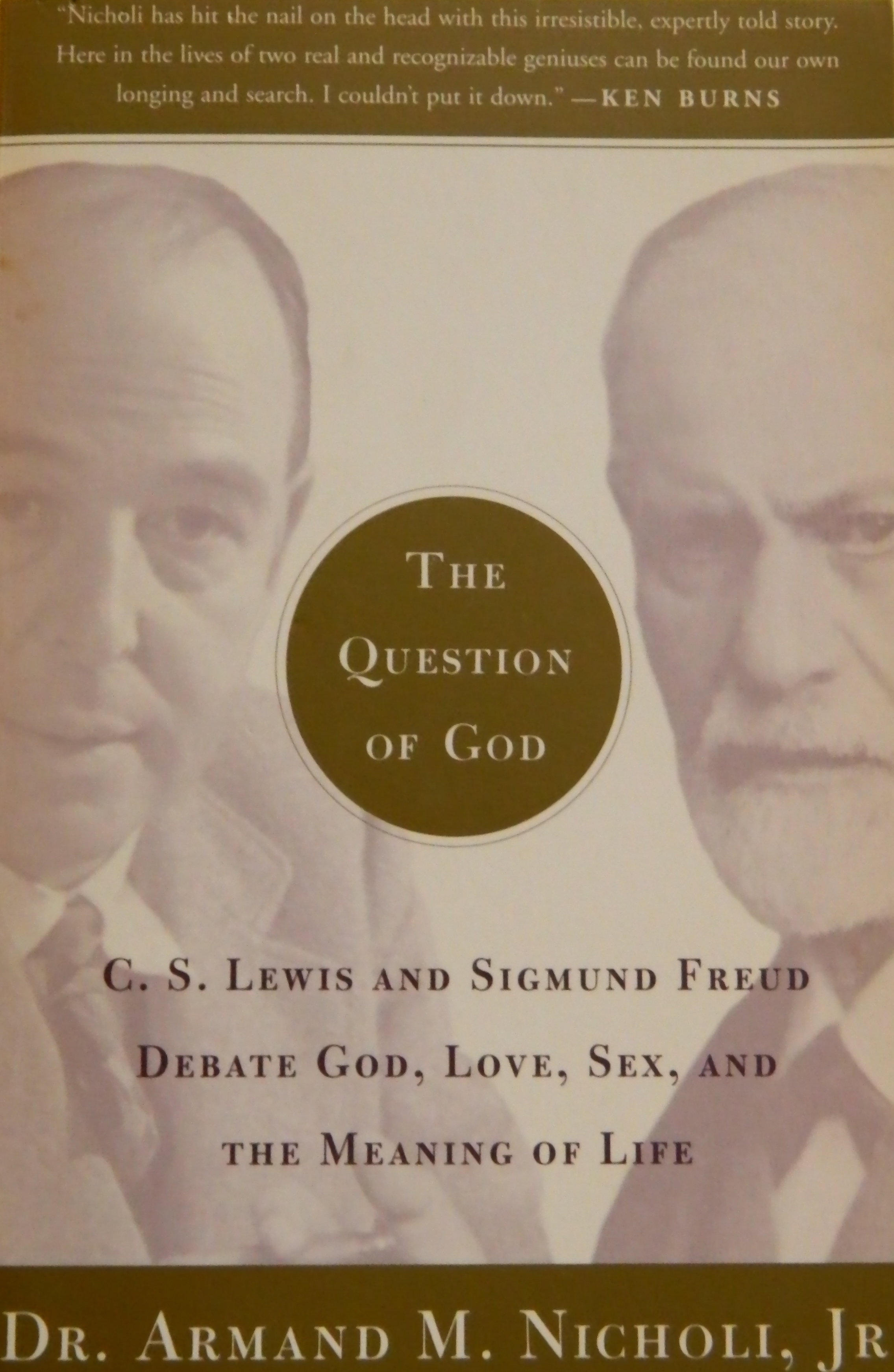
In the book The Question of God – C.S. Lewis And Sigmund Freud Debate God, Love, Sex, And The Meaning Of Life by Dr. Armand M. Nicholi, Jr., it is obvious that the author takes the side of Lewis with his mention of a lifelong fascination for the transformative aspects of faith. He presents Freud as a floundering pessimist, while it appears that post-conversion Lewis has all the answers. Nicholi’s title suggests that Lewis and Freud actually did debate, when in reality they may have never met, and Lewis wrote his points against Freud several years after Freud’s death.

The two men share some common themes – both based their atheism on a pessimistic worldview and lived in a time when there was less evidence to support a godless existence. The main difference between the two men is that Freud was a Jew and C.S. Lewis grew up as a Protestant. Protestantism never left the core of Lewis, and his friends (including Tolkien) hounded him through his atheistic years, discussing issues of faith late into the night. His peers played a major role in his conversion.

I’ve always questioned why an Atheist would become a Christian. In reading this book, I realized how limited the range of knowledge was just a hundred years ago. Lewis never actually believed that God did not exist. He only wished it. He had as much faith in that as a Christian has for the existence of God.

According to Freud’s theories, this wish correlates with the strained relationship Lewis had with his father resulting in a desire against authority figures. It’s no surprise that after the death of his father in 1929, Lewis converted to Christianity just two years later in 1931. Perhaps his unresolved issues led to a wish for a sense of authority over his life. Strangely enough, my father also converted just shortly after his father’s death, leading me to believe that this might be a common reaction to the loss of a parent.

“The very idea of an ‘idealized Superman’ in the sky – to use Freud’s phrase – is ‘so patently infantile and so foreign to reality, that … it is painful to think that the great majority of mortals will never rise above this view of life (Nicholi, 36).”

I haven’t lost either of my parents, so it’s hard for me to understand the need to find an imaginary replacement figure. But I will always remember, as clear as though it’s happening in the present, the months after my mom lost her mother. I was only nine years old, but somehow, from that time forward I began to feel that I was the mother and she was the child. It was a strange flip-flop that confused me and left me feeling overwhelmed.

To pre-conversion Lewis, since God allowed terrible things to happen, it seemed better that God not exist at all. This is an extremely weak argument, having more to do with the character of God rather than whether or not he exists. In the end, Lewis felt that his own knowledge of good and evil proved God’s existence. But does it?

In religious thinking there is the belief that morals are something separate from us. We don’t know how to behave unless God shows us how. Except that we do behave as long as our needs are met. It’s the same with all primates (because, yes we are primates) and all other species of animals.

As long as food, sex, and land isn’t hoarded by alphas, and as long as the population doesn’t get out of hand, there is no need to commit crimes or start wars. A friend just told me a story of an anthropologist who married a Venezuelan woman from a far-flung tribe in the jungle. They had a child together, but six years later, she couldn’t take it here anymore, and she went back to her village. She felt isolated in the States, and she missed the close-knit community and tight network of support in her village. Togetherness was the root of her happiness.

“‘The idea of a universal moral law as proposed by philosophers is in conflict with reason.’ He writes that ‘ethics are not based on a moral world order but on the inescapable exigencies of human cohabitation (Nicholi, 60).'”

Values differ between cultures according to the needs of the community. A culture that subsists on nomadic hunting and gathering would be disturbed by our obsessive need to hoard property and our lack of community within a massive population. However, according to Lewis, there is a universal moral order that does not change much from culture to culture. This imperialist attitude reflects his own shortsightedness and lack of education on the outside world. A master on the literature of Western Civilization, the stories he loved to read didn’t exactly fill in the gaps on world cultures.

Nicholi relays the change in Lewis post-conversion: “It happened when he was thirty-one years old. The change revolutionized his life, infused his mind with purpose and meaning, and dramatically increased his productivity; it also radically altered his values, his image of himself, and his relationships to others. This experience not only turned Lewis around, but turned him outward – from a focus on himself to a focus on others (Nicholi, 77).”

New Christians exhibit the changes of a person who is in love – but since the love object is imaginary and apparently all-powerful, the experience is heightened by fear, unworthiness, and the joy of escaping everyday reality.

When my mom first converted, no one outside the church really wanted to deal with her. She wrote her Catholic father that he would go to hell unless he converted. She answered every phone call with, “Hello, Jesus loves you!” and posted a yellow sign in the back window of her minivan that said, “Smile if Jesus Loves You!” It was all very in your face, and her siblings still struggle to forgive her for her actions. I’m amazed that my parent’s marriage survived through the eight or so years that my dad wasn’t a Christian.

Today, my mom is much more mellow, but still likes to put in her two cents. Nature is not at work – no, it’s always a miracle. And to her, an Atheist could never win a debate against a Christian. She is enmeshed in faith, and is happy with the blinders that block out the rest of the world. I love her, but it’s always bothered me that this faith, or the way that she chooses to live, keeps her locked in a fantasy. Overall, this has been my experience of churchgoers (and I lived among thousands of Christians in numerous denominations through the first half of my life).

Though Freud had many insights into psychology and is known as the father of psychology, he wasn’t the greatest example of a human being. He had a difficult life, faced life-threatening anti-Semitism, and partially because of this his ideas were met with a lack of acceptance. There was war and many deaths of loved ones. He suffered from depression, and found that small doses of cocaine lifted his spirits.

Nicholi uses Freud’s struggles to show that his life was a failure without the comfort of faith. But why should a Jew convert to Christianity in the first place? And why is Christianity the only faith given here as an example?

According to the Christian faith, it’s the only religion that transforms the believer from the inside out. I’ve never seen this to be the case. Instead I’ve seen people trying desperately hard to be good even though their impulses are testing them otherwise – the emphasis on avoiding “evil” makes the “dark side” ever more enticing. I never encounter this sort of obsession with non-believers, and everyone is much more relaxed and well adjusted.

To post-conversion Christians, just as in a relationship, that initial feeling of being in love evolves into a more stable steady love. The lover still behaves, but hidden away from the people who judge the most is a sea of inner desires. To share how you really feel is to run the risk of losing family and the community at large. The more that is hidden, the more it grows, becoming distorted and almost impossible to get a handle on. I don’t know of a Christian who hasn’t gone through some form of inner battle, and the best survivors are those that are control freaks. There is not much there in the way of pure honesty, especially regarding the self. In fact, when I first left the church, I was on a high of honesty for years, not caring how much I shocked people. It was just so freeing to be completely honest.

Throughout my years as a Christian, C.S. Lewis was the ultimate intellectual authority on Christianity. He brought issues concerning faith to the forefront of his stories and discussions. He took his beliefs beyond theology, and made it seem more like philosophy. Unfortunately his arguments don’t hold up since there was no room for facts. He was the perfect candidate for Christianity precisely because he was easily swayed by the emotions he felt through great pieces of literature.

He was always a Protestant – the fifteen or so years that he rejected it were not as much rejection as a wish against and avoidance of what he felt to be true. In his words, “God cannot give us happiness and peace apart from Himself… (Nicholi, 105).” Once again, our feelings, experiences, and morals are seen as something apart from ourselves and separate from nature.

“… Lewis wrote in a letter to a friend that ‘Christ promises forgiveness of sins. But what is that to those who, since they do not know the law of nature, do not know that they have sinned (Nicholi, 73)?”

What exactly is this law of nature and why wouldn’t natural beings that are of nature be privy to it? Putting nature into submission of a purported law is silly and egotistical. Lewis is not much next to the extreme power of nature. The fact that he was mortal is the first clue in this. Nature had little regard for him, and has little regard for all of us. Nature and religion are two very different things. Religion is a manipulation for order. Nature is a balance between supply and demand. The truth is, there would be fewer problems in nature if there were less of us living on the planet.

I think it’s very difficult for most Christians to understand that Agnostic Atheism is not necessarily a pessimistic worldview. I know that it is for some, but for me personally, I don’t feel that way at all. I feel that it’s the most realistic worldview there is. I have an ultimate respect for the grandness of nature, and the fragility of existence. I have no desire to exist forever as a spirit, or reside in an uneventful place like heaven – I’ve been in many beautiful mansions, and all they are is lonely. I feel empathy for other beings because I see that we are all as one. Since I love myself, I know how to love other people. It’s not that hard to figure out. And as for God, I’ve never seen any evidence of his existence, and it’s certain that I never will. That’s not to say that I don’t think there might be other beings in the universe. Wherever and whoever they are, they are nothing like the controlling egomaniac that humans have fashioned for themselves.

It is obvious that earth is a place meant for growing, and not things that are made out of magic. Ancient people groups had no way of understanding existence without the assistance of myth to soothe the masses. I find it unbelievable that people are still choosing to live that same way today. Faith is presented as a comfort, but compared with what is actually written in the Bible, it should be sending believers into a tailspin of fear and frenzy.

I wouldn’t wish a belief in God on anyone. Far from being “perfect” – he’s presented as jealous, insane, bloodthirsty, ready to ask his followers to commit genocide on the drop of a hat. The concept of God and what he demands is in total rejection of all that we naturally are. To believe in a being that is so contrary to us as a species is to make life much more difficult and full of conflict than it ever has to be.   The idea of God can make anyone go crazy – and it has on occasions too numerous to count. All you have to do is mention the date “9/11” and religious extremism presents itself loud and clear. Extremism has been a dominating force for centuries.

I’ve been told that I should question why I write about religion, and whether or not it’s honorable to cause people to question what they believe. I see nothing wrong and everything right with asking people to stop believing and start seeing with their own two eyes. For one thing, rational thinkers make for rational societies. Losing faith and analyzing it for what it really is was a painful and necessary process for me. Without that, I would have never found my own wellbeing. I like to spread that happiness.

Overall, though, I think that most of the readers who enjoy these posts are people who think as I do. I find it difficult and painful to read books that speak from the opposite point of view. For this fact, reading The Question Of God was not easy. Freud certainly had his hang-ups, but I didn’t enjoy how the author constantly pitted him against Lewis, presenting one man as the winner and the other as the loser. And all the while, Freud’s theories rang loud and true for me. Not to mention, they are the groundwork for which the author has based his life career on as a professor of psychiatry.


Lessons On Conquest

DSCN3605

Tonight, my sister’s family is boarding a plane that will lead them back to Wewak, Papua New Guinea. They have been doing their work there for eighteen years, and on this furlough, they were home longer than they have ever been – a year and a half – due to a new policy of needing full financial support before returning.

They are Wycliffe Bible Translators – trained in linguistics to use the blueprint of the Roman alphabet to produce a written language for a small village known as Pouye. This is one language of the 1,000 languages in PNG, out of the 6,000 languages in the world.

At the start, my sister and brother in-law learned to speak Pouye, then determined which letters are used in the language. After this map, they comprised the written language, taking into account cultural differences. Then they began the process of teaching the people to read and write, and of course, instilling them with their faith.

I could tell numerous stories about their time there, but I’ll never know what it’s really like to live the way they do. Each time they are preparing to go back, I keep hoping that they won’t go. And each time they come home, I watch patiently as they go through culture shock. It literally takes them a full year to reacclimate and catch up to all that they have missed.

Because my nieces are often so isolated, I didn’t really think that my oldest niece, Cynthia, would become a full-on teenager. But it’s happened – she’s fifteen and begging for a new phone every year. In that phase where she’s not fully present, rapt over social media, selfies, and games on her phone. Half young woman, half slightly awkward – but next time I see her, she’ll be eighteen, and that last half will probably be gone.

I was so amused, this time around, that the girls are at the age where they’re developing their own opinions. Mom and Dad are no longer the ultimate end-all be-all. They had journals of secrets and a complex magic club. Cynthia told us, “There are more pros than cons to the witch doctors where we live.” Being a super herbalist healer myself – due to years of no medical insurance – I had to agree. Though you wouldn’t want to be the unfortunate tourist who purchased the wrong kind of wooden statue – the one with a hex on it to keep the tourists out. The only way to reverse the hex, she told us, is by burning the token.

I’m trying to hold it together as I think about all of the memories I have with my nieces. All the times they spent the night and we ate ice cream and pizza, made paintings with watercolor and gouache, went to the museum where Cynthia pointed out the blonde voodoo doll that looks just like Leah, shopped at my herbal store where we bought pestles and mortars, toured a historic boat that functions as a hotel, went to the zoo, or the park. There is so much more I wish we could have done.

Since Cynthia is in high school, when they get back she’ll be going to a boarding school at a mission base on the other side of PNG. It makes me feel a little uneasy that she’ll be so far away from her family. Being the youngest sister myself, I relate a great deal to Leah. She often feels like the underdog, though she is talented and witty with an incredible imagination. My older sister left home when I was twelve, and now Cynthia is leaving when Leah is almost twelve as well. I keep seeing history repeat itself.

Being apart, they will change a great deal. Leah will come into her own and feel less overshadowed, but she’ll also feel lonely without her sister. Cynthia will become more independent, focused on making her own decisions, forming her own thoughts through her love of writing and art.

If this is the last term for my sister and brother-in-law, I also wonder what the next phase of their lives will be. What will they do? Will they teach? My sister has shown that she can acclimate, and has been working as an assistant Spanish teacher. But my brother-in-law seems more uncertain of his place outside of missionary life. He is known there as a leader, but here, he hasn’t had the opportunity to establish himself in that way. It seems important that he find his footing here in the states, eventually.

All four of them have kept moving so constantly that gypsy life is ingrained in them. They all fear the idea of staying in one place for more than a year. In that constant movement, there is little chance for a complete life to take root. I only say this, because for a long time, I lived that way as well. It’s the “Hello, Goodbye” lifestyle. We’re never able to completely work out our issues because there is never enough time together.

I get nervous being one on one with my sister. I attempted to have lunch with her once – the second time we were alone together since she got married. Her silence makes me want to fill the air with words. I wonder if she expects me to ask her questions, but I don’t know what questions to ask, and I prefer that she fill in the blanks without my prodding. She told me that I talked too much. I am an open book, and she is a closed one – she knows me so much better than I will ever know her. I have no idea how to solve her mystery.

There are many things we never say. We never bring up the fact that I didn’t become the Super-Christian that she so wanted me to be (including the time that she tried to send me to a rehab camp in Texas for straying Christians). They’ve read some of my writing, but no one ever brings it up. And we never discuss that I have mixed feelings about what they do for a living.

In Guns, Germs & Steel by Jared Diamond, the course of our evolutionary development is traced through the conquest and spread of civilization. His book offers a total education in how human society functions through the game of winners and losers. At one point he asks, “Why was proselytizing religion (Christianity and Islam) a driving force for colonization and conquest among Europeans and West Asians but not among Chinese (Diamond, 419)?”

As countries, empires, languages, and people groups have come and gone, China has remained Chinese, with an unchanging language and power structure for longer than almost anywhere. It is an insular large land mass, and though as a culture they have made leaps and bounds in technology and invention, an absolute leader has always stalled the process, causing a sort of catch-up game hundreds of years later.

In Europe, however, there are many small countries with open communication. If one leader is not buying a concept, another one will. If the concept is successful, the other leaders have to adopt it or risk getting swallowed up by the more successful country. This model pertains not only to countries but to corporations, organizations, governments, and religion.

Christianity is a conquest religion. First come the missionaries, then comes the government. The big businesses are drawn by untapped resources and cheap labor, which leads to total cultural take-over.

In the past eighteen years, a lot has changed in Papua New Guinea. Its resources have encouraged development – and if you want to rent a home there, $4,000 a month is on the low-end. I wouldn’t be surprised if land gets bought up right from under the feet of the natives. It’s the same old story.

In the 1970’s, the highlanders had been farming with stone tools for thousands of years while those in the swamp areas existed on a hunter-gatherer lifestyle. Before humans ever arrived, large mammals existed there, but since then, there has been so little protein, that cannibalism existed until modern Australians threatened the human-eaters with guns. Society there developed in utter isolation from the original Asian population that first founded it (certain people groups that looked much different back then than they do today).

“… difficulties of terrain, combined with the state of intermittent warfare that characterized relations between New Guinea bands or villages, account for traditional New Guinea’s linguistic, cultural, and political fragmentation (Diamond, 306).”

This fragmentation and geographic isolation kept New Guinea from developing as a civilization, though until three thousand years ago, it was actually more advanced than Australia, the islands of Bismarck, and the Solomon Archipelagoes.

To most Papua New Guineans, technology is “white man’s magic.” Western medicine and an encouragement to decrease warfare has improved the population. Is it patronizing to ask that a culture remain untouched so that we can enjoy the Stone Age from afar? Is it patronizing to take over? Rather than answers, there is the inevitable progression of globalization.

Quickly, the old traditions disappear, replaced with our customs, our food, our business, our religions. The first thing they are given to read is the Bible. Not their own stories, but the stories of a once tiny tribal religion that began in the Fertile Crescent – a place so raped of its natural resources that it is now only a dessert.

Within my family, there are eight different people with differing life experiences, belief systems, and lifestyles among three different generations. Maybe all of that difference keeps us balanced. When we come together, it can be a challenge. There is always an awkward moment, or the thing that someone says that makes me angry. In a sense, we understand more fully who we are when confronted with the opposite point of view. It seems to work for us – the small groups with mostly open communication that create innovation – kind of like Europe, or Microsoft, or Capitalism. In all of that difference, we find success.

Beyond Patriarchy

DSCN3579

When I married, I lost some of the respect I had gained as an independent, single woman. It was a change that I hadn’t seen coming. Strangers, without fail, defer to my husband. Servers only talk to me as an afterthought. We just had an experience at a steak restaurant, where only the men were given complimentary Port after dinner. It’s not only with strangers – I’m often asked by friends and family, “Is your husband okay with that?” As though I have a master waiting for me at home, rather than Michael, who loves me most for my strength and individuality. In fact, that is what I love most about him as well.

Michael can tend to be larger than life, and I often have to remind myself to step up and not fall into his shadow. As I’ve acclimated to our life together, I’ve learned I have to work much harder to earn the respect of everyone we meet. Instantly, it seems, people look up to Michael; whereas, it could take me years of being around the same people to receive affirmation.

Just in my lifetime, enormous strides have been made towards gender equality. But there is still so much of our culture that is steeped in Puritan roots. It is in our words, in our archetypes, and in the way that we view each other.

Within the patriarchal language of the church, woman is “the other.” “Society as we know it has a perverse need to create ‘the Other’ as object of condemnation so that those who condemn can judge themselves to be good (Daly, 60).”

It was doubtful at one point in history, whether or not women could actually be “saved.” Ideologically, she exists only as the property and projection of her husband. All other incarnations of women become a risk to the establishment – such as Joan of Arc who was burned alive by the church for the sentence of being a witch in 1431. Once hundreds of years had passed, she was then declared a saint in 1920.

images-10

Joan of Arc was a woman who could not be possessed in life, though the church has tried to claim her in death. In the symbolic paintings of Franz von Stuck, we see many versions of two men wrestling or fighting to “possess” a woman. Concurrent to Stuck’s era, this was a concept that Darwin explained, though obviously, he wasn’t the first to think so. It’s an ancient concept, having less to do with biology and more to do with a patriarchal power structure. Men projected their identities onto women, and displayed them as the prize of their success. Hence, we feel a little bit ill when a man trades in his wife for a younger version. Or, for example, when the leader of a cult has more wives than anyone else in his group – the ultimate sign of power.

I had the unfortunate experience of once dating a man who actually told me that he wanted to “possess” me, and said, “You are mine.” His general confusion led to death threats and court orders and drug abuse. For months, I was watched by people he hired, scared that he would turn up at my door. I understood, then, that a person’s desire to possess can turn into the mutilation of the thing they can’t have. In other words, I was an object to be claimed, rather than a human being.

Throughout the midcentury, it was commonplace for husbands to shut away their wives in mental institutions for displaying too much dissent over prescribed roles. In the tremendous shift towards liberation, women were no longer accepting their lives as a mere projection of their husband’s. Over 50,000 lobotomies were performed in that time, the majority on women.

“On February 24, 1972, Dr. Breggin’s article, ‘The Return of Lobotomy and Psychosurgery,’ was read into the Congressional Record. Discussing the remarkably large proportion of women who are being lobotomized, Dr. Breggin explains that it is more socially acceptable to lobotomize women because creativity, which the operation totally destroys, is in this society ‘an expendable quality in women (Daly, 65).'”

In Mary Daly’s Beyond God The Father, she challenges, “That language for millennia has affirmed the fact that Eve was born from Adam, the first among history’s unmarried pregnant males who courageously chose childbirth under sedation rather than abortion, consequently obtaining a child-bride (Daly, 195).”

From this myth, we gather that the male is the dominant sex. But in biological truth, all mammals begin as female. Even for those who inherit a male sex chromosome (XY), throughout the embryo stage we all remain and develop as female (XX). At the eighth week, the male embryo begins to produce testosterone, veering off course from the female starting point. If an embryo doesn’t respond correctly to male sex hormones, it will revert to being female.

The idea of a dominant sex is false. You can’t have one without the other. We are all individuals, with unique traits that in the past have been repressed by prescribed gender roles. Of course, there are many places in the world where these roles are still in place. Those regions are all governed by extremist religion. I have noticed that no matter what, religion is always extreme. It consumes the lives of people into false ideologies, and an “us verses them” mentality, which leads to violence and genocide.

“The symbol of the Father God, spawned in the human imagination and sustained as plausible by patriarchy, has in turn rendered service of this type of society by making its mechanisms for the oppression of women appear right and fitting. If God in ‘his’ heaven is a father ruling ‘his’ people, then it is in the ‘nature’ of things and according to divine plan and the order of the universe that society be male-dominated (Daly, 13).”

As a result, women have lived in submission, with no recorded history. I wonder over all the untold stories; the women inventors (where men took credit); artists, writers, composers we have never been given the experience of enjoying. For example, Fanny Mendelssohn, sister of the famous composer Felix was an enormously talented composer in her own right. Yet in 1820, her father wrote to her saying, “Music will perhaps become his (Felix’s) profession, while for you it can and must be only an ornament.”

Our society has experienced a tremendous loss for the fault of not allowing women to be human beings in the past, and we are barely aware of it. We have forgotten, because we were not allowed to know in the first place.

images-22

In their representation as “the other,” women have been dealt implausible archetypes such as the virgin mother or the ruinous Eve. A mother is shamed for remaining a sexual being. A young twenty-something is glared at for being too beautiful. It’s her own fault if she is physically attacked. If you are a woman, you will experience some form of these instant judgments on your life.

Joan Rivers is a perfect pop culture example of this. Watch Fashion Police just once, and you will see her non-stop tirade against women. She represents the worst aspects of patriarchy embodied in a female. Most of her jokes revolve around slut-shaming and the idea that if a woman wears a skirt that’s too short, she is dirty and diseased. Rivers never directs a single unkind word towards men, and if she does, it is directed at their fashion rather than their perceived lifestyle.

“Obscene is not the picture of a naked woman who exposes her pubic hair but that of a fully clad general who exposes his medals rewarded in a war of aggression; obscene is not the ritual of Hippies but the declaration of a high dignitary of the Church that war is necessary for peace (An Essay On Liberation, Marcuse, 8).”

The “obscene woman” is often used to create a distraction. The battle against abortion raged while 4 million civilians were being killed in Vietnam.

When Hilary Rodham Clinton ran for candidacy in the 2008 presidential campaign, she was referred to as “The Bitch,” and “Her Thighness.” She was berated for showing cleavage while talking to the Senate. Rush Limbaugh asked the question, “Will this country want to actually watch a woman get older before their eyes on a daily basis?”

I remember the exact sense that we were being distracted from her achievements by attacks against her female body. These attacks seem to be the reason why she turned down a Vogue cover shoot for the risk of appearing too feminine. How can you blame her, when her body seemed like the biggest obstacle to winning the race?

“The power of presence that is experienced by those who have begun to live in the new space radiates outward, attracting others. For those who are fixated upon patriarchal space it apparently is threatening… Such women are no longer empty receptacles to be used as ‘the Other,’ and are no longer internalizing the projections that cut off the flow of being. Men who need such projection screens experience the power of absence of such ‘objects’ and are thrown into the situation of perceiving nothingness (Daly, 41-42).”

images-9

Mary Daly wrote these words in the early 1970’s. She considered the sexual revolution of the sixties to be a failure. The illusion of liberation hid the fact that though they attempted to go beyond life as a possession, they remained as objects to be claimed along the way. Like Hilary Clinton’s stance on the Vogue cover shoot, women of the eighties fought against objectification with the power suit. One of the first fashion memories I have of my mother is her shoulder-pads that could Velcro in and out of sweaters, dresses, and suits. They gave her the instant look of a Quarterback.

In the nineties, every week there was a new battle being fought. Sexual harassment lawsuits were a new concept. Rape culture was exposed. Coming forward became more acceptable, and there was a slight chance that you wouldn’t be told you were lying, or that you caused the rape. Very slight.

In my Christian high school, we all ridiculed a girl for fighting against an issue of sexual harassment. We felt embarrassed for her. I too was harassed, but I kept silent because I was afraid. I felt powerless. I sat pressed into the wall of the bus, while a football player’s son leaned all of his weight into me so I couldn’t move. He ran his hand up my thigh and whispered things that made me cringe. Everyday, he waited for a chance to torment me, and he wasn’t the only one.

A year ago, I listened to women at an art talk say that they are genderless. They are sick of Feminism. I am too. We all are. It’s tiresome to fight. We’re so close to being equal, that we can almost ignore that we aren’t.

The truth is we don’t have the right to be sick of it. We wouldn’t have our lives as individuals without it, for one. We wouldn’t even get to have the elitist idea of being genderless if it hadn’t been for the women who fought for a century and more, before us. Older women are very confused and upset by the statement of being genderless. At the same talk, they reminded us, that they had to pretend to be a man to find any success in the art world. They used their initials instead of their first names just to get a gallery show.

To say genderless, though, has some positive aspects. It says “no” against sex role stereotyping.

I do not want women to rule the world, and I do not want men to rule the world. We deserve total and complete balance. There is a sense, that if Hilary Clinton runs for President in 2016, she will not face the same abuse and slander that she dealt with the first time around. More and more, we see women running companies, becoming scientists, lawyers, and politicians, following their dreams and finding success.

The next generation is an entirely different breed than my own. Young women that I meet really impress me. They make more money in one year than I’ve made in a lifetime, and are buying houses at the age of 23. They’re not wasting time. They have goals, and I have no doubt that they will meet them. I will never exactly be that sort of person. The society I grew up in treated me as “the other.” But it’s enough to see the magnificent change.

What’s Under The Covers?

KindleCover1

Here are two chapters from No End Of The Bed to entice you. Chapter 13 takes us back to adolescence, with my struggles in the church. Chapter 36 is the complete antithesis, or is it? By this point, I am trying to figure out who I am, while my lover consistently prods me into situations that are way over my head.

Chapter 13

“People will believe anything.
Except, it seems, the truth.”

Jeanette Winterson

Growing up, my mother’s entire social life was within the faith. Besides church on Sunday, she attended Wednesday night services, ran a Senior Citizen’s Bible study the next morning, and went to Praise night at Mrs. McMaster’s house on Friday night’s. But her Women’s Aglow meetings really took the cake. They met up once a month in various banquet halls. The only man I ever saw there was a handsome African American pastor. Everyone was in love with him. At the time, I was about six years old, and he told me that he liked the dress my mother had forced me to wear. I felt ridiculous in frilly things with bows and petticoats. But the tights were an even worse torture. I couldn’t stop scratching my legs.

At these meetings the energy would reach a frenzy, building to a climax until around twenty women would go up front. Amidst howling and shrieking and blubbering sobs, the pastor would shout, “By the power of Jesus’ blood you are slain in the spirit!”

Instantly they would all fall, flat on their backs. It was very funny to watch. It wasn’t as though they would sit on their asses and then fall back. It was more of a complete backwards faint. A long row of over-weight women in potato sack dresses just lying there, some of them passed out, others speaking in tongues.

One time a woman came with a neck brace claiming it was a permanent injury. The pastor laid his hands on her, along with five women praying out loud in a din of nonsense. Eventually the woman couldn’t take it anymore. She busted off her brace and started yelling that she’d been healed. Women’s Aglow was always good for a show.

There were other meetings like this one. One night we went to see a traveling evangelist who was a faith healer. Two parents brought in their screaming three year-old and told us he was possessed by a demon. It seemed to me he was just tired or sick or maybe had a psychological problem. But the pastor started yelling, “Release him from this torture! Set this boy free! In Jesus name!”

The boy screamed even louder. I had to admit, it was eerie. And it went on and on, until finally the boy stopped crying, and they walked off the stage. Yes, the stage. Everything seemed staged. Like theater, like an over-abundance of emotions, like hypnotism. The pastors all used that same rhythm in their voices, as though they were all from the south. It lulled you into believing what they said.

“You are getting very sleepy,” pause, “When I count to three you will close your eyes. One… two… three,” pause, “I will use the Bible as mind control. And because of the all-knowing tone of my voice you will never question me, I will use the pulpit to be high above you, and the words that I say will be the words of God. I will be like God to you. I will comfort you, but I will also fill you with fear. Because you would not want to falter in front of God, just as you will be your best for me. And you will give me your devotion, your money, your life, and your will. As a congregation you will grow, and feed my ego. And we will grow in strength. We will take over the world in our spiritual revival. We will spread to the far reaches. And I will be your leader. I will be your father. When I count to three you will be free from your own weakness, and will understand the strength in being my flock. One… two… three!”

My mother wouldn’t question the pastor, or the Republican president, because she was told their words were the word of God.

Throughout childhood I went through an inner battle that no one else could see. Pretending to be good was so stifling. At four years old, in church singing hymns, I thought it would be funny if I sang in potty talk instead. No one could hear me. But I felt liberated from all the staunch repression, free as I could be in my pee-pees and pooh-poohs and on and on in my own personal mantra. The boredom of the following sermon never mattered after that. I had committed my first act of rebellion against being made to sing words I did not feel.

I was sixteen and my mother and sister took me on a women’s retreat. Maybe I could finally prove that I wasn’t a failure at being a Christian. They asked if anyone would like to come up to receive prayer. I went up and asked to receive my prayer language. Three women laid hands on me. I closed my eyes hard in concentration, desperately wanting to feel something. Their touch sent a chill down my back. I looked over to the right and could see my mother prostrate on the ground through the crowd. Turning back, I zeroed in on my attempt to feel the presence of God. But there was nothing. Only my own mind telling me that now would be a good time to begin speaking gibberish.

When I opened my eyes, everyone was so happy for me. I had grown in maturity as a Christian. Their hope in my future was replenished.

Chapter 36

“I don’t love people I can dominate.” 

Colette

At the Vogue nightclub, a stale stench of sweat, urine, and spilt liquor made the air feel dense. Black walls and curtains made the room seem larger than it was. A lanky man in hot pants and a boa danced around a pole. His muscles glistened under the strobe lights as he thrust and swayed to the repetitive beat of industrial music. The pulsing bass was overlaid with rhythmic whips slapping down on a treble beat.

A woman with cropped bangs strode past the dancer as though she were on a catwalk, wearing only fishnets, a black thong and two pieces of black tape that covered her nipples. I tried my best not to stare, though I was completely enamored. I stood watching behind a high rectangular table that surrounded the dance floor. I wore hot pants, a black woven bikini with fringe, fishnets and six-inch platform peep-toe heels.

When we had arrived, Nico bought me a Long Island and disappeared. I could see him now, not far off, talking to a woman. She fondled his arm and flashed her eyes at him with her fat cheeks bulging as much as her breasts. I mused over Nico in his tight spandex tube dress and combat boots, and smiled over how the feminine attire enhanced his masculinity.

A bear of a man walked past me and grasped Nico by the arms, kissing him forcefully. Nico tensed up and shrank back. The man said something I couldn’t hear. Then Nico dodged away, and swooped over to me. It was the first time I ever saw him without control over a situation.

“How does the basil I put in your little pants feel?” he asked me.

“Refreshing. You could start a trend and call it herbs in undies. Enhance your natural flavors.”

“That’s my girl,” he said, slapping my ass. I put my hand on my hip and pursed my lips at him.

“Listen,” he said, “I have someone I want you to meet. He likes to be beaten and goes by the name Community Carl. He needs to be put in his place. I want you to dominate him.”

“I’m not sure I can handle that.”

“Of course you can! I’ll teach you! He’ll love it. You’re just the sort he likes.”

Nico took my hand, and I tottered behind in the very tall shoes. He was like a crazy little elf guiding me to the netherworld. We came to the back of the club where a doorway was covered with black curtains. I was afraid to enter. Who knew what was going on behind. Nico pulled the curtain aside and guided me in where an older man with a mustache was tied to the wall by his wrists. His shirt was off, and he seemed like a remnant from an old porno film. His bare chest was leathery, gravity pulling his skin down crease by crease.

“Please, I need to be beaten,” Carl begged, head hanging down towards the floor.

Nico abruptly slapped him in the face, “Does that feel good?”

“I need more. I want it to hurt.”

“Lauren he’s begging for it. You can do whatever you want to him. You can twist his nipples, slap him, or punch him. Just don’t hit his kidneys in the lower back, here and here,” he instructed, placing his hands across the sway of the man’s back.  “Any damage to the kidneys could be fatal. But the rest is yours.”

“Okay,” I said, hesitating as I stared at Community Carl.

“You can do anything you want to him.”

“I need to be beaten down,” whimpered Carl. I whaled into his chest with my fist, and my strength surprised me.

“Oh fuck!” he yelped.

I whacked his thigh then twisted his left nipple tight between my fingers.

“Good girl, Lauren,” said Nico, as though I were an obedient canine. “You just keep at it, and I’ll be back soon,” he said, patting my shoulder.

I looked at Nico with a touch of panic, but after his exit, my aggression turned on Carl. A man handed me a crop and I whipped Carl back and forth across his stomach and chest. His face pinched in pain and he sucked in air with each sting of black leather. He twisted and flailed against the wall. I hated that Nico always left me. What was he doing? Why did he need so much attention?

Carl looked gruesome in his pseudo submissive state. I could see beneath his act that he had spent a lifetime on a ruthless treadmill of self-importance. Physical pain seeped through his body, erasing the emptiness of his emotions. All the things he had believed in at a young age eventually became a lie. Blood vessels bulged in his neck as he cringed. He wanted it all to be beaten out of him. The crop in my hand zipped through the air and came down on his skin with a loud whap.

His eyes rolled back into his head as he whimpered, “I need more.”

“Do you?” I whacked him once more across the thigh. An audience had gathered at the door. I felt taken up into another existence. The vinyl had been a costume for me, but now my appearance was being interpreted as fact. I surveyed all the people watching the role that had gone past pretend. My mind was a cloud of manufactured fog and neon beams of light flipping to the consistent sounds of a lash.

Nico came bursting through the curtains, “Lauren! Don’t you think you’re getting carried away?”

“Not at all,” I replied, whacking Carl again.

“Come with me.”

“No.”

“Yes!” Nico commanded, taking my hand. “I want you to meet a man. He’s very rich. He could be good for you!” he spit into my ear, over the loud music. “You could live on your own. He could set you up.”

“I don’t want to meet anyone else. I’ve found you, haven’t I?”

“No, you must meet Franco. He’s been asking about you.”

Nico led me out to the bar where a rotund man in a bow tie sat. He looked like an opera singer.

“Franco! This is Lauren. She’s quite good with a whip.”

Franco laughed jovially as I held out my hand. He kissed it while I distractedly sipped my Long Island.

“The pleasure is all mine,” he said.

“I didn’t know people used phrases like that anymore,” I replied.

“You have a beautiful smile. You know you are going to make an amazing mother with a smile like that,” mused Franco.

“A mother?” My eyebrows creased together in confusion.

“Some little boy will be raised well because you exist in this world. You’re a rich woman, and any boy would love to have a mother like you. Easygoing and artistic, I can tell,” he added.

“You are a strange bird,” I said, laughing. “A strange, strange bird.” I shook my head.

Maybe Franco had a mother fetish, but I certainly wasn’t the motherly type. Nico told me I had the body of an adolescent boy. I began to shimmy and moved backwards, edging away from the two men who suddenly seemed foreign and strange and faraway. They watched me move as I closed my eyes and ate up their stares. I traveled into another dimension, beyond the creatures that circled like extras from a sci-fi film. I was a voyeur of my own life.

• • •

It was the time of year when the season turns grey and brisk with crystals of frost that form before dawn. I closed Nico’s red front door gently behind me and walked past the strangely configured broken white reproduction statues from various sites in Rome. Exiting the wind-torn curtains obscuring the entrance to the porch, I walked down the stairs. I breathed in, and the thick wet air seeped into my nostrils. Turning the key in the lock, I stepped into my aging hand-me-down car. The transmission was dying due to the time it was towed in second gear.

I felt poetic, nostalgic, and pure, like a virgin ready to be sacrificed to Dionysian delights or death itself. I turned down the street and drove through slumbering neighborhoods. The whole world seemed to be drowsy with hibernation. But amidst all the deadness I felt so awake.

My long monotonous shift at work would have little meaning in the knowledge that I was living an extraordinary life. I took risks that my friends would never dream of. I couldn’t care less about protecting my emotions if it meant it would hold me back from really living. But I wanted the parallel life to stop. I was tired of all the people from my past that shook their heads over things they didn’t understand. Though I loved them, there was nothing between us anymore. And I hated regressing back into the Lauren I had left behind, the one who faked everything just to be accepted. Then I thought of the costume I had worn the night before, and realized, that too was an act.


Purchase Your Own Copy

The Power Of Belief

DSCN3394A recurring dream I’ve had for the last three years – I am forced, for unfinished reasons, to return to my alma mater, a small Christian University. I am told that I have to think a certain way, act a certain way, go to Chapel and pretend that I believe when I pray. If I don’t do all of these things, I will not be allowed to graduate into adulthood.

I am a 34-year-old agnostic atheist. The dream would not be so terrible if it wasn’t for this fact. It would even seem kind of fun to go back to school. It wasn’t a bad place, and I really enjoyed my time there, especially my studies.

A friend of mine said, that it seems like most people that are raised in the church eventually wizen up and leave faith behind. Quite the contrary. Judging from what I have seen in my Christian high school and college, I would say 5% have left the church. I have no way of knowing if they have grown out of faith altogether, and on that count, it may be more like 1% (I might even be the 1 of that percent). I am intrigued to know if there are any others.

The theology of my education was indoctrinated into me from the time I was born. It began with my mother who was at the height of her “Jesus Freak” phase, when I was “miraculously” conceived after years of trying for a second child. My young life was immersed in Bible stories, songs, memorized verses. Then Sunday school, Vacation Bible school, Praise Night, tent revival meetings, Amy Grant, Sandi Patty, The Gospel Bill Show, Tammy Faye Baker on the PTL club, Christian school from third grade through my senior year of college. I was not allowed to go to a Buddhist friend’s house, I was spanked for asking what the word “witch” meant, and Disney movies were all of the devil. Every influence around me was a Christian influence. There was nothing else.

From my religious perspective, as a child, it did not seem strange, or even wrong, that God supposedly commanded the Israelites to commit genocide at Jericho.

It seemed normal, at least in the Bible, for Lot to offer up his own daughters to be gang-raped, protecting his houseguests from a similar fate.

And when Noah’s son Ham saw his father’s drunken nakedness, and told his brothers about it rather than covering him up right away, it was normal for God to condemn Ham’s descendants to be “The lowest of slaves (Genesis 9:25).”

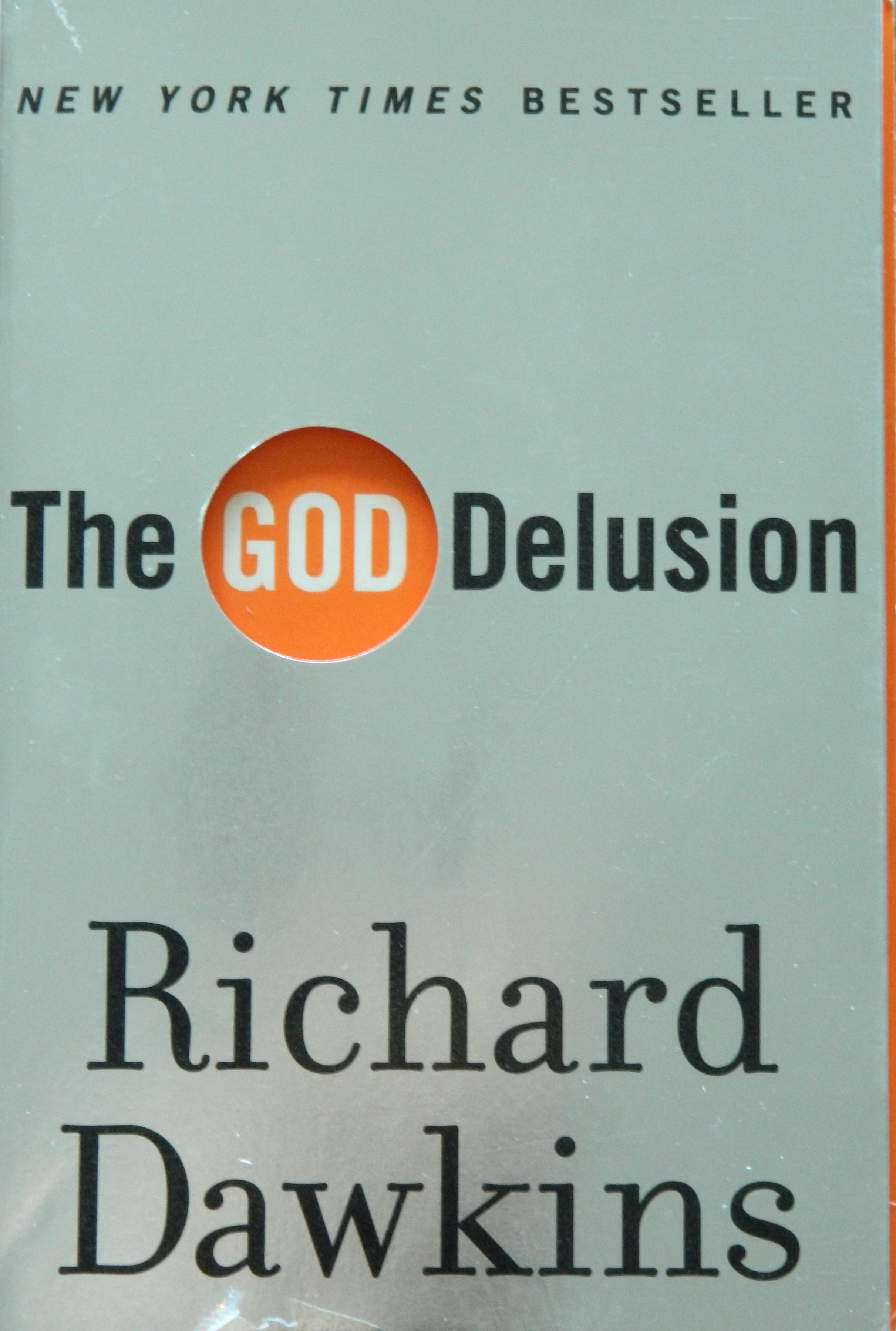
In The God Delusion by Richard Dawkins, he writes, “Shouldn’t a literalist worry about the fact that Matthew traces Joseph’s descent from King David via twenty-eight intermediate generations, while Luke has forty-one generations? Worse, there is almost no overlap in the names on the two lists! In any case, if Jesus really was born of a virgin, Joseph’s ancestry is irrelevant and cannot be used to fulfill, on Jesus’ behalf, the Old Testament prophecy that the Messiah should be descended from David (Dawkins, 120).”

In a study of 168 Israeli children, the kids condoned the well-known story of Joshua’s act of genocide. But when all the names and places were changed, they condemned it.

“Religious leaders are well aware of the vulnerability of the child brain, and the importance of getting the indoctrination in early. The Jesuit boast, ‘Give me the child for his first seven years, and I’ll give you the man,’ … In more recent times, James Dobson, founder of today’s infamous ‘Focus on the Family’ movement, is equally acquainted with the principle: ‘Those who control what young people are taught, and what they experience – what they see, hear, think, and believe – will determine the future course for the nation (Dawkins, 206).”

Though religion was ingrained in me, at school I often wanted to ask questions. But there was an unspoken rule that it was inappropriate to ask. If you asked questions of the Bible, your faith was faltering, you were weak, you were a failure, you lacked virtue.

“Christianity, just as much as Islam, teaches children that unquestioned faith is a virtue. You don’t have to make the case for what you believe. If somebody announces that it is part of his faith, the rest of society, whether of the same faith, or another, or of none, is obliged, by ingrained custom, to ‘respect’ it without question; respect it until the day it manifests itself in a horrible massacre like the destruction of the World Trade Center, or the London or Madrid bombings (Dawkins, 346).”

The idea that question equals failure permeated my entire consciousness to the point that I was afraid to ask questions in all of my other subjects as well.

Judgment was a huge fear for me. Everyone was always watching. So rather than falter in front of them, how about, just do nothing at all. Sit in a corner, and pretend you don’t exist. For eighteen years, that’s exactly what I did. I was not an exemplary student, to say the least.

Women barely exist at all in the Bible. I clung to the stories of Ruth and Esther for dear life. They were all I had. Mary, the mother of Jesus, certainly wasn’t worthy of admiration. She is described as being more like a vessel than a person. Jesus treated her poorly. He directed his followers to leave their families behind to join his hippy movement. Reading the Bible, it’s difficult to figure out where “Christian Family Values” came from.

When I was twenty-one, I chose to walk away from the church. I decided that I no longer wanted to battle against my own human nature. I longed to fully accept who I was so that I could find happiness. I didn’t think about my departure much beyond that basic need. For the next ten years, I avoided the concept of faith and religion completely.

Instead, I spent that time doing the basics. I had to rebuild my life and deprogram my brain (not an easy task). I put myself in uncomfortable situations so that I could learn, grow, and figure out my own path. I went through an inter-faith phase, and had a year or so of being enamored with mumbo jumbo, third eyes, magickal practice, and shamanism; but I never explored what I came from.

Three years ago, I was finally ready to face all of my fears surrounding the culture of faith. At first, when I started my research, I was horrified by the realization that all of my life I’d been lied to by people who actually believed the lies they told. I was extremely angry. I couldn’t pick up the Bible without feeling disgusted and repulsed. I expressed my rage in some of my past blog posts which (going viral) attracted the ire of some very hateful Christians. One accused me of wanting to be gang-raped by five guys on a pagan altar. When you come from Bible culture, this is not an “out there” thing to think.

As a woman (according to the Bible) I am a descendant of Eve (no matter that so are all men). Therefore, I am an evil temptress who can’t be trusted, and I need to remain under the protection and the thumb of my husband or father, who will keep me in line. I am not a man’s equal (since I come from his rib, and he was there first after all), so it’s okay to take me down a few notches and skewer me as a sexual deviant to take away the blow from my viable arguments against religion.

You can teach a normal, healthy human being the practices of religion, but the fact that they subscribe to blind faith makes it positively unhealthy. The more extreme the faith and the acts behind it, the more the rewards in heaven multiply. Thus, suicide bombers abound.

I had a good talk with my brother in-law last week. He and my sister are Bible translators in Papua New Guinea, though they are home on furlough. He gets sick of being judged that he is going to act or feel a certain way on the basis of his beliefs. I get sick of being judged by Christians that I am selfish and evil simply because I do not live by faith.

Unlike the Christian faith, I don’t believe that we only subscribe to morals for fear of punishment or hope for rewards. I don’t believe that I am a hopeless, fallen soul with no control over myself. I take full responsibility for all of my actions, for my well being, and the well being of those around me. I don’t believe my dreams will be handed to me on an answered-prayers-platter. I believe in working hard to make my dreams a reality.

A friend was visiting not long ago and said to me, “I forgot that you are an atheist, because you are just so spiritual.”

I’m not sure what this means exactly. I am in awe of the universe. Is that spiritual? Is my spirit separate from my body? There is no evidence that supports that.

Scientists believe we have discovered the origins of the universe. Though the theories make a great deal of sense, I wasn’t there, and I will never know what actually happened. And that’s okay, because I am merely a collection of matter, ever-changing, and living on this marvelous stage of life, lucky to be here, honored with the magnificence of it all, never ceasing to be intrigued and amazed by my journey through art, life, words, loves, dreams, and actualizations.

Could it not be, that we have come into existence by the actualization of atoms, which create the same feats in our own lives? From particles to beings, from beings to mass movements. If you believe something enough, it will come true. That is why I still believe that prayer actually does tend to work. In prayer or meditation, you have set your mind to something, and will (hopefully) lay the groundwork to fulfill that need.

I no longer feel angry when I pick up my Bible. For the first time in my life, I can enjoy it simply as a piece of literature. Well, on second glance, maybe not. That is wishful thinking in my case. It could only remain as a piece of literature to someone who was not affected by its life consuming goals. Such as, the way I was not affected personally by learning about Greek mythology. No one ever told me I had to live by the commands of the great and all-powerful Zeus.

In Philippians, Paul’s words remind me all too well of what I have left behind:

“… I consider everything a loss compared to the surpassing greatness of knowing Christ Jesus my Lord, for whose sake I have lost all things. I consider them rubbish that I may gain Christ and be found in him, not having a righteousness of my own that comes from the law, but that which is through faith in Christ… I want to know Christ and the power of his resurrection and the fellowship of sharing in his sufferings, becoming like him in his death, and so, somehow, to attain to the resurrection from the dead (Philippians 3:8-3:11).”

According to Ignatius, Paul was eventually decapitated as a martyr under the rule of Nero. He is not the first martyr or the last. He is not the first to give everything up over his lame powers of perception – believing in the great white light, spirits, visions, what have you. As I read the words now, I feel sorry for his loss. I admire that he lived his life with passion. But his blind love cost him his head. It also cost him the chance at finding truth and happiness in the one life he lived.


‘No End Of The Bed’ – Book Release!!!

I am so happy to announce that my memoir No End Of The Bed is now available on Amazon!

Print Edition

Kindle Edition

KindleCover1

Lauren J. Barnhart’s memoir No End Of The Bed spans her search for truth through differing perceptions of sex, with some surprising parallels made between the fundamentalist church and the sex-positive movement.

Raised within the confines of Fundamentalism, Lauren J. Barnhart is instructed that her body is inherently evil and unclean; that innocence is of the highest value; and that a woman is meant to be a servant to everyone but herself. She struggles to believe all that she is told or else disappoint family, friends, and an all-knowing God.

At age twenty-one, outside of her small conservative college, Lauren expresses her sexuality and is surprised to discover a lack of guilt for her transgressions. Within nature rather than against it, awakened to all five senses, she begins to record the feelings of intense love and empathy that she failed to find within the church. 

In the search for something more, she is drawn towards a group of polyamorists, who celebrate the body and the freedom to express themselves with many. Through their zest for life, she abundantly taps into her artistic nature. But at the same time, she experiences the same misuse of power that was left behind in the pews. Realizing that the need to find a leader is a fallacy, Lauren learns to value her own true voice, and finds the strength to forge a different path.

KnottedTreeLogo3

I began this book when I initially broke with the church twelve years ago. The experiences I had along the way were strange and extraordinary, and it took the entirety of that time since, for the story to fully unfold. In fact, the last chapter took place exactly one year ago.

In my early twenties, I became obsessed with the need to capture everything I was experiencing. I kept detailed journals, wrote poems, songs, and began writing short stories that grew to connect as chapters.

It took ten years, and one year of prodding from my husband, before I could face the fact that I was writing a memoir. I’m still shocked that I’m not hiding behind the false label of fiction. There are truths in the book that I wouldn’t even tell my close friends. But a book is different than a conversation. And without total and complete honesty, the story loses its effect.

Others who feature in my story might not remember the details the same way that I do. Each and every one of us has a different set of memories. But we all shared the same arc from repression to crazy expression.

I am very immersed in the present right now (more than I have ever been). I could not let go of the past until I finished this book. It helped me to process my life. I came to understand everyone else’s motives. I forgave them and went through a long phase of constantly thinking through the male mind. At least that is to say, the male minds that are in the book!

In the end, I found that there were more similarities between the Fundamentalist church and the Sex-Positive movement, than dissimilarities. Erica Jong once wrote, “All pornographers are puritans.” Residing in one extreme, the complete opposite extreme lies within it, just under the surface of repression.

Growing up, I was told that the body I live in is rife with taboo. I wanted to understand why. I put myself in highly uncomfortable situations just to test my own limits. I discovered that taboo only exists in your mind. Fear is based on the unfamiliar. Rules and religion began with the human desire for control and patriarchy, and control keeps the masses in the dark.

Through the long, arduous publication process, passages, words, phrases, and pages jumped out at me: flashes of years past. No End Of The Bed shows me how far I’ve come. I feel invulnerable to judgment. The young, confused girl in the book is not the woman that I am today.

But I also miss certain aspects of that very youthful place. I was so open to people that it bordered on unhealthy, though I learned so much from them. I was also scared shitless of all the new people that spoke a different language than the religious language I grew up with. Lately I am reminded, that if you’re not scared shitless, you’re not really living. Being on the stage seems to provide that over and over for me. I like to be constantly challenged so that I can keep growing.

Right now, I have two other books in the works, and I will be publishing other authors as well through Knotted Tree Press including literary fiction, memoir, essays, and poetry. You can find out more at Knotted Tree Press.

In the memoir, I found responsibility for my self. I let go of the need for a leader, and discovered my own truth. In taking charge of the publishing of that memoir, I found responsibility for my work. I’ve loved every detail of editing, formatting, designing the cover artwork, and marketing. The funny thing is, it took exactly nine months to complete the publishing process. Now, it’s just so good to be back to writing again.

The Value Of My Mothers

As women, especially, we carry our mothers within us. We carry our grandmothers, our great-grandmothers and so on. Beginning life through their looking glass, we interpret from their experience. As adults, we hopefully bring something new to the equation.

In The Dance of the Dissident Daughter, Sue Monk Kidd shares how she went from being the good Southern Baptist wife, to an awakening of the anti-female language in the church and the traditional roles she had fallen into without question, causing her to become the many breasted woman. She takes a precarious journey towards finding her own true voice, fearing that she will lose her husband or that her kids will be too shaken. But what results instead is a total awakening that greatly improves her relationships and her life.

I go back and forth between two worlds on a consistent basis. Living in downtown Seattle I am surrounded by strong-willed, independent, mature, and passionate women. They hold themselves tall. They’re never looking at the floor, but straight out into what they can learn and how they can grow. They earn respect from their peers, and are active in their community.

Being around them long enough, I can forget that there is another world, the one that I come from, where women live beneath a patriarchal religion that tells them they are unclean and not worthy; the downfall of humanity beginning with Eve who tempted Adam with an apple; a Bible with so few mentions of women, that as a girl I clung to the stories of Ruth and Esther for dear life.

It’s a struggle to still see this mindset in my family members. I am often held to the same standards as the mothers who went before me, even though my husband and I do not share the same value system as my family. Trying to gain their respect as an independent human being, apart from my husband, is difficult. I often feel that for them, a husband is the replacement of your father, and my decisions are like a child’s whims that need to be reined in.

My mother was raised in the fifties and sixties in the Midwest. The negative messages she received about being a woman were manifold. She began to believe that she was dirty, ill equipped to handle life, unintelligent, not worthy of a college education the way her three brothers were. She says that her greatest achievement is having given birth to my sister and I, and raising us well. My mother did the best that she knew how. Though within her, I always sense an untapped potential – creative talents lying inert, a lack of belief in her value. She wonders out loud, “I’m already sixty something, and what have I done with my life?”

She was always with us, always there when we got home from school. But as then, and even now, there is a sense that she is often absent. Maybe it is the trait that my sister and I both share with my mother – we all have a tendency to get lost somewhere up in our heads. My nieces also share this trait, with their wild use of the imagination and sudden bursts of wit. With this up-in-your-headness, there is the danger of retreating from a fully functioning life. All of us women in the family are artists whether we express that or not. Maybe the problem lies in wondering whether our expression is valid or valuable.

In Sue Monk Kidd’s The Dance of the Dissident Daughter – A Woman’s Journey from Christian Tradition to the Sacred Feminine, she writes, “I like the way Clarissa Pinkola Estes says it: ‘When a woman is exhorted to be compliant, cooperative, and quiet, to not make upset or go against the old guard, she is pressed into living a most unnatural life – a life that is self blinding… without innovation. The world-wide issue for women is that under such conditions they are not only silenced, they are put to sleep. Their concerns, their viewpoints, their own truths are vaporized (Monk Kidd, 21).'”

I want to know my mother from before I was born. In photos she looks mischievous and carefree. She wears dark eyeliner, with funky 1960’s hairstyles, and mod clothing. She plays the piano, or munches an ice cube in old film footage at the racetrack with my dad. In photos, they goof off with their Old English sheepdog, Big Boy. They are young and beautiful, and life is rich with possibility. She worked for the telephone company, and he was an engineer. On the weekends they took random road-trips, not sure where they’d end up.

As a child, her mother was bipolar and overwhelmed by raising five kids. Grandma preferred her three sons to the two daughters. She never really liked women that much, and she also wasn’t very happy with her emotionally distant husband. But she did love fashion, expressing herself, and working in retail.

On my father’s side, my history of mothers only exists in photographs. His mother died of cancer when she was my age. In photos, she is always laughing with friends. She looks like the center of the universe. Her face is a strangely familiar territory of my eyes, and my sister’s lips. So many aspects of her have been passed down to us, but what they were (outside of photos), we’ll never know. I cling to these images – a grandmother, only visible in stills of black and white. I build up stories around her that only make her more beautiful, more daring, more carefree.

I quickly flip past the photos near the end of her life. She is washing dishes, with my dad (a toddler) playing at her feet. The lines beneath her eyes have turned purple, her shoulders slump towards the sink, exhaustion is written all over her failing body. I choose to forget this, though it lingers in my subconscious, and I wonder if like her, I could possibly die young.

My history of mothers didn’t have the opportunities that I do. Through everything that I do in my life, I celebrate them. I celebrate my right to speak, to write honestly and openly, and leave a record of myself that goes beyond old photographs found in a shoebox. So much of what my mothers really felt, was never spoken.

As I think about opening my life to the possibility of motherhood, I understand the importance of a line of mothers. I see the magnitude of knowing, before I take that step, my own value as a self. It’s painful to me when my mother writes off her life as not being very important. All I can really do is make up for it, everyday, with how I live my own life.

When she lost her mother, I was nine years old. Mom lost her luster as a distant perfect goddess, always washing dishes at the sink. She became a human being. Our family was split down the middle at the time, mid-move from Chicago to Seattle. She and I were still in the old house. She was afraid, scared, hiding boos in the back of the refrigerator (she never drank). Every night we stayed somewhere else, or a friend stayed with us.

Suddenly, it seemed that I was becoming the mother. I resented her for it. I didn’t know how to control my anger. That was when mom began to say that I reminded her of her mother. I was scared that like grandma, I was bipolar too, and maybe diabetic. No one really painted a positive image of grandma, though she was always nice to my sister and I. And it was my aggression that brought up the comparison.

“Most of my life I’d run from anger as something that good daughters and gracious ladies did not exhibit. Perhaps the thing most denied to women is anger. ‘Forbidden anger, women could find no voice in which to publicly complain; they took refuge in depression,’ writes Carolyn Heilbrun. Her words came true for me. Without the ability to allow or the means to adequately express the anger, I began to slide into periods of depression (Monk Kidd, 74).”

You could say that depression runs in my family, but I broke out of a habit that descended down through the women for generations. It was a long, painful process, letting go of that mindset and way of being. But then one day I woke up, fully in charge of my own life, fully capable, and fully expressive. The sluggish, then raging, suicidal thoughts were completely gone. I cracked the code. The answer was within me all along. As long as I face life with no fear, give what I have to offer, and value my gifts, I am happy. It’s a simple equation. But there was nothing simple about how long it took, and difficult it was, to figure it all out.

In life, there is always what we are, and what we were. They live together simultaneously. Some people catch up to who we are now, and some never do. But we all manage to learn from each other. Though my parents raised me, their daughters have raised them as well. My family speaks a different language through an opposite worldview, but we can still connect with laughter, good food, and the stories of our interconnected lives. Everyday, we grow in awareness of ourselves in relation to each other.

The Silence of Snow

IMG_0018

Many years ago, I had a ten-month relationship with a Palestinian man who was getting his PhD in political science.  We were more like companions than lovers, but the sexual tension between us drove us crazy.  There was only one time, early on, that we acted on that tension, and it was a disaster.  Amidst our attempt at satisfaction, he fell asleep, and I left him there, alone with his own snores.  He woke up after I left, confused and lonely, wondering where I went.  I was furious, and it was a tremendous blow to my ego. I was very young, but I’d been through so much at that point, I was also very old.  Much older than I am now.

That winter it snowed so much, that I was stuck at his apartment in the University district for three days.  I hadn’t dressed warmly enough, so he lended me his black and white checked Keffiyeh.  It was thick cotton.  Piled around my neck, it protected me from the elements.  I thought of how the Keffiyeh is most commonly used for protection against the hot desert sun.

It wasn’t really a fad yet, to wear a Keffiyeh around a college campus as a fashion statement.  So a lot of people gave me funny looks.  It felt as though the scarf could speak much louder than I ever could.  There were people whose eyes lit up with happiness, and others who frowned.

Magid was much older than I was, and looked like a cross between Omar Shariff, and Louis Jourdan.  Outside, his cigarettes added smoke to the steam escaping from his full lips.  We walked through the city, beneath trees with intricate twig webs of white.  We drank espresso at the Solstice coffee shop.  He read the world politics section of the newspaper with his legs crossed.  I wrote poems.

Mostly, we just fought all the time.  But that weekend, with all of that snow, we created a cozy world for ourselves.  Unobstructed by stress, power struggles, and Magid’s pain over always feeling like an outsider.

 Though he had many friends, he was locked inside of solitude.  And within him, always the constant conflict between East and West.  To be in the West was both to avoid his homeland, and also to fight for it with the safety of distance.  To be in the East was to be beaten down and humiliated.  Even community, tradition, and  family, could not protect him from this.  He was a foreigner no matter where he went.

The same feels true of Ka, Orhan Pamuk’s main character in his richly poetic novel, Snow.  Through Snow we are given a view into the struggles of the small town of Kars in Turkey, and the conflict between Islam and the State.  Since a ban on headscarves for girls in school, there have been several suicides among the headscarf girls, but it is uncertain as to whether their reasons were religious or having more to do with their miserable lives.

Ka is a poet who comes to Kars on the pretense of covering the suicide girls and the political elections for a Frankfurt newspaper (where he lives as a political exile).  But his real reason is to seek out a beautiful woman he remembers from college.

While in Kars, Ka writes several poems.  He is snowed in, and the roads have been closed.  Political tensions come to a peak.  And though involved beyond what he would care to be, the events pale in comparison to the love he has found, and the overwhelming feeling that he will lose her.  What is more, his Atheism is challenged by the perfect symmetry of snowflakes, and so he begins to see through all points of view.  He becomes susceptible to the mystical, the charismatic, the theatrical dramas that cross the line from stage to reality.

My companion, Magid, did not seem to have a sense of faith.  I admired that about him.  His family was Christian, and he always said that Americans had no idea how many Christians lived in Palestine.  He taught me that the news we receive here is very dishonest and biased.  He took it upon himself to educate me on world issues.

There was a part of him that wanted to be liberated from his culture.  But the part that was still entrenched in tradition, railed against my strong willed nature.  He was both attracted and humiliated by my need for independence.  Insanely jealous, with no reason to be, since is wasn’t beyond him to take another woman home, if I wouldn’t go with him.

He said he would take me to Israel, but he never did.  Instead, he went alone when his father was dying.  And on his way back, he was strip searched and made to stand naked in front of group of guards.  They rifled through his credit cards.  They confiscated his luggage, and then gave it back to him after they had stolen the gifts he was bringing back.  They assigned him a guard, to escort him at all times in the airport, until he boarded the plane.  He was made to feel like a dangerous criminal.

When his plane had a layover in Jersey, he called his family and found out that his father had just died.  There was a sense of relief at having missed it.  If he had been there, it would have been weeks of sitting in the house and mourning while all the neighbors came by to offer food and condolences.  He considered whether or not he should grow out his beard as a sign of mourning.  Then he decided that no, he was in America now.  He didn’t have to do that.

He flew home, and when he told me all about what had happened, he cried.  It was summer now, and we were eating burgers at a bar in Fremont.  The sun was hot on our heads, streaming through a large window behind us.

The last time I saw him, we fought so badly that I drove him back to his street and dropped him off on the sidewalk before we could even make it to dinner.  I drove away without even saying goodbye.  The next day, I moved to New York.

Our story was a small pocket of my life.  And in that pocket is the silence of snow, a Keffiyeh, Magid’s cigarettes and a newspaper stuck under his arm.  We are not fighting the fight between East and West.  We are peacefully gazing at each other from across the table with love in our eyes, while the students around us are wondering what a young girl like me is doing with a stubborn old man.

I see that Magid is living a successful life as an intellectual and writer.  He is hard at work, stripping the layers off of the Westernized condescending and racist approach to Arab culture.  His research has led him to express his thoughts through a historically Arabic point of view.  It appears that he has returned to the East.

I will always remember that in Arabic there are over twenty words for “love” but in English, we only have one.  I will remember the way that the men all danced together, and swung their hips in a subtle way.  I will remember the koobideh with basmati rice and saffron.  The poets and musicians; the pain and love that they expressed.  The ancient culture that we could never feign to understand in the West.

Breaking the Myth of Purity

As a young adult, my entire worldview was shaped by Fundamentalism.  But everywhere I looked within the church, I saw that what was being preached, didn’t measure up.  Pastor after pastor took a “fall,” usually of a sexual nature.  My own “fall” was the best thing that ever happened to me.  Unfortunately for the pastors, they lost their jobs, and sometimes their families.

See Me Naked – Stories of Sexual Exile in American Christianity by Amy Frykholm, was not the book that I thought it was going to be, but it was valuable all the same.  No one interviewed for the book was actually tossed out of the church or excommunicated for their sexual sin.  Yet I hear those stories all the time, particularly at creepy Mars Hill church down the street; the very last church I attended.  Pastor Mark is such a misogynist power tripper that his downfall is bound to happen any day now.

DSCN2948

Amy makes brief mention of the infamous Ted Haggard (mega pastor who was ousted for his secret homosexual life), then dives in to everyday people who have come to terms with bridging the gap between their sexuality and their faith.  Throughout the book, however, the interviews are tinged with a bias.  Frykholm is Episcopalian, by far my favorite Christian denomination for its all-inclusive, caring for the community spirit.  But one can’t help but feel proselytized to from the standpoint of her beliefs.  Impossible not to, I know.  Just as when I share my own belief system (Atheism), Christians tend to feel attacked or even threatened, with knowing remarks about how someday I’ll “see the light.”

While reading See Me Naked, I recognized my own path in many of the stories, though my journey had a much different outcome.

“The message she heard from every corner was: you do not belong to yourself.  You are not your own.  You belong to us and you will do what we say (Frykholm, 80).”

I remember when all of my words were bottled up inside me, held back, weighing me down.  I constantly had questions.  All through my first twenty years, I wanted to challenge what I was being told.  But if I challenged it, I would be seen as a failure.  And a person who questions the word of God is weak.

I didn’t feel strong, I felt diminutive, as though my unspoken words would swallow me up into nonbeing.  I walked through life like a ghost – not speaking, not touched, not known.

“He had “given a piece of his heart to all of them” and therefore did not have a whole heart to give to his bride.  In this conception, purity is a finite, all too easily expendable quantity (Frykholm, 108).”

The word “purity” has no meaning for me.  When I hear that word, it does not go beyond the age of twelve.  I see a child.  As an adult, purity has no value.  It means purely free of personality and life.  It signifies a person not fully formed.  Someone with little understanding of the complexity of human relationships, and how much we can learn and grow from a love that is not finite but expands and grows.  The highest value is in maturity, wisdom, and intelligence.  People who can offer these three things have value that does not flit away, unlike the fleeting “purity.”  Of course, it’s also wrapped up in the idea of innocent youth, and in an over-thirty something, “purity” is a train wreck of desperation.

For Christians on the marriage track, the fantasized about future will surely disappoint them once they are wed.  In the courtship phase, moments that should be filled with intense pleasure and enjoyment, are instead replaced with the constant danger of falling over a cliff into a deep ravine of insatiable pleasure.  Danger.  Mistakes.  Regret.  No going back.  Every touch is quantified and measured.  And if the couple slips and falls, then one has “used” the other, selfishness has entered the game, bodies are “objectified.”

I use quotes here for all the words that fail to play a role in my vocabulary.  Coming to a different worldview, has also meant coming to a new language.  When I talk to my family, I listen to the ways in which we speak two different languages, and I feel the pain of a disconnect.

Purity is a pleasure to sully.  Humans have enjoyed this sport since the beginning of time.  In cultures around the world, the male pursuit of purity has imprisoned women in unhappy marriages, subservience, and shame.  By ridding culture of virgin worship, we come to a place of equality for both men and women.

“Many of the people I interviewed for this book grew up with the idea that, if they made one mistake, they would fall into doom and misery.  Sexual mistakes had the most dire consequences.  Thus, sexuality became ensconced in fear – fear of being found out, fear of being truly known, fear of failing.  Yet nearly everyone I interviewed had found a way through fear and found their deepest intimacy with God in their capacity for wonder (Frykholm, 173).”

When I was twenty-one and had sex for the first time, it took a year’s worth of therapy to get over the discovery of who I really was beneath the Christian veneer.  The therapists didn’t do much beyond just allowing me to voice my own honesty for the first time.

With that honesty, I began to feel brave, and shared my poetry with classmates.  Through writing, I broached the pain of feeling that all of my life, I had been lied to.  It was obvious to me, that the body and sex and all of our five senses are not selfish and depraved, but immensely beautiful and giving.  I never really knew how to love until that year.  My awakening to empathy is intrinsically linked with pen and paper, and the need to write.

“If we pay very close attention, I think we will find that the pleasures of excess, hedonism, and self-indulgence are thin.  Deeper, wider, more lasting pleasures are available as we grow more attentive to and more comfortable in our own skins, and as we give up the notion that pleasure is inherently selfish (Frykholm, 176).”

Frykholm offers no remedy for the conflict between church and sexuality.  A difficult quandary when people are living ancient tribal beliefs in the literal sense.  The church would like people to think that they have no control over themselves.  The taboos loom larger than they really should be.  They are afraid of what they don’t know.  If you are afraid of something, maybe you should try it.  It’s the key to understanding your fears.

How Belief In God Limits Us

The question we all have as human beings is “what lies beyond our limit?”  We just watched the film Another Earth where humans are faced with the perplexing realization that there is another earth mirroring our own, even another self completely synchronized with us.

In reality, when we come into contact with other people, their inner being transcends us.  They might let us into a few thoughts, but other than that, we will never fully know them.

But to find another replicated self – would we recognize ourselves?  Would that other self transcend us as well, as though we are looking at a stranger?  Would you feel competitive of your other self?  Would you find your other self ugly?  Would you be annoyed by your other self?  Would you love your other self?  Would you tell your other self to get over all their hang-ups and get on with life?

Just as we will never meet our other self, we will never meet our idea of God.  In Gordon D. Kaufman’s book, God The Problem, he states, “If there were no experiences within the world which brought us in this way up against the Limit of our world – if there were no point at which man sensed his finitude – then there would be no justification whatsoever for the use of God-language (Kaufman, 49).”

To embrace what lies beyond the limit, we talk of God in ways that we can understand from our experience of human relationships.

“…God is spoken of as lord, father, judge, king, and he is said to love and hate, to make covenants with his people, to perform “mighty acts,” to be characterized by mercy, forgiveness, faithfulness, patience, wisdom, and the like – all terms drawn from the linguistic region of interpersonal discourse (Kaufman, 62).”

In the Webster’s Dictionary, the word God is defined as “1 cap : the supreme reality; esp : the Being worshiped as the creator of the universe.”

When I say that I do not believe in the existence of God, I am saying that the belief of a creator and a ruler do not measure up in our current state of reality, or even within the context of the past and ancient history.  He was the explanation that existed before we had a scientific explanation, used as a way to interpret people’s experiences.  People desire to make sense of things, but the problem is, God does not make sense.

I am in awe of our cosmic universe, so much so, that I find it impossible for our existence to be so limited by this idea of God.  To me, we are looking too far out into the distance, when the answers all lie within us, within and beyond our massive and destructive home on earth.

“Indeed, we have learned, that it is precisely by excluding reference to such a transcendent agent that we gain genuine knowledge of the order that obtains in nature, are enabled to predict in certain respects the natural course of events, and thus gain a measure of control over it (Kaufman, 120).”

So there is no direct encounter and never will be – no way to interpret God outside of our own imaginings – in which case, God is actually a mirror of our own humanity – full of insecurities, the need for affirmation and praise, the desire to be close to these humans who are always so distant and cold, the desire to have their obedience, to incite dominance, to be in charge, to have control.  Why does God mirror the fickle childishness of a human being?  And if God is the creator, then who created him?  The answer seems obvious – human beings created him.

“When feeling is given a dominant place in shaping the interpretation of reality or the world, a religious world-view results (Kaufman, 214).”

Lately, every time we see my parents, my mother has to make a comment about God’s existence.  God is woven deeply within the fabric of my family.  He is given praise for all the good things.  The universe is over-simplified through Bible stories taken literally.  My mom celebrates the day that she will “go to be with Jesus.”  It’s not by my father’s intelligence and diligence in over forty years of hard work that brought them financial security.  No, it’s God.

The last time I wrote about religion, I was extremely angry for being raised without a choice.  Writing is good therapy, and I’ve come to a new place of peace and acceptance.  I feel released through my own realizations and views on life.  But I’ve also chosen to keep those views separate from my family life.  They have an idea of what I think.  The problem is, no matter how much I bring it up, they will forget it, or write it off by tomorrow.  My mom especially, has selective memory.  She blocks out the things that she can’t handle.  Especially since, according to their belief, I am “lost” – whatever that means.

When I am with my family, I do my utmost to respect them.  You cannot argue with a mind-set, culture, history, or the entire fabric of someone’s life.  They will do anything to shut out conflicting views, to keep the cognitive dissonance at bay.

Family is extremely important to me.  So I hold hands with them when they pray, I smile and say nothing over the Jesus comments, I listen to my nieces simplify the world by stating the Bible as fact.  In the meantime, I hope that as my nieces grow older, they begin to see that life isn’t so cut and dry.

Coming from children, religion makes sense.  But from adults, I expect more.  Sigmund Freud said, “The roots of the need for religion are in the parental complex; the almighty and just God, and kindly Nature, appear to us as grand sublimations of father and mother, or rather, as revivals and restorations of the young child’s idea of them… when at a later date he perceives how truly forlorn and weak he is when confronted with the great forces of life, he feels his condition as he did in childhood, and attempts to deny his own despondency by a regressive revival of the forces which protected his infancy.”

A universe that circulates around our own egos – that sounds like a man-made myth if ever I heard one.  We are all in the struggle of existence whether we like it or not.  We will all one day fall prey to death.  We have no real control.

“May it not be the case, moreover, that the very act of believing in God is in itself morally dubious?  May this not be largely an attempt to avoid taking full responsibility for ourselves and our lives by creating in fantasy a “heavenly father” into whose care we can place ourselves when the facts of life become too unpleasant (Kaufman, 14)?”

I find this over and over in people who dedicate their lives to God.  Life is just too much for them.  They would like to whitewash all the realities that are too painful for them to take.  It’s a coward’s way out.

The older Christians in my life all believe that I will come back around.  They were “wanderers” in their twenties and thirties, and are convinced that by forty or fifty, I will realize that my demise is nearing.  There are too many things I cannot control.  My body will start failing me, or friends will start dying off.  I’ll be faced with the futility of my existence.  I don’t think they understand, that I have already experienced all of those things.

It seems to me, when people leave faith behind, they fail to search beyond faith.  They avoid the question of spirituality altogether.  Then eventually, they inevitably end up going back to what feels comfortable, to what they knew in their youth.

My dad told me, “Never stop searching,” with his hands clasped tightly around my shoulders in a desperate attempt to get through to me.

I replied, “I never will.”  I wish I could please him, and be what he wants me to be, but I have to be myself.  I will never go back to where I came from.  I will move forward and live to the utmost before my body turns to dust.  And believe it or not, I’m okay with that.


For more on this topic:

https://laurenjbarnhart.wordpress.com/2012/01/31/god-against-nature/

https://laurenjbarnhart.wordpress.com/2012/01/02/why-i-stopped-believing-in-god/