God Against Nature

Image

             A picture was posted on Facebook, “Twins in the Womb – Hey Brother!  Do you think there is life after birth?  Do you believe in Mom? – Nah!  I’m an Atheist, I mean, have you ever seen Mom?”

This analogy literally makes no sense.  First of all, we don’t leave our bodies when we exit the womb.  The mother is also a physical body and everything she does directly effects and is experienced by the fetus – Walking, talking, dancing, listening to music.  Not only are the twins physically inside of her, but they are also consuming what she eats through an umbilical cord.  Both mother and fetus are a part of and joined in nature.  But the idea of ‘God’ is not.

In Nature, Man And Woman, Alan W. Watts explains, “The architectonic and artificial style of Christianity is nowhere clearer than in the idea of God as the maker of the world, and thus of the world itself as an artifact which has been constructed in accordance with a plan, and which has, therefore, a purpose and an explanation.  But the mode of action of the Tao is called wu-wei, translatable both as “non-striving” and “non-making.”  For from the standpoint of Taoist philosophy natural forms are not made but grown, and there is a radical difference between the organic and the mechanical (Watts, 39).”

Western man would like to measure, categorize, explain, experiment, and use every last inch of our earth.  If he probes deeply enough into our insides he feels he can explain our bodies as mechanized objects.  In this way, existence is only used as a method for profit and gain.  And though we have come into an age of a more secularized society, the brain is still programmed from religious thinking to be on the outside of nature looking in.  In this way, life is experienced as a bystander, irresponsible and apart in a perceived isolation, separate from all other creatures.

As a person who grew up in the church, it was exhilarating to first experience the freedom of my natural self without guilt or shame.  I was surprised that I felt no guilt, but for me, it was like an escape from a prison that I had been in all my life.  I had struggled to make my belief real.  But it was dead and I was left hungry and thirsty for real life and the riches of gritty experience.

“For in identifying God, the Absolute, with a goodness excluding evil we make it impossible for us to accept ourselves radically: what is not in accord with the will of God is at variance with Being itself and must not under any circumstances be accepted.  Our freedom is therefore set about with such catastrophic rewards and punishments that it is not freedom at all, but resembles rather the totalitarian state in which one may vote against the government but always at the risk of being sent to a concentration camp (Watts, 133).”

I think it is obvious to everyone that merely having belief in principles does not make you those principles.  A person who lives by belief must also wear a mask, because what is occurring on the outside and what is being thought on the inside are two entirely different things.  And the more you try to be ‘good’ with all your might, the more its shadow twin ‘evil’ is increasingly prevalent from the denial of it.

Christians like to say that their belief is not about might.  They say that Jesus will change you from the inside out.  If you believe that enough, through the power of self-hypnosis and faith, yes, you will change to some extent.  But you will still have all the same feelings you had before.  Feelings that are now associated with a sinful nature.

“To give free rein to the course of feeling is therefore to observe it without interference, recognizing that because feeling is motion it is not to be understood in terms which imply not only static states but judgments of good and bad (Watts, 93).”

Allowing our feelings to guide us is the only way to be truly happy and centered, to break out of isolation and connect into the flow of life.  “… Confucius felt that in the long run human passions and feeling were more trustworthy than human principles of right and wrong… (Watts, 177).”

Christianity has a long history of denying the spiritual that we experience in the physical.  In denying the body we deny life.  And fear of experience becomes worse and more consuming than the actual experience.  In pain we learn the possibilities of ecstasy and pleasure.  In sex we find spontaneity and transcendence.  In expressing emotion freely, we are released and connected with other human beings.  The full spectrum of physical experience moves us forwards into spiritual growth.

I had a friend in college that I love very much.  She goes to a questionable church that I used to attend.  They believe in punishing the unfaithful by disassociating with them, which is probably why she doesn’t talk to me anymore. But we had also grown apart, and the last time we saw each other, it felt slightly forced and awkward.

I first fell in love with her when we were on a student trip to Europe.  We were in Salzburg, and we all ordered Wiener Schnitzel with currant sauce and lemon.  It was succulent and delicious.  It was so good that she began to cry.  I had never seen someone so moved by the pleasure of eating.  She lived out her pleasures in the most beautiful ways, and I have always admired the joy she takes in the simple things.

She has alluded to a sexual sin in her families past that resulted in an excommunication from a church.  This seems to have shaped her fear of intimacy, beyond basic morals.  She believes in waiting for marriage, and has denied herself the sexual experience of being with a man.

It is obvious to everyone who knows her well, what a truly sensual, and beautiful person she is.  Her greatest repression has become her ultimate mission.  She goes out with her church group at 3am to help prostitutes by talking to them about God and giving them toiletries.  Her passion is to help stop sex trafficking.  But I find it ironic and strange when such a difficult repression is used to fuel a passion.  I am always happy to hear that someone is helping people, but I also worry that it can be patronizing to the less fortunate tiers of society.

“…  Profound love reveals what other people really are:  beings in relation, not in isolation (Watts, 199).”  A coward’s life is in isolation.  But the lover’s life is in relation.  I see my friend as a lover who is only allowing herself a fraction of what life has to offer.  In my opinion of this, of course, I am making the judgment of an observer.  But it pains me to see how religion can limit a person’s experience of life, where feeling is repressed beneath doctrine and dogma.

“… a God to be grasped or believed in is no God, and that a continuity to be wished for is only a continuity of bondage (Watts, 116).”

The Little Death

The first thing I noticed when I picked up my used copy of Platform by Michel Houellebecq, were the bits of jizz on the edges, making the pages stick together.  Not surprising, given the amount of orgy scenes.

Houellebecq’s exploration of our contemporary malaise is only relieved through the constant pursuit of sexual adventure.  The protagonist, Michel, is a depressing character with really no personality to speak of.  He drifts through life bored and alone.  “Anything can happen in life, especially nothing (Houellebecq, 148).”  He is unable to find a suitable partner, or even really, connect with anyone at all.  But then he meets Valerie on a group tour in Thailand, where he goes to enjoy the benefits of Thai prostitutes.  In Valerie he discovers a sexually giving nature with the benefit of having someone to love, talk to, and enjoy life.

She works in the tourism industry, dealing with the problem of customers who are bored by their vacation experiences.  Michel suggests a line of hotels that specialize in sex tourism.  At first it’s a huge success – until Muslim terrorists step in.

“The problem with Muslims, he told me, was that the paradise promised by the Prophet already existed here on earth.  There were places on earth where young, available, lascivious girls danced for the pleasure of men, where one could become drunk on nectar and listen to celestial music; there were about twenty of them within five hundred meters of our hotel (Houellebecq, 250).”

Michel listens quietly to his companion, but he is more concerned with the sexual problems of westerners.  “Something is definitely happening that’s making westerners stop sleeping with each other.  Maybe it’s something to do with narcissism, or individualism, the cult of success, it doesn’t matter.  The fact is that from about the age of twenty-five or thirty, people find it very difficult to meet new sexual partners…  so they end up spending the next thirty years, almost the entirety of their adult lives, suffering permanent withdrawal (Houellebecq, 172).”

In my early twenties I attracted more men and even women than I ever have since.  And since then I have been analyzing exactly why this is so.  I had that youthful glow and was always smiling and laughing, whether it was nervous laughter or not.  I was much more friendly and open to all experiences – not yet scarred by all that was thrown at me later.  I was naïve, which older men found highly amusing for a while.  In fact, I was everything they were looking for to make them feel young again.  I was the answer to their existential crisis – youth.

My 22 year old self

For a number of these men – sex in its basic form wasn’t cutting it anymore.  They were resorting to cocktails of Ecstasy and Viagra, group sex, role-playing, bondage, domination, whips, hooks, orgy-parties.  And yet, they were still always bored.  “Organized S&M with its rules could only exist among overcultured, cerebral people for whom sex has lost all attraction.  For everyone else, there’s only one possible solution: pornography featuring professionals; and if you want to have real sex, third world countries (Houellebecq, 175).”

When I did date normal, mainstream guys, I was bored out of my mind.  They were so vanilla, with nothing to talk about and a limited capacity for pleasure that was stunted and one-sided.  They were also not as honest.

Since then I have gained much more than lost.  But if I have lost anything, I would like to bring back that openness I had to people all around me.  I want to love fully without fear, with more effort on my part in the awareness that we are all as one.  Houellebecq, of course, puts it more bluntly, “It is in our relations with other people that we gain a sense of ourselves; it’s that, pretty much, that makes relations with other people unbearable (Houellebecq, 63).”

Houellebecq has a dire view of the world, and though he writes of the dangers of isolationism, he also gravitates to it.  I see it as laziness. How can you feel connected to others, if you are not first willing to give? The character of Michel expects women to sexually fall all over him when he has not given them anything to fall over.  He is a walking dead man. There is nothing lovable about him.  And when he meets Valerie, it is hard to understand why she is attracted to him.

Behind Houellebecq’s fictional sexual forays is the mind of a Puritan. His characters are always punished for finding sexual satisfaction.  They begin and end in their fear of intimacy.  The sterile, noncommittal experience of a prostitute becomes the safer approach.

I watched Houellebecq’s interviews, and got the sense that he is already dead.  He appears to fall asleep, and takes an inordinate amount of time to answer questions.  His hands and mouth constantly grab for the stimulus of a cigarette.  In an interview for The Paris Review, he was asked how he has the nerve to write some of the things he does.  He answered, “Oh, it’s easy. I just pretend that I’m already dead.”

Portrait of an Addict

Image

            For the first time in twelve years, I am sober now for the last five months.  I am happier and more productive than I have ever been.  My mind feels crystal clear every morning – excited to write, bursting with ideas and thoughts.  And when I’m out with friends and the bars close and they’re all loaded and stumbling through the streets – I realize I am the only person who is really seeing everything, feeling everything, experiencing a memory that won’t slip from my mind by morning.

I have just finished reading Bill Clegg’s memoir, Portrait of an Addict as a Young Man.  Clegg is a successful Literary Agent in Manhattan who struggled with an addiction to crack.  The very drug, crack, is symbolic of his state of being at the time.  Though outwardly he is a success – amazing job, parties, beautiful home, loving and supportive partner, friends that care about him – on the inside he feels an absolute disconnect.  He does not love himself, does not even seem to know himself, and he would rather be dead.  Eventually, he loses everything he had.

“It feels as if each week, there is some lunch or some dinner or some phone call that is going to blow my cover, reveal that I am not nearly as bright or well read or business savvy or connected as I think people imagine me to be.  My bank account is always empty, and when I look at the ledgers at the agency, I wonder how we will pay our employees, the rent, the phone bill…  I often wish it all felt the way it looked, that I could actually be living the life everyone thinks they see.  But it feels like a rigged show, one loose cable away from collapse (Clegg, 128).”

I relate to this so completely.  I too worked as a Literary Agent in New York and never stopped thinking that someone would blow my cover.  My boss was a bit of a rogue, and I liked that about him.  We clicked – I was his first employee, and in the beginning it was pure joy.  He trained me intensively.  I read books on law, and editing, and publishing.  I read manuscripts to report back with critiques.  He helped me refine my style and challenged me.  Then I began taking on clients and lunching with editors, which is when the shit hit the fan.

Being an agent is like being a gambler – and I’ve never had good luck.  You put your time and energy into a book in hopes that the editors will buy it – but you don’t get paid until they do.  My boss wanted me to quit my restaurant job, so I did.  He gave me $1,000 a month – but my dad always ended up having to give me $300 more.  After paying the bills, there was barely anything left.  Lunch with the editors was the only time I wasn’t eating hot dogs and lentils or some other cheap fare.

My boss gave me money to go out and buy a decent pair of shoes, but the ones I finally found didn’t even seem right.  I certainly couldn’t walk miles in them, and I realized they were too trendy.  I felt like I was wasting all of his money.  He believed in me so much.  Outwardly, I looked and seemed ready to be a success.  But on the inside I was a raging artist, becoming more and more lost in the role I was playing.

There was this voice that wouldn’t shut-up inside my head – I believed in my own writing more than anyone else’s.  It felt selfish.  But I was putting all of my energy into the others – and nothing was left for me.  My boss grew upset that I couldn’t keep up with the two new hires.  I wasn’t reading fast enough.  There was no time for a life outside of work.

But I was leading a parallel life.  I lived in Hoboken.  My tribe was a crowd of never do well musicians.  The bartenders only charged me six bucks to drink all night.  And when the bars closed we’d head to someone’s apartment and drink till the sun came up.  On weekdays, I’d wake up with some passed out rocker in my bed and then go into the process of switching lives – from braids to sleek ponytail, from combat boots to heels, from gypsy skirt to pressed slacks.  I’d rush to the train in a crowd I didn’t belong in – the yuppies that we’d just been taunting the night before.  And then I would reach the perfectly sleek office with the glass doors and the blonde hardwood floors and the giant view of the Empire State Building and the insanely bright lights.  Suddenly I would realize that I looked like shit – that my eyes were bloodshot and my skin dull and dry.  At lunch I’d buy something greasy like a patty melt from the corner deli.  My boss would cross over from his office to my cubicle and stare down at my desk at the mess of a sandwich and say, “Hangover food.”  And then I’d make some lame denial, “Not really, it just looked good.”

My first potential sale was a client he’d pawned off on me – a chick lit thing that I didn’t really like.  I failed to sell it and felt humiliated.  The pressure was unbearable.  None of my clients seemed exactly right.  I’d grown attached to them and was driven more by the emotion of making their dreams come true than by their talent.  Their work was good, but not great.

It all came to a head.  I lost my footing completely and anxiety took over.  And then came the talk.  My boss took me to the conference room, and said, “Lauren, you are the artist, not the agent.  This is a waste of my money.”  I called all of my clients to tell them they would need to find new representation.  I’d lived vicariously through their hopes and dreams, and it felt terrible letting them down.  My hands were shaking.  But there was a huge sense of relief as I walked out the glass doors, rode the elevator down and was at last out on the street where I could breathe.  Where I didn’t have to be something for anyone.

Drinking was only part of my failure as an agent.  I was young, introverted, uncertain, and completely inept at sales.  My boss always told me, “If people are drinking, you drink.  If they are smoking, then smoke.  If they’re talking about church, then you’re a church-goer too.”  But I didn’t want to live my life to please others.  I’d escaped from that already.  All I wanted was truth.

I didn’t stop drinking of my own accord.  For years it was normal to have six drinks a day.  I’d try to take two days off a week, but rarely managed that.  Then for the past five years, after particularly heavy nights, my liver started to hurt.  By last summer the pain became constant.  Even one sip caused sharp pangs to shoot through my side.  Physical activity grew difficult from the swollen discomfort.

I’m not sure if or when I’ll ever get to go back to that feeling I always loved.  Not much beats that charge of excitement, that interconnectedness with other human beings; on the other hand – the monotony of going in circles, the hangover, the lagging energy, the boredom.  It used to be a social crutch, but now I don’t need it, and don’t need to go out as much.  The worst of it was, alcohol was always good for taking a romantic night and turning it into a knock-out fight.  Eventually, it may have ended my marriage.

I enjoy the experience of being around others who are drinking.  I like to ride the wave of their energy and partake in the free flowing conversation.  I’ve learned to not try and make sense of what they say beyond a certain point.  And the only time I feel depressed is when there is a ridiculously nice bottle of wine on the table, and I can smell all of those complexities and the journey it could take me on -complexities that I was known as an expert for describing.

“But it’s more than just a conversation, it’s the best sex, the most delicious meal, the most engrossing book – it’s like returning to all of these at once, coming home, and the primary feeling I have as I collapse back into my desk chair and watch the smoke roll through my office is:  Why on earth did I ever leave (Clegg, 187)?

            For years I looked down on people who were numbing out the pain and not working through their issues.  Their drug of choice kept them stagnant.  But when I quit drinking, I realized that I was this person.  Everything came up from before the time that I had my first drink.  I had recurring dreams of being trapped in college.  It began to purge out of me, painfully, as I remembered the person I left behind a long time ago.  I began to make peace with her.  And I am still making peace with the fact that addiction can steal your life away.

Bill Clegg was a man who lacked self-acceptance.  But I think he found it through his writing and through sobriety.  He purged his secrets, and freed himself from the power they had over him.  Having a perfect life is a façade that doesn’t really exist.  Accepting the truth makes for a much better story.

Layers of Time and Existence

It’s always strange when the topic of one book I read leads right into the next.  Jeanette Winterson’s novel, Sexing the Cherry surprised me in many ways.  To begin with, I never got around to reading the back cover, so on the basis of the title I expected an erotic romp rather than a one-sentence reference to gardening terminology.

Then the book begins with a gruesome female giant and a boy she finds in the Thames set in 17th Century England – my least favorite time period.  I cringed.  Six pages in I wanted to toss the book in the giveaway pile because I struggled to connect with the voice of the giant.  But then Winterson’s magical gift overtook me, and I was lost in a beautiful and poetic story.

The giant suffers abuse by the Puritans, and witnesses the execution of the King.  “The Puritans who wanted a rule of saints on earth and no king but Jesus, forgot that we are born into flesh and in flesh must remain (Winterson, 70).”  She goes on a murdering spree – the best method of attack being in a brothel where the Puritans purge their fetishes in secret.

“I have met a great many Pilgrims on their way towards God and I wonder why they have chosen to look for him rather than themselves… if the other life, the secret life, could be found and brought home, then a person might live in peace and have no need for God.  After all, He has no need for us, being complete (Winterson, 116).”

The boy Jordan loves the giant, though as he grows realizes it’s not right to feel so tiny next to your mother.  He dreams of becoming a hero, and eventually sails to exotic places, both in the world and in his mind – beyond time, place, existence.  He finds more mysteries than answers.

“The inward life tells us that we are multiple not single, and that our one existence is really countless existences holding hands like those cut-out paper dolls, but unlike the dolls never coming to an end.  When we say, ‘I have been here before,’ perhaps we mean, ‘I am here now,’ but in another life, another time, doing something else.  Our lives could be stacked together like plates on a waiter’s hand.  Only the top one is showing, but the rest are there and by mistake we discover them (Winterson, 100).”

I once had a professor who always said, “We lead one life, but we have many lives within it.”  This is very true of Jeanette Winterson.  She was adopted and grew up near Manchester, England.  Her parents were working class and Pentecostal.  They intended her for the missionary field and by age six, she was evangelizing and writing sermons.  At sixteen she realized she was a lesbian and left home.  Her mother told her, “Why be happy when you could be normal?”  She took several odd jobs and eventually supported herself through an English degree at Oxford.  Her first book Oranges Are Not the Only Fruitcame out in 1985 and since then she has had a very successful literary career.

Winterson’s novel, Sexing the Cherry reminds us that we are all explorers of existence.  It is in the distance between who we are now and who we will be by the end of our lives.  Catching up to a mind and body filled with the knowledge of experience – aware that we are finite in the layers of the earth – but connected to all things in consciousness.

A friend once told me that I give her the creeps because I’m like a ghost from the 1920’s.  It might have helped that at the time we were working in a Circus tent that was one hundred years old.  But she was right.  I have always felt more akin to a life lived in 1920’s Paris – busting at the seams with artists and writers.  I keep searching to find that place wherever I go.

It’s like the feeling you get when you listen to a song that was written before you were born.  You are certain you were there.  You feel everything that was felt at that exact moment of time.  Nostalgia overwhelms you.  You almost want to go back, but were you ever there to begin with?  Is it a common shared memory passed down – or do we live through other lives?

And what has really changed between the 17th century and the present? Our needs are the same – food, shelter, companionship, sex, and the need to record and understand the human experience.  All that has changed is the scenery.

Everyday at my writing table I have the gift of an amazing view of Seattle.  Buildings stretch out from downtown past Lake Union.  The space needle looms to the right and the Puget Sound and Olympic Mountains stand behind it.  I watch hundreds of cars passing everyday.  And all day long people walk up and down the bridge.  I see the same people over and over, but most I’ve never seen before.  They are walking the dog, buying the groceries, going to work or the gym.

One old man never has a destination.  He is Native American and mentally ill. He walks in circles everyday, wearing the same clothes and the same cane, yelling obscenities to keep people away.  He lets life happen to him. He finds interesting things left by those who leave the past behind.

Perhaps I love the city for its endless layers.  The energy is invigorating.  People keep circulating within hundreds of overlapping stories. Their footsteps mark the passage of time.

the view from my window

     the view from my window

DSCN0531

Why I Stopped Believing in God

Image

After my sister was born, my mom was told she couldn’t have any more kids.  Six years later, I was her miracle.  She always told me I wouldn’t be here if God hadn’t intervened.  So I guess it’s kind of ironic that I no longer believe in God.

The writer Christopher Hitchens passed away last week.  In Vanity Fair he openly shared his struggle with cancer over the last year in his column.  His death brought him to life in my mind, and I knew it was time to read his book, God Is Not Great – How Religion Poisons Everything.  I had suspected this all of my life, but never had the words to fully formulate what I felt.

Over Christmas I felt agitated by the fact that my parents are not able to accept that I am not a Christian.  They gave us a book entitled Dinner With a Perfect Stranger about a modern day businessman who has dinner with Jesus.  On the back flap is a direct quote from the character of Jesus, “… You’re worried about God stealing your fun, but you’ve got it backwards…  there’s no adventure like being joined to the Creator of the Universe.”

I think my parents feel that this is why I left the church – because it wasn’t fun enough.  My mom kept telling stories about people being transformed when they were ‘saved.’  I just had to say it, “Actually, for me it was the opposite.  I was depressed when I was a Christian.  I am finally healthy after breaking down all those old mental patterns.”  Immediately my dad leapt over from the coffeemaker and held my shoulders in his hands, “Never stop searching Lauren.”

“I never do.”  Of course my search does not lead back to where my dad would like it too.  I am a creative thinker, and religion does not like either of those things.  I was in Christian schools from 3rd grade through college.  I was taught to be afraid of everything that had to do with “the world.”  But this only made me want to understand exactly why I should be afraid.  I began to have a lot of questions.  But if you question faith, you are a weak believer.  Questions equal failure.

Towards the middle of college I decided to put it all in and really discipline my life to God.  But the more time I spent praying and meditating the more delusional I became.  I started to have visions of absolute destruction that I would somehow manage to escape.  Then there was the night in my dorm room, being taunted by spirits.  I looked in the mirror and had the distinct sense that I was no longer in my body.

It felt like I was in a life or death struggle.  A poltergeist.  If Jesus wasn’t inside of me, the spirits would take me over and I would be obliterated.  I really believed this.  All the fear I’d been brainwashed with, and all the guilt, and my complete split personality was driving me mentally insane.  I’d been severely depressed since the age of nine and had been suicidal for ten years.  But it was really just the need to kill the side of myself that wasn’t me at all.  It was the side that everyone around me wanted me to be.  I felt so much pressure.  I can remember my disbelief going back to the age of five – but all that time fear had ruled the roost.

After college I began the long, arduous process of retraining my brain how to think outside of the false concepts of religion.  I went to extremes, breaking the old self through pleasure.  Eventually, I grew numb to all of my devices for forgetting.  It took me ten years to finally be ready to face what I really felt.  And then I began to feel a great deal of anger.

I don’t blame my parents.  I love them and I support them in the way that they feel.  My mom was very extreme when I was young, but I blame all the people that she was susceptible too.

More and more I began to see that pastors and leaders in all faiths are simply people hungry for power.  They like to preach that if you love God, you will get rich.  But if bad things do happen, never question God, and never question the pastor because his words come from God.  Of course, power and libido are made for each other.  I witnessed the downfalls of many pastors, usually due to a secret sexual life that leaked.

Then there is the issue that religion and the concept of God are completely man-made.  “God did not create man in his own image.  Evidently it was the other way about, which is the painless explanation for the profusion of gods and religions, and the fratricide both between and among faiths, that we see all about us and that has so retarded the development of civilization (Hitchens, 8).”  If you take the Bible literally (which many Christians are taught to do), God comes off as a complete mental case and a reflection of the lunacy of man.  And religion is responsible for more lunacy than anything else in the history of humanity.

“Violent, irrational, intolerant, allied to racism and tribalism and bigotry, invested in ignorance and hostile to free inquiry, contemptuous of women and coercive toward children: organized religion ought to have a great deal on its conscience (Hitchens, 56).”

It seems lazy to never question religion, or explore all the evidence against it.  But it has more to do with fear.  When you are infiltrated with a belief system from birth, and told that everything else is wrong, and everyone you know is within the faith; if you leave, you have nothing at first.  You have to build a new life.  You have to change the way you’ve been trained to think and die to the old self to be reborn an individual.

People will always try to explain the universe.  And the more unbelievable it is, the more people are apt to believe.  “It is not snobbish to notice the way in which people show their gullibility and their herd instinct, and their wish, or perhaps their need, to be credulous and to be fooled.  This is an ancient problem.  Credulity may be a form of innocence, and even innocuous in itself, but it provides a standing invitation for the wicked and the clever to exploit their brothers and sisters, and is thus one of humanity’s great vulnerabilities (Hitchens, 161).”

For a while I explored other belief systems – Buddhism and concepts of Hinduism, Shamanism and Wicca.  Anything mysterious seemed like it might be the thing.  But it all turns out to be the same.  An insecure chosen one who claims to know all the secrets, while the further in you go the more sinister it becomes.

Religion is only made real by the minds that believe it is real.  And religion will exist as long as there is fear – fear of ourselves, fear of death, fear of each other.  Religion thrives on fear.  And powerful people take advantage of this.  They have always done their best to silence anyone who questions.  “All religions take care to silence or to execute those who question them (and I choose to regard this recurrent tendency as a weakness rather than their strength) (Hitchens).”

The claim of all religions is that you will be freed from pain and suffering if you believe.  But I have not found this to be true.  In fact, my experience with Christians was always just the opposite.  Repression equals depression.  And as Christians look down on other people, it makes them feel just a little bit better.  On one hand they function as a servant to God, on the other the ego is served through a God that cares about their minute details.  At my college it was a common occurrence for a boy to approach a girl he’d never spoken to before and say, “God told me that I am to marry you.”  How wonderfully self-serving!

I believe in a universal connective energy between us.  I feel that other dimensions do exist.  But none of it has anything to do with simplistic notions of good and evil.  I am not a child who needs rules and boundaries and bedtime stories.  I am an adult who is open to the full experience of birth, life, death, and what lies beyond.

Life after religion is a gift of happiness.  I speak my mind, and question, and gather information and always remain in awe of the fact that the universe is full of inspiration in its own right – overlapping layers of time and existence, a beautiful and heroic place made even more amazing without the existence of a man-made God and dictator.  I am at peace with the unknown.

Norman Mailer’s Combustible Ego

Image

            I have read about Norman Mailer’s exploits for years in magazines and books. He is remembered as the womanizer, the misogynist, the disturber of the peace, the brilliant man.  He was hated and loved simultaneously.  He stabbed one of his six wives.  He ran for mayor of New York City.  These details made me think his writing would be all macho pomposity, not something that would interest me.  I was very wrong.

            I have just finished reading An American Dream, which came out in 1965 and was originally written as eight installments published in Esquire magazine in 1964.  It is a lurid story, but one only has to read a few pages to realize that this is a work of genius.  It bounces from world-wise dialogue to magnificent prose that just drips off the tongue.  I found myself reading paragraphs over and over.  Mailer is somewhat akin to Henry Miller in his obsessions, yet more combustible and bourgeois (Mailer actually wrote a book about Miller).  And within the protagonist of Stephen, lies so obviously, all of Mailer’s insecurities, paranoia, fear, weakness. 

            “I had loved her with the fury of my ego… but I loved her the way a drum majorette loved the power of the band for the swell it gave to each little strut (Mailer, 22).”

            At the start of the book Stephen murders his wife.  Like in Miller’s work, Mailer’s character is ultimately drawn to the woman he can celebrate as a goddess – a representation of the ultimate feminine ideal.  He feels he is nothing without her; that he would crumble.  His mortality is wrapped up in her – even in the way she treats him like dirt.  He is completely emasculated by her presence.

            In the aftermath of the murder and ensuing cover-up, Stephen is driven to wipe out the void by sleeping with whatever woman comes across his path.  Sex is his only solace in the aftermath of death.  But every person he meets is somehow connected back to his dead wife.  They all manage to bring up his fears – fear of loss, fear of power, fear of women, even fear of the black man, which culminates in an attack against his rival, jazz musician Shago Martin, for a nightclub singer named Cherry. 

            “Some hard-lodged boulder of fear I had always felt with Negroes was in the bumping, elbow-busting and crash of sound as he went barreling down, my terror going with him in the long deliberate equivalent of the event which takes place in an automobile just before a collision… (Mailer, 172).”

            Every character is a vessel for Stephen’s fear.  And as he charges the bull in all forms, he becomes electric with magic.  He stands on the edge, testing his own mortality simply so that he can accept it.  On the opposite end of his fear lies loss.

            At the time that this book was written in 1964, so much progress was being made so fast that the balance was thrown off kilter.  The old hierarchy that served the white man was breaking down, and as Mailer illustrates, there was a great amount of fear towards all that the white man had oppressed.  But on the reverse side, the character of Stephen initially reacts from his abusive heiress wife.  He knows the anger of the oppressed for himself.  He understands both sides, which contributes to his paranoia.  Mirrored in Stephen clenching his fist in his wife’s palatial living room, there is tension on every page that won’t let go.

            Like the character of Stephen, when I was single I often sought men who I could worship and fear.  It was the fear that drew me to them in the first place.  I wanted to conquer their overpowering charisma and become as strong as they were.  Just standing next to them, in one minute you could feel like an adored celebrity, and in the next they could say something that made you feel like nothing. They thought of themselves as Greek gods with a personal sense of mythology that must be spread to the masses via the mouth and the penis.  They desired to leave their territorial marks through mind games, disease, and numbers.  But that is a brutal simplification of the story, and I still love all of them. 

I depended on their magic to create my art.  Back then the air was filled with electricity when they entered a room.  Now the thought of being in the same room fills me with something more akin to dread.  But these world-wise, intelligent, creative genius’s all taught me how to live my life with freedom.  Looking back, I admire the intensity of my hate and my love for them.  As the main characters in the novels I write, they are held in time, when reality finds their game so tiresome. 

There is an enormous sense of relief as the character of Stephen confesses to all his failings.  In each of his outbursts, I think back and wish I had stood up to fear, not in a murderous or violent fashion, but in the wish that I could have grown into strength and vitality a little sooner in life.  I didn’t stand up to these men in my past as much as I should have because I was afraid of losing them.  I just wanted the magic to last.  But there is magic, even, in the death of a relationship. 

Why Art Will Always Be Literary

 Image          


            I have just finished reading The Painted Word by Tom Wolfe and my mind is spinning with the insanity of the Modern Art world.  I’ve always loved Modern Art, but suspected that something was flawed with the movements heaped upon movements and the over-intensity of new theories at every turn.  Pieces became more a dissection of art than a complete work to be enjoyed.

            Art has always been and always will be a reflection of our culture.  The twentieth century was a story of mass consumption and the obsession with the newest, best, latest thing.  Suddenly realistic painting was not cool.  “Literary became a code word for all that seemed hopelessly retrograde about realistic art…  The idea was that half the power of realistic painting comes not from the artist but from the sentiments the viewer hauls along to it (Wolfe, 5).” 

So strip away the story and the vision and all the things that allow us to emotionally connect to a piece of art.  Subtract until all you have is color and unrecognizable form and absolute flatness.  Build a pile of overlapping theories that sit in the corner like dirty laundry.  Then you have the truly bohemian disease; the disease that keeps the artist from becoming a success.

            Few artists can make the leap from, what Wolfe calls, “The Boho Dance” to “Consummation.”  Few can genuinely double-track between their anti-bourgeois values while kissing the ass of the bourgeois.  But who else buys the art?

            Picasso was an enormously talented painter but so was Georges Braque.  Today we remember Picasso as the great master while Braque remains that neighbor he chatted about Cubism with.  Braque clung to his bohemian values and was never going to let go.  Picasso, however, adapted to wealth and used it to the advantage of his art.  He was versatile and knew he had to constantly evolve as an artist and a man. This is what made him great and gave him such a diverse body of work.

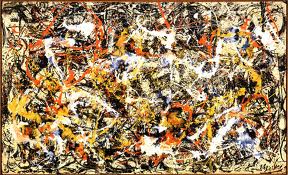
            Jackson Pollock, in his time, was lauded by the critic Clement Greenberg as, “the most powerful painter in contemporary America.”  But he couldn’t sell a painting, never evolved past the drip-phase, and “… one night he arrives drunk at Peggy Guggenheim’s house during a party for a lot of swell people.  So he takes off his clothes in another room and comes walking into the living room stark naked and urinates in the fireplace (Wolf, 57).”  I kind of love him for that.

            Within Pollock’s personal values also lies the art that cannot be understood without the theories that go with it.  Otherwise you might just look at his work and think, “Well, his mind must have been a mess.”  Which leads us back to where realism left off.  “Modern art has become completely literary: the paintings and other works exist only to illustrate the text (Wolfe, 5).” 

The difference is that in twentieth century art, only a very small group knew the text behind the art – the artists themselves and a small group of collectors.  But in realism we all have the text to bring to the art – realism is all-inclusive.  This is why it’s so hard to sell abstract art.  “They will always prefer realistic art instead – as long as someone in authority assures them that it is (a) new, and (b) not realistic (Wolfe, 65).” 

            I usually have no money to my name.  But I am still often driven to buy art, and will find a way (layaway plans) if I love something enough.  Great art tells a story that you can get lost in.  This is timeless.  The same goes for literature.  I’ve never liked Hemingway because he is an abstract writer.  He only puts ten percent of the story onto the page.  It reads so dry and empty – whereas his personal letters were full and rich and honest and true, as he would put it. 

            After all the Abstract Expressionism came the relief of Pop Art.  Art was fun again.  The paintings still had the same flatness of abstract art but with recognizable images from everyday life – American flags, soup cans, comic books, celebrities.  Collectors bought it up and who was more cutting edge or as obsessed with the rich than Andy Warhol?  His work was new, and not quite completely realistic.  The Bourgeois ate him up with a silver spoon.


The Rape Propaganda of the Nineties

            Remember the nineties when rape and sexual harassment were everywhere?  There were all those televised court cases such as Clarence Thomas and Anita Hill.  In Modern Novel class in college, every book we read had a rape scene in the first chapter.  Wherever you turned, there was some outrage over the untamable impulses of male sexuality – that evil creature that for one second is the boy next door and in the next is that gang rapist in the fraternity at 3am on a Saturday night.  The problem was that young women grew up thinking that men were evolved spineless teddy bears.  But feminism is no match for nature.

            I’d forgotten about the rape preoccupation until I read Camille Paglia’s collection of essays, Sex, Art, and American Culture.  To be honest, the book is outdated and repetitive.  But Paglia’s voice more than makes up for it and her rich knowledge from ancient history to pop culture is passionate and invigorating.  She loves to tell it like it is.  “American feminism has a man problem.  The beaming Betty Crocker’s, hangdog dowdies, and parochial prudes who call themselves feminists want men to be like women.  They fear and despise the masculine.  The academic feminists think their nerdy bookworm husbands are the ideal model of manhood (Paglia, 5).” 

Paglia embraces nature and our natural impulses to understand why we behave the way we do.  When it comes to survival in nature, you must always be aware. “Feminism keeps saying the sexes are the same.  It keeps telling women they can do anything, go anywhere, say anything, wear anything.  No, they can’t.  Women will always be in sexual danger (Paglia, 50).”

            I still hate admitting that this is true, even though I have learned from many bad experiences that it is.  And of course, Paglia tends to contradict this statement as well.  I’ve been mugged, and more humorous than scary, once I was on my way home from work in my sweats and a guy in an SUV from the suburbs mistook me for a prostitute.  He asked me how much for a blow job, and was embarrassed when I rounded the corner and entered my building.  But it still left me shaken, because he was following me in his car.

            Most recently, I was walking home from dinner and on a street corner a man asked me the time.  “10pm,” I said.  The light changed and I started walking.  He followed me for six blocks – up the bridge, over the freeway, through the dark foliage of the side streets.  My heart was pounding as I felt his presence behind me, keeping close watch on his shadow.  Then he said something, which I couldn’t hear.  I turned and snapped, “What?” 

He goes, “How would you like me to rub my penis up on you?”

“Fuck off!” I yelled, “Do you want my husband to come down here and fuck you up?  You need to respect women!”  I shook my finger at him, inflamed.

Immediately he stepped back four feet, struck by the sheer force of my anger.  He held his hands up in surrender.  Just at that point, I reached the well-lit entrance of my building where my neighbors were in the lobby getting their mail.  My hands were shaking, “That guy was disgusting.”

“Welcome to the neighborhood,” they cheerfully replied.  I tried to keep myself composed as we rode up the elevator, but as soon as I was inside my door, I melted onto the floor and lost it.  In a rage my husband ran down to the car, circling the neighborhood to find the guy – someone who could be almost impossible to recognize, slipping in and out of shadows, a faceless loner in the night.

Feminism’s biggest mistake was in denying nature, history, and the archetypes of our mythology.  Utopia doesn’t exist, and we live in a world of risk.

At some point in his journey towards maturity, the average man will reject his mother and his dependence on women.  He will join the pack mentality in a rite of passage and succumb to his most basic nature, the nature that society tries it’s best to refine and suppress.  But when a man relies on assault to overtake a woman, he becomes a pathetic figure, weak and inept, revealing all of his vulnerability as a man.  If you need to take something by force, then you will never really have it at all.

So why did the rape and sexual harassment propaganda get out of control in the nineties?  “The theatrics of public rage over date rape are their way of restoring the old sexual rules that were shattered by my generation (Paglia, 52).”  It always scares me when women want to return to an infantile, protected structure lacking in freedom.  In the end, I don’t see that this preoccupation with fear won out.  The young twenty-something women of today don’t remember a time when they weren’t equals.  Overall, they seem to be well informed, prepared and strong.

I relate to Paglia’s warrior mentality, “Rape does not destroy you forever.  It’s like getting beaten up.  Men get beaten up all the time…  If it is a totally devastating psychological experience for a woman, then she doesn’t have a proper attitude toward sex (Paglia, 64-65).”  I have experienced sexual violence, and I would have to agree with this.  It was physically and emotionally painful, and it came from the pain my attacker had suppressed.  That is the way of nature.  A pain-free world does not exist.  We must all be trained to fight, to be fit, ready for what comes.  But through it all – take the risk of being open and free to all human experience.  Lacking in fear – but full of awareness.


A Real Live Girl

            For a while, last summer, I made a good attempt at going to book readings at Elliott Bay Book Company.  I like to study what authors do in their readings, how they present themselves, what sorts of people show up besides the two old ladies who sit up front and knit sweaters with their bifocals on.  Unlike the two knitters, I could only make myself go if I actually wanted to buy the book.  And this fall there has been little to draw me in.  I’m not much for all the cozy historical fiction and ‘we are the world’ multicultural fare.  I realize what really excites me is a thought provoking memoir.  Nothing ever seems stranger than the truth and I like to experience the author’s process of release.  When we write down our stories, we are finally able to let them go.
I went to see Sheila McClear give a reading for her debut book and memoir – The Last of the Live Nude Girls.  She looked stunning with none of the visual queues of an ex-stripper.  Tall, slim, and flat chested, she had the same body type as I do but with much better legs.  She wore a white shift dress that reminded me of the Jetsons with a zipper going all the way down the front.  Her tall tan wedges and long feather earring added contrast to her choppy asymmetric haircut.

The interesting thing about this reading was that I was seeing someone comparable to myself.  My age, first book, sexual subject matter.  I related to her intensely before she even opened her mouth.

There were not enough people in the audience, maybe five or six.  I sensed her embarrassment over this.  She told the organizer the book had gotten great reviews in New York, but she was having trouble garnering interest outside of the city since it was a memoir about working in the Live Girl Peep shows of Times Square.

She began the reading, and all I could feel was how awkward she felt.  It was impossible to tell if the book was any good by the nervous way she read her work.  I thought to myself, at least I’ve had a lot of stage experience for when it comes time to do my own readings.  But then I remembered she had been onstage too.

After the brief reading, she took a few questions.  One man in the back asked, “So why do you think Peep shows have gone out of popularity?”  She didn’t really have an answer, and neither did we.  They just seem like a thing of the past in an era of lap dances.  Left behind with the unsanitary version of Times Square, before it became a Disneyfied family attraction.

I began to feel nervous as I always do when getting a book signed by an author.  Racking my brain for something good to say.  Apparently authors feel the same way, because almost always they compliment me on an article of clothing I’m wearing – a coat or a hat as though this is written in some book promotion guide for writers.

“Awesome reading,” I said abruptly.  She signed the book, “8/25/11 Hi Lauren!  Thanks for coming to see a live girl in Seattle!  XXXO, Sheila McClear”

I thought it was clever.  I liked her, and I desperately hoped I would like her book too.  It was a great read and I couldn’t put it down.  But I felt it could have used a better editor, and that her experience had needed more time for processing.

I am still contemplating how exactly she was drawn into the live shows.  I understand the giant leaps we introverts sometimes take to overcome our shyness.  I also understand just how easily New York can suck you up and spit you out.  Look at me, after three years in New York I had to give up because I couldn’t find a job that paid as much as the first lucky find I’d had.  There is still always the thought in the back of my head that I could’ve made it if I’d just tried harder.  Why hadn’t my tenacity kicked in a little more?  But the sheer force of home drew me back.

In those last few months in New York, I had a friend.  We met through a man we had both been involved with.  Originally she taught English as a second language.  But over ten years prior, our mutual ex-lover had come along and she decided to show him how much he hurt her by working as a prostitute in a fake tanning parlor.  I’m sure it didn’t phase him at all, but now she was running a brothel out of her apartment in the West Village.  It seemed her main motive in being my friend was to convince me to come work for her.  She couldn’t accept that I wouldn’t.  I couldn’t accept that she only saw me as a commodity.

“My Dad can help me out this month, “ I always told her.  I was the only person I knew of who didn’t have a jackass for a Dad.  Cliché as it is, maybe my rejection of sex work partially stems from that.  Why didn’t I do it?  I still wonder.  Reasons why – I hate living a double life and had already done enough in that regard.  I could disappoint my parents by being who I am (aka not a Christian), but I couldn’t abuse them with the knowledge that all the money they’d spent for my education, all the love they’d given me would be in vain since I would be the antithesis of the strong person they raised.  It was also personal.  I didn’t want to end up hating men.  But would it have come to that?  Who can know?

All I saw was that my friend was hugely depressed and didn’t seem to know it.  She resented people for everything they took from her, though she offered them everything.  And towards the end she was ridiculously flaky.  I got off the Path train to meet her for coffee.  “Oh Lauren, I’m so sorry.  A client just called and is only in town for the day.  I’m meeting him at his room at the W.  I can’t make it.  But please come!  I still want you to sit in on a session and just observe to see what you think.  He’ll pay you $300.  And then you can see if you’d like it.”

“Oh no, that’s okay.  I’ll see you another time.”  But I never heard from her again.  She gave up on me.  I found it bizarre that men paid for her – she looked like a stressed out housewife with long scraggly brown hair and a deep worry crease between her eyebrows.  I guess she made men feel safe.

Years later in Seattle I briefly saw her leaving a bar in belltown, getting into a limo with a big group of black guys.  It happened so fast, walking past her in that tight hall as I came through the door; she seemed like a mirage.  Her entire life is like a mirage – appearing here and there in different cities, sitting beneath the law, fading from people’s lives before they ever get too close.

Her loneliness had weighed me down.  Her money weighed me down too.  I was too broke to afford the cabs and expensive restaurants she wanted to eat at.  She probably held that against me.

“Things like sex and nudity were supposed to be imbued with meaning.  But isolated from a relationship, they meant nothing – or rather, I realize now, they became something to be negotiated, and I became nothing – little more than a dress-up doll for them to project their narratives onto (McClear, 22).”

One night at this friend’s apartment I met a woman who worked for her.  She was getting a divorce, her husband had cheated on her, and she had two kids.  She liked sex work almost too much and was lonely enough to find solace in it.  Tall, blonde and bare-breasted, she spread her expensive lingerie across the kitchen table, deciding which lacy silky thing she would wear for her client.  I didn’t realize that business would be in session while I was there, but I decided to roll with it.

It was supposed to be a forty-minute session, but she wouldn’t stop talking to the guy afterwards.  They were in a front room blocked off from the back of the apartment.  We had to be quiet in the back.  But I had to leave.  It was midnight, and I wanted to catch the next train that only came every half hour late at night.  Against my friend’s wishes, I busted a move for the front door.  It jammed and just then the John walked out into the hall.  I saw his look of astonishment as she shoved him back into the room until I could get out.  What had I been doing there anyway?  Out on the street I breathed in the cold air, with every step feeling further away from that heavy, alternate reality.

“That’s what I was learning from New York: you could fit in anywhere if you hung around long enough (McClear, 201).”

In the book, Sheila finally escapes her peep show life and finds work as a writer with enough love, acupuncture and therapy to begin to heal.  But how can you begin to shake off all of those faceless men who make you what they want you to be, or the fellow live girls who disappear into the ether or turn into over-sexualized plastic deformities?

“There was a moment, after every show, after the light abruptly snapped and the glass fogged to opacity, when I could suddenly see my reflection: naked and alone, untouchable, on display like a zoo animal, suspended behind glass (McClear, 45).”


How We Perceive Nudity

In my evolution of what I like to call “Gypsy Jobs” my latest addition is working as a model for the art school up the hill. I have always had a fascination with Bohemian Paris, artists and their muses, Kiki de Montparnasse. So after several months of thinking about it, I finally brought in my application.

On my first day I had two back-to-back three-hour classes. Bright and early that morning, when I usually wake up, I began with an open studio, monitored by a student. There is always that initial funny feeling when you first take off your robe, like here goes nothing. They started with 10 one minute poses, then 5 ten minute poses, and 2 twenty minute poses. During the longer poses I began to hallucinate. I was staring at a speck on the blanket covering the stage. The speck started to move. I was convinced it had come to life as a bug. In the next class, I stared out the window at a tree and soon I was a heron flying through the large open center of its branches.

I didn’t feel awkward once I was on the stage, only when I was waiting to go on. The pain however was another thing. By the end of twenty minutes, even in a basic standing pose, my feet fell asleep and my legs felt stuck when I was finally able to move. I realized you can’t rest your weight on one straight leg or else you’ll hyperextend and cause an injury. Even though it’s less striking, I’ve learned to always keep both knees slightly bent.

I’ve gotten a lot of compliments since then on my stillness as a model. Having an active mind saves me. I focus on a point, do breathing-exercises to work through the pain, and then distract myself by thinking of interesting memories or ideas for my writing. Now that I model two to four times a week, it feels completely natural, and I forget that I’m not wearing any clothes. It actually feels cozy.

Last week at a long pose session I walked through the class to see their interpretations. In the drawings my weight ranged from 110 to 160. One woman was drawn to the more Rubenesque, and said she tends to draw what she is working with, as in her own body type. The men drew me much thinner than the women. I thought of our differing perceptions – how women put themselves in the females position, and men see women with rose-colored glasses.

The experience of posing got me thinking about how we interpret nudity in our society. Years ago my friend took two of us girls to a nude beach in New Jersey. It was a gorgeous place. I found it beautiful that people of all ages, shapes, and sizes were completely out there. I swam topless and hung out with an older guy in the waves, having fun. Later on at a restaurant I saw him again with his clothes on and had to look twice. He looked like a Senator or an Investment Banker, though I’d had no way to interpret him without his clothes. Now we were back in our hierarchies and I wanted to go back to the beach where we were all equals.

I had a phase when I lived in Hoboken, where I’d drink so much gin I became inspired to take off all my clothes in the confines of my apartment with friends. I guess I liked the feeling of absolute freedom. But the guys interpreted it to mean that I was ready to go. Climb on in or take a number and come back another day. I look back on my own spontaneity in amazement – a desperate need for an adrenaline rush. And it is interesting how nudity outside of the confines of an art class, a nude beach or a hospital is interpreted as sexual. But nudity is much more nuanced than that. Nudity also brings to mind our own mortality, our equality as human beings, the mystery of existence, anatomy, art, beauty, the poetry of motion and form.

Friends and family may not quite understand my job or how I can feel comfortable without clothes. My mother still asks my husband, “Are you okay with this?” But for the first time in years I am enjoying a job and looking forward to going to work. I get to learn more about something I love – art, and be in an academic environment with enormously talented people. I take romantic walks afterwards, feeling poetic, drinking coffee and eating crepes with enough time left in the day to write for a while before dinner. When I’m not at the school, I’m thinking about the next time I get to be there, creating new poses for the students.

It’s an instance where life led me to two books. The Nude Female Figure and The Nude Figure by Mark Edward Smith. They are both visual references for the artist working without a model. I am learning the range of the human form, thinking of ways to inspire the artists. And now, I find myself returning to the place where I began – painting and drawing figures just as I did when I was a kid and was obsessed with fashion illustration and portraiture.

Artists of all ages are honored to be able to work from a live model and respect the opportunity. I get the sense that they are grateful for the model’s bravery. And in the stillness of a pose my mind is in motion, building ideas and images, undisturbed, in perfect meditation.