The Birth Of Frankenstein

I had a dream the other night, that I was one of three siblings.  One sibling had stripped our father of his skin to see how we are made.  He was laid out on a gurney, and we looked at the red layers of muscle, studying how they fold and overlap.

Our father was invincible and extremely angry.  Maybe it was the process we had put him through, or maybe he was that way before, but he was insane and out to get us.  Wherever we went, he followed – all over the world.  We were on the run, and the situation was dire.  We couldn’t kill the father, because the father was within all of us.  But he was out to destroy what he had made.

You could make some religious allusions to all of this symbolism, or you could say that this is nature.  I did not play myself in the dream, and the father and siblings were not my own.

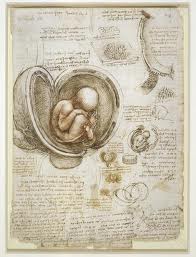
The imagery stems from a slide show that Camille Paglia displayed in her talk last week at the library, of Leonardo Da Vinci’s private notebooks.  In it, he studied the structure of muscles, and a fetus inside a dissected womb.  If anyone had found out, at the time, that he was dissecting cadavers, the church would have severely punished him for it, maybe even put him to death.  The drawings give us a sense that he is looking at things he should not be seeing.

This week, I read Frankenstein, by Mary Shelley.  I love her for being such an emancipated woman, born to radical parents in 1797.  Frankenstein is not my kind of book.  I only read it because it was on a list of the greatest books ever written, and it’s so obviously influenced our culture, where science (or philosophy as it was called in Shelley’s day) can go too far, producing something gruesome and disastrous.

“So much has been done, exclaimed the soul of Frankenstein – more, far more, will I achieve; treading in the steps already marked.  I will pioneer a new way, explore unknown powers, and unfold to the world the deepest mysteries of creation (Shelly, 33).”

But once Frankenstein achieves his obsession, he is horrified as the creature takes its first breath.  He realizes his mistake and deserts the monster.  But after a series of murders of all those closest to Frankenstein, the creature gets a chance to tell his story.  He began his life with love, but everyone he met hated and reviled him, turning his pain into a need for revenge.

Around the time that the novel was written, Mary had lost her first baby and had just given birth to a second, named William.  Her half-sister committed suicide, and her partner, Percy Shelley, still had a wife who drowned herself in the Serpentine.  Mary then lost a third child.  After the novel was finished, she lost her son William, gave birth to Percy Florence who survived, and had a dangerous miscarriage after that.  In the summer of 1822, Percy, her partner, drowned with two friends in a storm off the coast of Pisa.  The badly decomposed bodies were burned, but Percy’s heart was removed and eventually buried in Rome.  Mary was only twenty-five.
Reading her story in the introduction was much more horrific than the ghost story she wrote while summering with Percy and Lord Byron.  The natural reaction, especially with losing a child, is to think at first that they will come back to life.

I edited a novel once, where a mother lost her baby and couldn’t let go of the little corpse.  It had to be pried away from her.  The writer was Australian, and was certain that American audiences wouldn’t be able to handle it, since in our culture we choose to be so far removed from death and dying.

Becoming a mother is to also face the possibility of ultimate loss – the chance of miscarriage, the chance of failing to protect your child from a world that is full of struggle, disease, and danger.  For Shelley, bringing a corpse-like creature to life is the ultimate revenge against nature that takes away.

My strange dream of the father stripped of his skin reminds me of seeing the Bodies Exhibit.  All those parts that make a whole, the muscles and organs frozen in time, not quite life-like in their preserved state, but disturbing because they were alive once, now frozen in space, dead, and there for our voyeuristic fascination.

In an art class, the students were told to spend twenty minutes drawing my head, and twenty minutes drawing a skull placed directly behind me.  They moved in a circle alternating between death and life.  For some reason, that day, all the students drew me to look much older than I am.  I looked decrepit, as they over-emphasized the sagging lines of my face.  I wished I had never looked.

I have reached that age, my thirties, where you begin to realize that you’re never going backwards.   The physical body has changed its chemistry completely.  I’ll never be tiny and thin again, my metabolism has slowed down, my liver throws back all the toxins I send its way, my immune system is sensitive to any disturbance.

But beyond my body, I’ve grown much stronger.  My spirit feels invincible, unbreakable, my sense of discipline is becoming as solid as a rock, and nothing but my body slowly breaking down, could ever stop me at this point.  It’s not quite as much fun as being young, dumb, and out of control, but this is the season for building my life.  Knowing how quickly it all passes, I push harder each day to express in words and art the things that make us feel alive and well.

My Life As An Art Model

You may remember that I wrote a post a while back about making my living as an Art Model.  I’ve been modeling now for the past eighteen months, and I actually receive more work than I can handle.  It’s strange that all of my previous jobs gave me anxiety, but for some reason being naked on a stage in front of twenty people totally relaxes me.  I feel safe up there, in the artist’s appreciation and quiet meditation on the human form.

Last Sunday night I went to my first studio as an artist.  I actually felt nervous to be crossing over to the other side.  Drawing was an awkward struggle, and I wanted to loosen up my hand.  The model was beautiful, and it was torture attempting to draw her perfect lines.  She is much shorter and curvier than I am, so it was difficult for me to get her proportions just right.  But now, I am hooked.

In high school and early college, I thought that I would be an artist.  I was selling paintings and winning contests, and the head of the art department was upset when I decided not to major in art.  I thought the fashion business could be a more dependable income, but the industry wasn’t for me.  Instead, writing chose me, and since college, I’ve worked to support my craft.  But I’ve never stopped doing little art projects here and there.

As an Art Model, I rarely meet people outside of the art world that can really comprehend what I do.  The job makes my family slightly uncomfortable, and they don’t want to see the art that comes out of my collaboration with the artist, at least not the figure studies.  My dad even just asked me, “Are you still doing that?”  This after I told him that I’m booked solid through January.

At a party last summer I told an acquaintance that figure artists are often able to sell their work to wineries since wineries want to be aligned with European tastes.  The woman replied, “Oh great, then your friends will see you naked!”

If that bothered me, I wouldn’t be doing this.  Most funny, is that she tends to hang out with the sex-positive crowd, and you would think she would be more relaxed.

My liberal friend from my conservative college days responded by saying, “Oh, I see you’re still objectifying yourself.”

It gave me meditation on the word ‘objectify’ – a word that does not take place within, but without, a choice of the viewer, and not the viewed.

 Definition of OBJECTIFY

1: to treat as an object or cause to have objective reality

2: to give expression to (as an abstract notion, feeling, or ideal) in a form that can be experienced by others <it is the essence of the fairy tale to objectify differing facets of the child’s emotional experience — John Updike>

I could never objectify myself since it would be impossible to experience my own self as an object.  I am within, not without.  It is the viewer’s benefit to see the human form as an object.  In their study they can come to a greater understanding of our own structure.  Not just physically, but spiritually, emotionally, mentally.

People also don’t realize I actually make money as an Art Model.  They see it as a funny little hobby.  They always assume that because I’m a wife without a traditional job, I’m just gadding about, living off my husband’s income.  Besides food and housing, we don’t share our money.  Modeling pays my bills.

I love being an Art Model for the feeling of collaboration.  I love that I see it from both angles as a model and an artist.  I love the unknown – the moments where an artist’s work blows me away or surprises me, or when they see a person that I don’t look like at all.

“’Thereness’ follows nothingness.  It is impossible to premeditate.  It is to do with the collaboration of the sitter, …  but also to do with the disappearance of the sitter the moment the image emerges (Berger, 78).”

In John Berger’s book “The Shape of a Pocket,” he meditates on art and different artists throughout history.  But it was his discussion on the mystery of the model that most fascinated me, whether the model is a building, an object, or a person.

“The ‘sitter’ is at first here and now.  Then she disappears and (sometimes) comes back there, inseparable from every mark on the painting.

After she has ‘disappeared’ a drawing or two are the only clues about where she may have gone.  And of course, sometimes they’re not enough, and she never comes back (Berger, 80-81).”

An artist I work for said that she felt invisible when she stopped modeling.  I think I began modeling for the same exact reason.  I can’t say that now I feel seen, because much of what there is to see is within.  Sometimes people see that, sometimes they don’t.  But I see my body differently than I did before.  There is no shame in it, no discomfort.  I see it as an instrument.  I train it to be strong in the pose.  I sink into the physical pain for long periods of time, and travel through my thoughts.  Then eventually I come back again, and slip into my robe.

Works of art stay within my mind for years.  If I love them, I never forget them.  Sometimes I even think about how I can recreate them.  I dream about the works.  They become a part of my subconciousness.  They can even change my life.  These images go way beyond what anyone in the media can toss up on us.

“…  the media surround people with faces.  The faces harangue ceaselessly by provoking envy, new appetites, ambition or, occasionally, pity combined with a sense of impotence (Berger, 58).”

Art doesn’t speak as much as it feels, unless, of course, it’s propaganda.

Watching those who are adept with the charcoal, capturing every single muscle as though they have been trained by Leonardo Da Vinci, gives me strength to go on feeling clumsy and awkward until there is some kind of breakthrough.

“Real drawing is a constant question, is a clumsiness, which is a form of hospitality towards what is being drawn.  And, such hospitality once offered, the collaboration may sometimes begin (Berger, 75).”

It is a pleasure to be clumsy as an artist, and graceful as a model.  The two balance each other out.

My problem with past jobs was the same exact problem with the media.  I always felt harangued, pitied, made to feel envious, impotent.  But as an Art Model, I can just be.  No one is asking more of me than my perfect stillness.  While the timer is ticking, I solve all of my problems, envision plans, come up with titles and new writing ideas, and sometimes let my emotions fall into a song playing on the stereo.  While somewhere off in the distance, artists struggle along over the lines of my body and the colors of my form.


The Scent of the Circus

I just finished reading My Apprenticeships, by Colette – the French novelist and performer born in 1873, most famous for the novel Gigi.  My love for the writing of Colette has always felt like a guilty pleasure – like intensely dark chocolate, a red bouduior drenched in velvet, or my new perfume Black Afgano, a hypnotic blend of hashish and tobacco.  I slip into Colette’s books and fall away from distraction – finding complete understanding of all that I have left behind to be with her.

My Apprenticeships is a memoir of Colette’s young adulthood as a country girl, new in Paris, and married to M. Willy – an older man who had a knack for publishing and self-promotion.  M. Willy asked her to write stories based on her days in boarding school with a few titillating bits thrown in.  He eventually published them under his own name, and the Claudine series became so popular that every girl in Paris wanted to look just like Claudine.  But Colette received none of the credit, or the proceeds.

“Love comes disguised as a thunderbolt and often vanishes at the same pace (Colette, 103).”

The problem with M. Willy was that he was in love with his own power over oblivious doe-eyed youth – the minute Colette began to near thirty, with success in the theater as an actress, he was done with her.  He suggested a different kind of life, and by different, she understood that he was asking her to leave.

“How old was I?  Twenty-nine, thirty? – the age when life musters and arrays the forces that make for duration, the age that gives strength to resist disease, the age when you can no longer die for anyone, or because of anyone.  Thirty already – and already that hardening which I would compare to the crust that lime-springs form, dripping slowly (Colette, 101).”

Before M. Willy’s suggestion of a different kind of life, a woman offered Colette a traveling show with thirteen trained greyhounds.

“I have forgotten the name of the envoy who let fall this balm, this dew, this temptation, this breath of the high-road, this scent of the circus.  I shrugged my shoulders and refused even to see the thirteen greyhounds.  Thirteen greyhounds, their fabulous necks outstretched, the curve of their bellies drinking in the air.  And thirteen hearts to conquer.  Disquiet, anxiety.  It was all very well for me to shrink back into my scribe’s virtue, my familiar, faithful fear, anxiety remained, working within me, for me.  Thirteen greyhounds, a rampart, a family, a home.  How did I ever let them go (Colette, 122)?”

Just as I am, Colette was a complete nomad and a solitary homebody at the same time.  She was theatrical (No matter how many times I turn my back on it, there are always new ways to be on the stage).  She never had many female friends (women blow in and out of my life like the breeze).  She lacks sentiment, or any idealistic tripe, and yet, her writing revolves around love – realistic love rather than fake, idealized love.

For a long time I worked for the circus.  Unfortunately, there was no act with thirteen glorious greyhounds.  As suited to my homebody needs, it was a circus that doesn’t travel – they just change shows every four months to create a different theme on the same variation.  Teatro Zinzanni – a dinner theater involving vaudeville acts, an opera singer, a chanteuse, acrobats, trapeze artists, aerialists, jugglers, and lots of sequins.

The tent is one hundred years old, and imported from Europe.  You get the sense that Colette could have performed there.  Table 13 is haunted, and the guests that sit there always behave in a ridiculous way and leave feeling dissatisfied somehow.  Sometimes in the back hall, the chairs flip themselves off the hooks on the wall.  At night, after the show is over, one lamp is left lit on the stage to keep the bad spirits away – it’s an old circus theater tradition.

To be in the tent after everyone is gone late at night, is more intense even than the spectacularly glitzy show.  The quiet is strange because you still hear the sounds in the air – forks clinking, voices singing, the announcer bellowing, the instruments swooping music to the swinging people in the air.  The tent holds an enormous amount of energy.  Every night 268 people are served their food simultaneously.  Within five minutes they all have their plates.  Every entrée somehow always tastes the same, no matter what it is.  It tastes like it’s been in a heating box for hours.

At the circus, I worked as a dancing server.  Every night I crammed into a small mirrored-dressing room with ten other girls who had beautiful bodies and very loud mouths.  We applied our liquid eyeliner, tons of rouge and bright matte lipstick.  We swapped fishnets (this weird extreme version that are so strong they leave dents in your legs, but are not quite strong enough to withstand the abuse that we put them through).  The girls gossiped, sang at the top of their lungs, and swapped stories about auditions, boys, and crappy day jobs.  Being quiet, I always felt like I was on the outside looking in.  The loudmouths had their own club, and the quiet ones had secrets shared backstage when everyone else couldn’t hear.

99 percent of the performers were introverts when offstage.  They were from all over the world, and the one thing that stood out, was how lonely they all were.  Well, except for the performers that lived in Seattle.  As for the international stars – the more beautiful, ethereal, and otherworldly they were, the more alone they seemed to feel.  They never stopped traveling from circus tent to circus tent, wherever they could find them, throughout the world.  Marriages didn’t last, unless the partners were in an act together, or always in the same show.

The servers looked up to the performers with adoration and jealousy.  Almost all of the servers were actors or musicians.  We presented the performers like diamonds every night, while we were relegated to the periphery of the tent with brief food-baring dances at the center.  We were scolded whenever we accidentally stepped into the performer’s spotlight, or tripped into their path.

Every Sunday night to make up for it, we all went to sing karaoke down the street.  We needed that moment in the limelight to refuel our egos.  One night, we found ourselves up against the cast of Hello Dolly, and surprisingly, we put them in the dust with our singing skills and audience lust.

Besides being told every now and then that I needed to “sparkle more” or that my tickets were “too perfect,” I suppose I wasn’t so bad at being a server at Teatro Zinzanni.  Five nights a week, sometimes more, I was there doing the exact same repetition every night.  The circus began to feel like a broken record, a loop that could suck me into the vortex.  I had tendinitis from carrying too many plates, and my back was always a mess.  Without fail, just before we opened the curtains to let the guests into the tent, I had anxiety attacks – dizzy and nauseous, like I was about to pass out.

Work came home with me too.  The same workmares haunted me over and over in my sleep – flashing lights, lurid faces, and some terrible obstacle course to get to my tables.  In general, the same cluster-fuck that I lived every single shift.

Now when I see my past coworkers from TZ, I am always impressed by their extreme energy.  I wonder if it’s the tent that gave them that tenacity, or if they would just naturally be that way if they had not worked there.  Being around greatness makes you strive to be great as well.  No one wants to be that server in the wings, and if you don’t get out eventually, you languish there until you are too old to “sparkle” anymore.

It’s obvious that the theater added to Colette’s greatness as a writer.  In the theater she studied people and places, traveled, and gained admirers.  She became a ravishing woman in that circle of activity.

In one of my favorite scenes from My Apprenticeships, Colette meets Mata Hari, and relays what a fake she thought she was.

“The people who fell into such dithyrambic raptures and wrote so ecstatically of Mata Hari’s person and talents must be wondering now what collective delusion possessed them…  the colour of her skin was disconcerting, no longer brown and luscious as it had been by artificial light but a dubious, uneven purple…  (Mata Hari) did not move a muscle as the voice of Lady W________ rose beside us, saying in clear, plain words:

“She an Oriental?  Don’t be silly!  Hamburg or Rotterdam, or possibly Berlin (Colette, 129-130).””

Teatro Zinzanni was exactly like Mata Hari.  For a while I was in love with the fantasy life.  On rainy, depressing days I could escape into the lights and forget my own life.  But then the cracks began to show – the constant stench of body odor backstage and non-stop febreze spray in the pits of our costumes, the guy who refused to pay on New Years Eve, the way we all had to fake it every night of our lives, the way I had no life outside of the tent, and how the rest of the world began to feel distant and strange, like it was passing me by and I was missing it.

On my bookshelves, there are fifteen books by Colette.  I stumbled onto them in chance meetings in bookshops.  Some are almost impossible to find.  My favorite (and her favorite as well) is The Pure and the Impure – a dark foray into the erotic underworlds of Paris.  There is really no plot, just character after character swimming in their own particular decadence.  When I first read the book, decadence was my tool for self-discovery.  Now I see it as a tool for avoiding pain.  I’m not in pain anymore, so I don’t’ really need decadence, at least, not all that much of it.

Colette understood life, unflinchingly – her writing is poetic because of this.  It’s not the poetry of solitude, but the poetry of human understanding – beautiful life, dark life, art that imitates life, life that always has a new beginning.


Breaking My Erotic Silence

After watching the excellent film The Private Lives of Pippa Lee, I had no choice but to pick up Dalma Heyn’s book, The Erotic Silence of the American Wife.

In the film, Pippa marries a wealthy man thirty years her senior when she is a young runaway living on the edge.  She mutates from being an expressive human being with problems into the stilted and empty role of being the Perfect Wife.  But underneath all of her prim lines, you sense the real Pippa lurking underneath.  She begins sleepwalking, ending up at the min-mart where she buys cigarettes.  And then, out to lunch with her neurotic friend, Pippa begins to combust:

“You could be married to anybody, if that’s what you’re worried about.  Marriage is an act of will.  I mean, I adore Herb, but our marriage functions because we will it to.  If you leave love to hold everything together, you can forget it.  Love comes and goes with the breeze, minute by minute.”

When Dalma Heyn set out to write her book comprised of years worth of interviews with wives who committed adultery, she began with an armload of clichés, stereotypes, and societal views that had nothing to do with the feelings of actual women, their marriages, and their experiences.  The problem that all of these women shared, was that they bought into the ideal of the Perfect Wife – she is selfless, giving, able to predict the needs of everyone else, without ever meeting her own needs.  When these women don’t measure up to this idea of goodness (and no one ever does or should), they constantly feel bad – they are a failure, there is something wrong with them.  In the process, they disconnect completely from themselves and go numb.  They can no longer experience a fulfilling sex life either.  They’ve become what they thought was their husband’s fantasy, but it has nothing to do with them.  They are looking at themselves from the outside in.

“They spoke of a profound awareness that they were somehow no longer themselves, that they weren’t in a relationship but playing a role in one (Heyn, 103)…”

They wonder what became of the sexual outlaw they were before marriage.  Some of the women had not even had premarital sex.  Regardless, women from their twenties to their seventies, and all walks of life, experience adultery as a rebirth of self.  They don’t experience shame or guilt – they experience life, total joy and an uninhibited place to reclaim their authenticity.  They seek out men that have none of the prerequisites that they look for in a husband or even a boyfriend.  They might not even be in love with these men, it doesn’t matter; the experience of total freedom is the same.

The women often have no desire to leave their husbands.  But through the experience of adultery, they understand that they need to change the shape of their marriages, so that at last, their needs can factor into the relationship.  There is no going back to the Perfect Wife.  Some of the women never tell their husbands and fare well, while a large percentage of the women who do tell end up in divorce.  But every marriage is different with different outcomes.

I never thought that I would get married because I loved being single so much.  My sexuality was the ultimate adventure for me.  So sometimes, I wonder, how did I end up married to a man whose sexuality is so vanilla.  He’s turning fifty this year, and though he thinks of having sex all the time, it’s often the last priority.  When it doesn’t feel like a routine, when he isn’t being too sensitive and careful, sex between us is wonderful, but rarely ever dark, or seductive, or unbridled.  Can these things exist in a marriage?  I always thought they could.

When we were dating he struggled to keep up with me.  He stayed up late with me till the early morning hours and we had sex everyday.  He was working three jobs and started to feel the pressure.

Around the same time, I decided to give him a fashion show.  I went into my closet and put on all my old fetish gear – vinyl, thigh-high fishnets, towering platforms.  When I paraded out, he was not aroused by it at all.  He said I was playing the part of someone else.  Maybe it was who I was before he met me, maybe I never was that role to begin with.  It just wasn’t for him.  He wanted me to put on a sleek and elegant dress instead.  I’d never encountered a man who didn’t go crazy over artifice.  For a week after that, he struggled sexually, and then unbeknownst to me, Viagra saved the day.

For him, the two events were unrelated, but after that week, I stopped taking risks.  I started feeling nervous about making him uncomfortable.  I left my kinks behind.  He loves my strength in all facets of our life together.  But he has a puritan side, a clumsy embarrassment over anything out of the ordinary.

The other issue is that he’s not the string bean-types that I used to date.  He’s like one of those massive warriors that you see in movies like 300.  Built like a rock, solid, stocky, with huge hands that don’t know their own strength.  When I told him that I like to be choked, he gave it a try and almost broke my neck.  When he sleeps with his arm across my chest, my ribs begin to feel like they’re crushing under the pressure and I panic, trying desperately to wake myself.  I’m still learning how to live with our differences.

But life is also easier, happier, more content with him.  We can’t get enough of being together – we work together, go out all the time, talk openly about everything, and share our passions.  It’s always fun, even when we’re fighting.  We don’t buy into the term “settling down” like many couples do.  I play the role of the Perfect Wife more for my parents than my husband.  When they show up, everything is clean and dinner is delicious.  When they’re not here, our lives are chaotic and slightly out of control.

I don’t idealize our relationship.  I didn’t marry a man for his status or money.  I married a fellow outlaw, who lives by his own rules, and makes me laugh.  I’m well aware that the future is uncertain.  I’ll be surprised if our marriage survives for the rest of our lives, and I very much hope that it does.  And does that only mean the rest of his life, since I’m so much younger?  I make jokes about being a wealthy old widow, living like a gypsy and on the prowl.  But really, it’s just to make myself feel better about the unknown.

I went through some confusing changes in the process of our growing closer.  Like a rubber band snapping back and forth.  I was caught up in the whirlwind, in the romance in the beginning.  Then after our engagement I rebelled and fought and wanted to leave.  I couldn’t figure out what I was doing.  But on our wedding day, it all made sense.

For a short while, I turned into an old lady, had no real friends, started to compensate for my husband’s reckless, accident-prone nature by being extremely anxious, nervous, overly careful.  At times, the pressure of being a wife overwhelms me.  I’ve often wanted to run back to when my life was more straightforward and simple – when I could just work, do my art, and have sex with random people every now and then.

Sex was self-discovery, mutual-discovery, empathic-discovery.  Married sex is something completely different that I don’t quite understand.  It’s like we need to learn to speak each other’s languages, and haven’t quite gotten there yet.

There is a strange role-reversal where in our relationship I am supposed to be more like the man and he is more like the woman.  He wants to cuddle and be close, and I just want to get laid.  He wants to work up to it for long periods of time, while I get bored waiting.  He wants me to initiate, while I just want to feel wanted.  And yet, he is enormously giving, patient, and selfless – which makes me feel like an impatient, selfish, taker.

No couple is perfect, and somehow our differences balance things out.  My husband is the first man I was ever in a committed relationship with.  I guess I got bored with everything else.  Before we met, I had become an evil heartbreaker.  The ego trip felt nice, but it didn’t feel right to hurt people and feel nothing.  My husband didn’t buy all that crap.  He saw right through it (though he admits to being scared of me at first).  It was good to be seen at last.  Really seen.  It still is.

When I think of other men sexually, I wonder what would be the point, when there’s only one man who lets me be who I really am.  Maybe not the dominatrix side, but every other side.  Everyone else pales in comparison.  Everyone else seems like they’re missing something.  With everyone I dated before, I was never really myself, and was never accepted to begin with.

I am the subject of my husband’s life.  He says that I give his life meaning.  He even took my last name.

Yesterday was our 2nd Anniversary.  I hemmed my wedding dress and surprised him by wearing it on our dinner date, along with my birdcage veil, and my grandmother’s jade necklace.  We talked about our plans for building our future together.  We talked openly and honestly about how we really feel about all of it.  We raved over Sea Urchin, Veal Sweetbreads, Cavatelli with Morels, Chocolate Truffle Cake with Black Cherries.  We even talked about this post, and how our memories are different, and yet the same.

This is the first openly honest thing I’ve ever written about my husband, stripped of all the idealistic tripe.  I’m breaking my erotic silence.

How Belief In God Limits Us

The question we all have as human beings is “what lies beyond our limit?”  We just watched the film Another Earth where humans are faced with the perplexing realization that there is another earth mirroring our own, even another self completely synchronized with us.

In reality, when we come into contact with other people, their inner being transcends us.  They might let us into a few thoughts, but other than that, we will never fully know them.

But to find another replicated self – would we recognize ourselves?  Would that other self transcend us as well, as though we are looking at a stranger?  Would you feel competitive of your other self?  Would you find your other self ugly?  Would you be annoyed by your other self?  Would you love your other self?  Would you tell your other self to get over all their hang-ups and get on with life?

Just as we will never meet our other self, we will never meet our idea of God.  In Gordon D. Kaufman’s book, God The Problem, he states, “If there were no experiences within the world which brought us in this way up against the Limit of our world – if there were no point at which man sensed his finitude – then there would be no justification whatsoever for the use of God-language (Kaufman, 49).”

To embrace what lies beyond the limit, we talk of God in ways that we can understand from our experience of human relationships.

“…God is spoken of as lord, father, judge, king, and he is said to love and hate, to make covenants with his people, to perform “mighty acts,” to be characterized by mercy, forgiveness, faithfulness, patience, wisdom, and the like – all terms drawn from the linguistic region of interpersonal discourse (Kaufman, 62).”

In the Webster’s Dictionary, the word God is defined as “1 cap : the supreme reality; esp : the Being worshiped as the creator of the universe.”

When I say that I do not believe in the existence of God, I am saying that the belief of a creator and a ruler do not measure up in our current state of reality, or even within the context of the past and ancient history.  He was the explanation that existed before we had a scientific explanation, used as a way to interpret people’s experiences.  People desire to make sense of things, but the problem is, God does not make sense.

I am in awe of our cosmic universe, so much so, that I find it impossible for our existence to be so limited by this idea of God.  To me, we are looking too far out into the distance, when the answers all lie within us, within and beyond our massive and destructive home on earth.

“Indeed, we have learned, that it is precisely by excluding reference to such a transcendent agent that we gain genuine knowledge of the order that obtains in nature, are enabled to predict in certain respects the natural course of events, and thus gain a measure of control over it (Kaufman, 120).”

So there is no direct encounter and never will be – no way to interpret God outside of our own imaginings – in which case, God is actually a mirror of our own humanity – full of insecurities, the need for affirmation and praise, the desire to be close to these humans who are always so distant and cold, the desire to have their obedience, to incite dominance, to be in charge, to have control.  Why does God mirror the fickle childishness of a human being?  And if God is the creator, then who created him?  The answer seems obvious – human beings created him.

“When feeling is given a dominant place in shaping the interpretation of reality or the world, a religious world-view results (Kaufman, 214).”

Lately, every time we see my parents, my mother has to make a comment about God’s existence.  God is woven deeply within the fabric of my family.  He is given praise for all the good things.  The universe is over-simplified through Bible stories taken literally.  My mom celebrates the day that she will “go to be with Jesus.”  It’s not by my father’s intelligence and diligence in over forty years of hard work that brought them financial security.  No, it’s God.

The last time I wrote about religion, I was extremely angry for being raised without a choice.  Writing is good therapy, and I’ve come to a new place of peace and acceptance.  I feel released through my own realizations and views on life.  But I’ve also chosen to keep those views separate from my family life.  They have an idea of what I think.  The problem is, no matter how much I bring it up, they will forget it, or write it off by tomorrow.  My mom especially, has selective memory.  She blocks out the things that she can’t handle.  Especially since, according to their belief, I am “lost” – whatever that means.

When I am with my family, I do my utmost to respect them.  You cannot argue with a mind-set, culture, history, or the entire fabric of someone’s life.  They will do anything to shut out conflicting views, to keep the cognitive dissonance at bay.

Family is extremely important to me.  So I hold hands with them when they pray, I smile and say nothing over the Jesus comments, I listen to my nieces simplify the world by stating the Bible as fact.  In the meantime, I hope that as my nieces grow older, they begin to see that life isn’t so cut and dry.

Coming from children, religion makes sense.  But from adults, I expect more.  Sigmund Freud said, “The roots of the need for religion are in the parental complex; the almighty and just God, and kindly Nature, appear to us as grand sublimations of father and mother, or rather, as revivals and restorations of the young child’s idea of them… when at a later date he perceives how truly forlorn and weak he is when confronted with the great forces of life, he feels his condition as he did in childhood, and attempts to deny his own despondency by a regressive revival of the forces which protected his infancy.”

A universe that circulates around our own egos – that sounds like a man-made myth if ever I heard one.  We are all in the struggle of existence whether we like it or not.  We will all one day fall prey to death.  We have no real control.

“May it not be the case, moreover, that the very act of believing in God is in itself morally dubious?  May this not be largely an attempt to avoid taking full responsibility for ourselves and our lives by creating in fantasy a “heavenly father” into whose care we can place ourselves when the facts of life become too unpleasant (Kaufman, 14)?”

I find this over and over in people who dedicate their lives to God.  Life is just too much for them.  They would like to whitewash all the realities that are too painful for them to take.  It’s a coward’s way out.

The older Christians in my life all believe that I will come back around.  They were “wanderers” in their twenties and thirties, and are convinced that by forty or fifty, I will realize that my demise is nearing.  There are too many things I cannot control.  My body will start failing me, or friends will start dying off.  I’ll be faced with the futility of my existence.  I don’t think they understand, that I have already experienced all of those things.

It seems to me, when people leave faith behind, they fail to search beyond faith.  They avoid the question of spirituality altogether.  Then eventually, they inevitably end up going back to what feels comfortable, to what they knew in their youth.

My dad told me, “Never stop searching,” with his hands clasped tightly around my shoulders in a desperate attempt to get through to me.

I replied, “I never will.”  I wish I could please him, and be what he wants me to be, but I have to be myself.  I will never go back to where I came from.  I will move forward and live to the utmost before my body turns to dust.  And believe it or not, I’m okay with that.


For more on this topic:

https://laurenjbarnhart.wordpress.com/2012/01/31/god-against-nature/

https://laurenjbarnhart.wordpress.com/2012/01/02/why-i-stopped-believing-in-god/


Culture Over Color

Zora Neale Hurston’s novel, Their Eyes Were Watching God, is so rich with lyrical prose that I had to read the first page three times before moving on to the next.  She flips back and forth effortlessly between a deep southern African American dialect into literary narration.  I found myself speaking out loud in the tone of her dialogue, just to listen to the way it rolls in and hangs there, like humidity in the calm before a storm.

The plot follows a woman named Janie as she struggles to find herself through imagination, love, and experience.  When the book was first released in 1937, it was attacked for not fitting within the African American protest tradition of the 1930’s.  The lives of Hurston’s characters are rich and varied; not the diminished, victimized culture portrayed in other works of Black fiction at the time.  The main focus is on a woman’s right to life, while race is merely the framework of her culture.

As Henry Louis Gates Jr. puts it in the Afterword, “… the social realism of the thirties, and the cultural nationalism of the Black Arts movement – was the idea that racism had reduced black people to mere ciphers, to beings who only react to omnipresent racial oppression, whose culture is “deprived” where different, and whose psyches are in the main “pathological.”  … Socialists, separatists, and civil rights advocates alike have been devoured by this beast (199).”

This is an idea that shouldn’t, but still does, persist in some ways today.  When I was a poet in New York City, I grew tired of listening to the African American poets perform angry diatribes against racist white people.  At every single reading, it always happened.  Rather than action, it was reaction.  I deal with my own kinds of anger, and I understand how difficult it is to exorcise that as an artist.  A part of the process in expressing anger is to move forward, but it’s easy to get stuck.  By playing the role of the victim, you avoid personal responsibility.  You cannot always blame someone else for your lot in life.  You must take action, no matter the obstacles.

Zora Neale Hurston’s voice is extremely relevant for today.  Rather than fighting for or against race, she celebrates culture, which is something different entirely.  She shows us, that regardless of outside factors, we all search for the same thing – for life, for soul, for the full human experience and the freedom to have it.  She brought more humanity to the Black experience than any of her contemporaries.

Janie is on a search for love from the time she blossoms underneath the pear tree.  “She saw a dust-bearing bee sink into the sanctum of a bloom; the thousand sister-calyxes arch to meet the love embrace and the ecstatic shiver of the tree from root to tiniest branch creaming in every blossom and frothing with delight.  So this was marriage (Hurston, 11)!”

Janie’s grandmother wants her to sit and do nothing – the ultimate achievement for a 2nd generation woman past the time of slavery.  Her grandmother arranges a marriage to an older man who is stingy and has plenty of land, but Janie doesn’t love him.  She escapes with Joe who is on his way to the first all-black town to build a life and community.  But in his efforts to be a successful businessman and mayor of the town, he fails to recognize Janie as a human being and sees her only as the object of his possession.  He desires the ownership he was denied before, from all things and people.  Janie is not allowed a voice, and Joe’s accomplishments (in his mind) serve to make her a great woman.

“…  Ah told you in de very first begginnin’ dat Ah aimed tuh be uh big voice.  You oughta be glad, ‘cause dat makes uh big woman outa you (Hurston, 46)”

At his death, she finally transitions, as Henry Louis Gates Jr. puts it, from “object to subject.”  She is rich with an empty life.  Leaving it all behind means nothing to her if she can have what the pear tree knows every spring.  A young gadabout named Tea Cake sweeps her off her feet.  He loves her, and lets her be exactly who she is.  They go fishing all night, shoot guns, and take off to work “on the muck” all summer long in Florida.  She goes from wearing fancy dresses to overalls, and everyday feels brand new and alive.

But nature is a brute force, and a massive hurricane destroys their new life together.  In the end, it doesn’t matter as much that Janie loses Tea Cake, as much that she experienced what everyone is looking for – love.  She is fulfilled by experience, complete and refined in her own self.  Now, just sitting there doesn’t seem so terrible, when her mind is full of beauty.

“Dey gointuh make ‘miration ‘cause mah love didn’t work lak they love, if dey ever had any.  Then you must tell ‘em dat love ain’t somethin’ lak uh grindstone dat’s de same thing everywhere and do de same thing tuh everything it touch.  Love is lak de sea.  It’s uh movin’ thing, but still and all, it takes its shape from de shore it meets, and it’s different with every shore (Hurston, 191).”

Anyone who dares the world for love can relate to the character of Janie.  I spoke to a poet the other day.  He told me that when he was younger, he didn’t finish his PhD. because he went through a divorce.  But in the process, he fell in love and became a poet.  When I told my husband this, he said to me, “Heartbreak is better for writing poetry than love.”

I replied, “But first you need love to experience heartbreak.”

It’s true that I wrote my best poetry when I was broken.  All of my best poems were inspired by men who could only see me as an object, not a human.  Likewise, I could only see them as my teachers and not my equals.  I was in the chrysalis phase that, Janie as well, took so many years to fly out from.

What I thought was love was only fantasy.  And when you live inside of fantasy, reality is not allowed to exist.  Nighttime is the only time for this sort of love, in the daytime there are too many reminders – that I was an object left behind on the bed for more important things, a side-note, a thing whose roots to the earth must be ignored since mothers and fathers and even friends remind a man that a woman is a subject and not just an object.

Zora Neale Hurston was a prolific writer until she fell into obscurity in the early fifties.  Her work could not be simplified, her ideals could not be categorized, and this made her ambiguous.  She was accused of molesting a 10 year-old boy, though she was in Honduras at the time of the crime.  Still, the charges damaged her career.

She worked as a maid in Florida, and failed at a string of jobs.  Ten years later she died in a welfare home.  She was virtually forgotten until the writer, Alice Walker, wrote an article for Ms. magazine in the early seventies, on how she went in search of Hurston’s unmarked grave to give her the recognition she deserved.  Since then, Hurston’s work has gained popularity and been recognized for its importance.

But her obscure death and eventual poverty are upsetting to me.  I relate to the string of miserable jobs that never work out.  Her financial struggles and the fight against what she wrote in an essay entitled “What White Publishers Won’t Print” demoralized her, and diminished her output.  Hurston did not feel like a human being without pen and paper – the curse and the gift of being a writer.  If you are truly a writer, there is nothing else for you, but to write.  In the end, she did her best to give us the keys to understand ourselves.  I am grateful to Alice Walker, for bringing Hurston’s work back from the dead.


It’s Not Your Genes, It’s The Way They Raised You

It’s hard to remember the first six years of your life, but according to Oliver James in They F*** You Up – How To Survive Family Life, those first years and how our parents relate to us, define us more than genes.

Parents are often limited in their ability to connect with us in all stages, such as the competitive adult who lacks understanding for the fantasy life of a four year old, but strongly relates to the adolescent.  Other parents are short on empathy due to problems with depression or lack of proper care in their own upbringing.

If our parents lacked empathy, were abusive or absent, there’s a very large chance that we will end up struggling with depression, narcissism, or personality disorder.  If those issues aren’t dealt with, we’re at risk for repeating the exact same cycles in our own children.

What our parents value in us and encourage determines to a large extent who we become as people.  From infancy on, we are treated a certain way on the basis of a complex weave within the mind of the parent.  What do we remind them of, do we bring back memories of negative experiences in their own childhood, do we remind them of their own failings.  The cycle repeats itself when we become parents ourselves.

“Each parent treats each child so differently that they might as well have been raised in completely different families (James, 8).”

Though obviously, I can’t remember how I was treated as an infant, the one thing I do know is that my mother does not like babies at all.  She has difficulty relating to them, and is bored until they get to the toddler stage of being able to talk.  She was also unable to breastfeed.  Our Old English Sheep dog, Big Boy, guarded my crib religiously and growled at any unfamiliar person who dared to enter my room.  All through my childhood, I was often much closer to animals than to people.

When I was older I lived at the pool with the girl from next door.  My skin was a dark chocolate, my hair a golden mushroom.  I don’t remember if there was an adult with us.  It was normal back then for small kids to run rampant through the neighborhood without supervision.  My mother hated parks, possibly because it meant she had to talk to the neighbors.

My parents didn’t really interact with me in playtime, and my sister was too old for most of my games.  What I remember is that my mother seemed like an ever-present figure in front of the kitchen sink.  Always washing dishes.  I would look up at her from my spot on the floor, next to the record player, chewing small square ice cubes and listening to children’s albums from the 1950’s.

She always loved us, was always caring, if not strict due to a desire to ingrain us with her beliefs.  But she was a distant, foreign presence until my teens.  My father didn’t really know how to deal with being a dad.  In fact, he is still figuring it out.  As a parent, do you ever stop figuring that out?  Especially since your children are constantly growing, changing, evolving – hopefully.  Once stern and emotionally unavailable, he is now more loving and affectionate than I ever thought possible.

I remember having a fear of using the toilet.  I was afraid that a giant snake would come up the pipes and bite me in the ass.  I washed my hands before flushing, then pressed the lever down and went running, flailing my arms down the hall, certain the snake would get me.  There was also an angry tiger that lived in a massive empty oil tank in the basement.  I could hear him groan within the metal.  I pictured him pacing, muscles flexing beneath his orange and black striped fur.

My sister told me they opened a McDonald’s in Africa, but since they didn’t have cows there, they just used six-foot long worms that they sliced into patties.  She said the patties were kind of rubbery and grey.  I actually believed her, and then held a grudge for years when I realized she’d made it up to prove my gullibility.

I find it lame that some people think children are not sexual creatures, and that you wake up at twelve suddenly aware.  All children are sexual, and their levels of inhibition all depend upon how adults handle their sexual expression.  There was enormous embarrassment around my constant desire to stimulate my genitals.  It was a humiliation for my mother.  I found ways to hide it – hands hidden in pockets, the edge of a chair.

When I was four or five, I was at someone’s house, and a boy pulled me into a bedroom for the classic, “I’ll show you mine if you show me yours.”  With our pants pulled down around our ankles he pointed at my crotch and said, “I can almost see it.  Don’t worry, you’ll grow one soon.”  Suddenly, I felt incomplete.  I was missing something.  But that something looked kind of funny and I didn’t get why it was so important to have one.

I didn’t have a crush on a boy until the first grade.  Below age six, my crushes were on beautiful women, particularly, my preschool teacher.  She carried a Gucci purse, and always wore purple with lots of make-up.  I craved her attention, wanted to be close to her, wanted to be like her.

At four, I was so shy that when people asked me my name all I could say was “Hi”.  For a while, that is what they called me.  “Hi.”  I stuttered and could only speak after literally spitting it out.  From the very beginning, I was behind in school.  Maybe my sister struggled too, but she was an over-achiever.  My parents always treated her with respect, like an adult, while I was always, and still am, the entertaining fuck-up.

“From the moment we gather on Christmas Eve or the day itself, our parents and siblings demand that we enact our appointed role.  Never mind that we may have long since ceased to be the clever one or the fatty, the attention-seeker or the moaner, our family treats us just as they always did and within minutes of walking through the door we are back in the nursery.  The achievements and independence of adulthood are swept away and we find ourselves performing a role that we thought was long obsolete (James, 35).”

Going back a generation, it seems that everyone in my mother’s five child family needs therapy.  “Offspring of families with five or more children are significantly more likely to be delinquent and to suffer mental illness (James, 4).”  My grandmother had depression.  She was not really suited to having so many children, and would have been happier with a career.  She loved fashion, and later in life, liked to write.  But to her children, she lacked empathy and was prone to negative outbursts.  My grandpa was emotionally distant and had trouble expressing affection.  He was reserved and stern – does that sound familiar?

Growing up, my father had very little emotional support.  His mother died when he was three, his grandmother who helped raise him after, died when he was eleven.  His sister ran away from home at fifteen, and his brother died in a car accident at eighteen.  To cope, my grandfather was an alcoholic, and he married a woman who never accepted my father as a son.  So for a long time, my father struggled to emotionally connect with people for fear that he would lose them.  He’s had moments of irrational fear and outbursts, particularly, when I learned how to drive.

Something about the whole environment of repressed feelings has turned me into a fighter for speaking my mind.  When I came to adulthood, I was the first in the family to speak directly and honestly and openly.  It was an enormous shock, I think, for everyone.  When they attempted to close up, or retreat backwards, I kept marching forwards with my banner raised.  Now when an issue lurks beneath the surface, it is always bound to come out at some point, and we are all happier for it, even if my mother blanks out the things that she doesn’t want to remember.

At this stage of my life I have a very healthy, strong relationship with my parents.  I work through the way things were in the past through my writing, and I find understanding and forgiveness for the course we were all on that we really had no control over.  The mind is made up of maps and patterns that can only be broken through vigorous insight and awareness.  My mother can afford a therapist.  I can afford a pen and a pad of paper.

As I think about having a baby, I have become even more aware of breaking negative patterns.  In some ways, I feel prepared because I have already done a lot of work within myself.  I’m looking forward to the possibility of the challenge.  And despite a few hiccups, I’m extremely lucky that, growing up, I had a strong and loving family life, and still do.

Oliver James refers to many studies that have proven genes play much less of a role in us than we have been led to believe.  I appreciate this stance, and have witnessed to a great extent, that we do have the ability to change our reality completely, even working through the deficiencies in our early development that are inevitable no matter how wonderful our parents.

I’ll always be the entertaining fuck-up to my family, and that’s okay with me. But as a result, there is always the feeling that I have to prove someone wrong.  I know within that I am a winner, and I’ll just keep doing what I do regardless of what the rest of the world thinks.  The main thing is – I’m okay with myself.  Once you achieve that, others are okay with you too.


New York State of Mind

Last Sunday, at the bookstore, I saw the name ‘Emily Gould’ in red letters on the spine of a book in the memoir section. I don’t forget the names of editors I worked with briefly as a literary agent. Back then Emily was an editor at Hyperion. She has since worked at Gawker and is now on her own doing freelance. Her memoir, And The Heart Says Whatever, is a snapshot account of her life from college through young adulthood in New York City.

“I felt the vacuum of the empty suburbs surrounding me like a black hole in which my body was suspended, as though I were the only warm alive thing left in the world (Gould, 27).”

After her childhood in the burbs, Emily only lasted one year at Kenyon, a university in the Midwest full of loser frat boys, where women end up objectified or abused. It’s obvious that she does not fit – the same way that I did not fit at small, conservative George Fox University. While all of my roommates were out with their fiancés, I was sitting alone in my bunk bed with a stray cat, eating Chinese take-out and watching old Fellini films. I dreaded the moment when they would return, “What is this crap you’re watching? It doesn’t make any sense!”

Once in the city, Emily pays her way through writing classes with a series of server jobs where she suffers from anxiety. She feels exhausted from performing, leaves her feminism at the door, and puts up with being treated like a dimwit.

My first job in New York was in Soho at an Italian restaurant. The manager wanted me to stand outside to try and draw people in. I was not even a host, and I was not getting paid. Around 9pm, a band started to play, and the manager asked me to sit with some rich businessmen. I have to admit, though he was turning me into some kind of unpaid escort, I enjoyed the conversation, since one man owned the art gallery across the street, and bragged about how he had worked with Andy Warhol.

The manager said I would be serving at another location that was just opening up in the Lower East Side, where my commute would take twice as long. On my first day there, the owner only came upstairs to yell at us then disappeared into the basement for hours.

The other two servers were actors and called me “babe,” in a condescending tone that I found irritating. There were no sections, and they viciously fought for tables. Being the newbie, I had one lone table, and ended up bussing the other 49, spinning in confusion.

When it was time to go, I went downstairs to find the boss. Down a long hallway, he was sitting in a grimy office smoking a joint and counting piles and piles of money. There were at least twenty stacks over six inches high. I’d been in New York for one week, and already I was working for the mafia. I’ve since learned that in Jersey and New York, restaurants are backed by mafia money, while in Seattle they are backed by drug dealers – same thing, different titles.

I walked back to the original location and told the manager that I wanted to work in Soho, but he didn’t have a position for me. It was a good thing. I was the only person there who wasn’t right off the boat, and all the money was under the table with no salary. I was beginning to think that the entire city was outside of the law.

A year later I ran into the manager again at a party thrown by a flamboyant Italian man. At all of his parties, the host hired a model to walk next to him carrying a sign that read, “Stefano Is Here” with an arrow pointing down. The manager was working as the DJ that night, and I had been hired as a dancer with a percussion band that I performed with. We were at a swank restaurant uptown, called Zanzibar, and the party had a tribal theme.

The ex-manager/DJ was completely shocked to see me. I was no longer shell-shocked and outside of my element. In fact, I was getting paid to be the life of the party. Things moved fast in New York, so fast, I can’t believe it all happened.

After a series of serving jobs, Emily Gould found herself working as the Editorial Assistant to a Senior Editor at a publishing house.

“I was realizing that the production of book-shaped products had very little to do with “books,” the holy relics that my college education had been devoted to venerating (Gould, 99).”

Once at the literary agency, I imagined myself taking on literary clients and life-changing books, but I couldn’t halt the constant stream of fluff being thrown at me by my boss or the pressure to find a sale that could meet current trends. I didn’t feel strong enough, or maybe nothing seemed good enough, and everyday was a pressure cooker to make that deal happen.

Being let go was a tremendous relief. For all that time I’d never been able to read my own books, or write my own words. So every morning for the next six months, I was up at 6am to write for an hour outside the coffee shop, with people rushing past me to work. After writing ten pages, I would begrudgingly join them, and go to my shitty job in the city, numbering every single piece of crap artwork that came out of Peter Max’s factory. Like that first restaurant I worked at, only recent immigrants lasted in his exploitation-fest. He was donating millions to charity, and I couldn’t afford to live. But as long as I got that writing in every morning, it seemed okay.

Emily Gould still lives in Brooklyn, and I have to admit, I feel a sense of envy that I am not still in New York too. There is always the sense that I am missing out on something – connections, parties, shows. You can find all that in Seattle too, the problem is that I really haven’t yet.

I also have a theory – that when you leave New York you get slightly weak and introverted because the pressure is finally off. I hadn’t realized how much energy it took. I’ve watched as friend after friend left the city and completely went into reclusive mode. One friend even took to the mountains, and never lasts for more than 24 hours when she comes to visit me. In New York she was a tough, angsty, goth rocker chick in platform boots. Now she is a peaceful hippy, who prefers to live in a yurt, pee in an outhouse, and grow vegetables.

Five years since my move back, I’m teaching myself how to refind my New York energy. I’m remembering that in New York, amidst all the crazy, I learned how to live, how to survive, and how to love exponentially. Not the fake romantic love of adolescence, but real love for all of my friends and my community.

Instead of complaining about how I lost that when I left, I’m now remembering how to be what you wish others would become. And surprisingly, I’m finding what I’ve been looking for. Friendships are flowing naturally, the way they should be. I sense I’m growing closer to the pulsing beat of energy. Life takes a turn, once again.

Traveling Sisterhood

Esther Freud’s novel, Hideous Kinky, is a semi-autobiographical novel of two sisters traveling with their hippy mother through 1960’s Morocco. Freud is the daughter of the famous figurative painter, Lucian Freud, and the granddaughter of Sigmund Freud – a fascinating family rife with details we would all like to know more about, but privacy runs in the family.

The narrator of Hideous Kinky is a four-year-old English girl. Her narration is deceptively simple, leaving the reader to comprehend the complex layers of the story on their own. Mysteries are left untold, such as what they left behind in England, who her father is, and who sends the money. Through the little girl, we are unable to decipher the details of her mother’s love life (though we can surmise), and never know where they are traveling next, or how long they will stay. We feel the confusion and the uncertainty. Time slips away without the basic information needed to succeed back home in England, such as even, how to count.

My emotions over the mother ran the gamut. At times I felt exhilarated that she could live so far off the edge with two little girls in tow. At other times, I felt angry when the girl’s were not receiving education, medical care, food; at one point even spending a day as beggars. Upon their return to England life would seem so regimented in comparison. How would they adjust? But those events take place after the last page.

I’d seen the film before I read the book – and they both have much to offer. One did not ruin the other, as is often the case, though the details of the story differ.

My two nieces are missionary kids. They have been going back and forth between a jungle village in Papua New Guinea, a mission base, and the states all of their lives. Life for them is a constant readjustment. They are flexible and easygoing, because they have to be.

The oldest is very social, relates better to boys than girls, and likes to write fantasy stories (mainly, because she lives one). The youngest is exactly the same as I was at her age – always up in her head, living in imagination, weaving thick plots to escape the boredom of the present, yet a social underdog. However, that was two years ago, and every time I see them, they are different and yet the same.

Now that they are thirteen and ten, childhood is quickly disappearing. They are on the border, where glimpses of the women they will become disarm you completely – vivacious and strong, with lively blue eyes that are full of curiosity.

The oldest is at the stage where her parents and those in her environment are forming strong opinions in her. When they were younger it wasn’t that big of a deal that we have different beliefs. But they are being taught to look down on those who do not believe what they do.

They have always looked up to me. And now, at this stage, I’m afraid of being looked down on. Maybe it’s all in my head. But it isn’t, because I was taught exactly the same thing, and at that age, I looked down on, and judged everything that was “of the world” and “fallen”. I didn’t yet understand life as it really was.

There are cracks in the veneer every now and then. The oldest is now on facebook and she once posted a comment that read something like, “Sometimes it’s hard to believe that there could be another life out there.” I went searching to find it again, but she has since erased it. Don’t we all feel trapped within our parent’s existence until we are free to go?

But for now, my nieces live below the equator, a day ahead of us. When it is summer here, it is winter there. In my neighborhood, it is loud with the noise of people and cars. In the jungle, it is loud with insects, birds, and animals. They navigate difficult terrain over-run with foliage. I navigate cracks in the pavement and annoying people asking for money.

When my oldest niece was a baby she crawled like the natives in the village – with her left knee on the ground, and her right foot walking. She had ringworm from sitting naked on the dirt. I worried over her – but she was completely resilient. It’s the babies that are born there that are really at risk. Many of them don’t even survive birth.

In four weeks, my sister’s family is coming home on furlough and will be in the States until April. When they are gone, I turn off all thoughts of them with the press of an imaginary button. But now, the button is off and I think about their return constantly.

The night before my sister’s wedding, I couldn’t stop crying. As her bridesmaids flitted about, she came into my bedroom to comfort me. It didn’t matter what she said, I knew that I was losing her. She’d found her husband and now all they needed was a distant place to be sent to. A year later they were gone.

They said it was a twenty-year mission, and it’s been sixteen years. As their responsibilities grow, I keep wondering if they’ll ever come back. And how will they cope with life here, without financial supporters, without constant movement, with some sort of steady job that is the same day in and day out?

When we were kids we used to pack our suitcases, hoist everything up on the swing-set, and pretend it was a train that would take us all over the world. It was her favorite game, her escape from boring suburbia.

We have both traveled, escaped conformity, and found an obsession with words – she as a linguist, and me as a writer. But I don’t really know who she is anymore. She never talks. We have only been alone together once in the past sixteen years. We took a walk, and she told me that there are things about my life that she envies, because as a missionary, you have to keep up the façade of minimalism. I told her that I envy her nomadic existence.

When I was a teenager, I idolized her, and thought that I would never measure up. She seemed like a saint, and I felt like a failure. I was her project, something that needed to be fixed.

My nieces represent something that was lost between my sister and I. They are the next generation of traveling sisters. They talk in secret sister code. Life will be a shock for them when they leave the fold. In some ways, they are even more sheltered than we were. I wonder where their lives will take them. I wonder if they will ever consider Seattle home.

Write To Live

I am feeling vulnerable.  The pitch for my memoir is about to be sent out to editors, and I have spent the last ten years pouring everything I have into this book.  It has evolved and grown with time, and thanks to rejections of past versions, it has become more refined, more complete, more honest.

Though I try my best to not take rejections personally (having worked in publishing has helped me a lot with this), it is still always a hard blow to the ego, with days spent feeling like a failure.  I know my book has enormous potential, now I just need people in the publishing industry to see that too.

In vulnerable writer moments, the best author to turn to is Erica Jong.  “Only if you have no other choice should you be a writer (Jong, 6).”

I have just finished reading her book, Seducing the Demon – Writing For My Life.  The stories from her life are all hilarious, and told in nonlinear fashion.  Most memorable would be how she broke up Martha Stewart’s marriage when it was already falling apart (picture Stewart’s husband as an emasculated chore boy).

Humorous stories aside, it seemed that Jong was speaking directly to me and everything that I am dealing with right now – death and the struggle of trying to capture life in words.

“Life is a dream, but the dream disintegrates unless you write it down (my father) reminds me (Jong, 253).”

I first began writing because I wanted to end my life.  It was a common theme throughout my adolescence, but escalated when I was twenty-one.  I always knew that I was not the person my family wanted me to be.  Within my core, I was not a Christian, but I was told by everyone around me that if I did not follow I would lose their acceptance.  I would be fallen, lost, going to hell.  I did everything to make God real to me.  But instead, I began to see that everything I’d been told was false.

In the process of all this, I was prone to deep depression and would fall into trance-like states where I left my body and began to ponder how I could destroy it.  Looking back, it was symbolic, since the Christianity I was raised with denies the body.

Eventually, when that mode became an everyday issue, I had to enter therapy.  The therapist didn’t sort my issues since I was still stuck within my Christian university and didn’t feel free to speak what I was really feeling.  What really changed my life was writing.

“Writing is tough, but it’s a lot less tough than depression.  Which basically leads to suicide.  Unless you make a joke (Jong, 232).”

At first the writing was not good.  It was melodramatic, sickeningly romantic, full of unnecessary flourishes and old-fashioned language.  Through hundreds of poems, I attempted to express what I was feeling.

I experienced a real breakthrough while reading Allen Ginsberg’s poetry.  Here was a man who bravely and beautifully wrote about gay sex in the 1950’s.  If he could do that then, than I could celebrate sensuality in my poetry, turn it in, and risk getting marked down or reprimanded.  Surprisingly, my teacher raved over the poem I wrote.

We normally looked at each other’s work anonymously.  But at the end of analyzing my poem the professor said, “And the girl who wrote this…” (Everyone looked around since there was only one other girl in the class) “Ope!  Sorry Lauren!”

The room full of boys twittered in embarrassment.  But then my professor continued, “This is the first poem I’ve seen all semester that is ready to be published.”  I sat there red in the cheeks, but brimming with pride that this professor who was such a tough nut to crack, who was known for yelling at people for using the word “deep” because it didn’t express anything, was now telling me I had potential.

“For the poet, the lover becomes the world.  The exploration of love becomes an exploration of life (Jong, 66).”

Before poetry, I painted portraits, then realized I had more to tell.  Poetry was vague enough to feel safe writing what I had to say.  But then I wanted to tell the whole truth and share the whole picture.

To write I have sacrificed money, jobs, relationships, and security.  But I have no choice, and wouldn’t be happy any other way.  My book sits there like the holy grail, full of promises that might not be met.  When I first tried to publish it, I was cocky, with no doubt that the first agent would snap it up and put it on auction, scoring a great book deal which would lead to it becoming a bestseller with a movie deal in the works.  I literally did not doubt this one iota.

In it’s earliest version (not nearly as fleshed out as it is now) it was rejected by over a hundred agents and editors.  Back then it was just a novel about a girl who parties too much.  Now it’s a memoir about a girl trying to forget an oppressive upbringing through an underground subculture that turns dark quickly.

“People who most crave ecstasy are probably least capable of moderation (Jong, 134).”

The people I write about in my book will be both horrified and gratified to see themselves frozen in time.  But the only reaction that really concerns me is that of my parents.  I hope they can forgive the fact that I need to lay them bare to understand my life.  Like many parents, it’s painful for them to allow their child to be their own person.  They will never fully accept who I am because it doesn’t fit into their worldview.  I am the reality that they find hard to face.

“If you want to be a nice person, don’t write.  There’s no way to do it without grinding up your loved ones and making them into raw hamburger (Jong, 239).”

Now when I actually see the living people who embody the other characters in the book, I hardly know how to look at them, without only seeing our past.  To me, they have become caricatures of themselves, mythology.

“Time and again I have found that once I have frozen a person in a book I can hardly remember what the real person was like (Jong, 268).”

At a memorial, I saw them all two days ago.  I realized, that they feel the same way about me.  They are completely unable to understand who I am now, unable to listen, and can only speak in jokes or insensitive diatribes.  They have frozen me in time.  I didn’t want to be there, but in coming together over the death of our beautiful friend, I came to the ending of my story.

“You are not doing it all alone.  You are standing on the shoulders of the dead.  You are writing love letters to the grave.  The word is a link in a human chain (Jong, 61).”

I’m in those last years where you can be considered young.  But I don’t feel young at all.  I feel like time is too short and I have too many stories to share to fit into that shortness of life.  Ideas keep popping into my head.  I want to write them all, to share this thing I cannot stop.  To live, I must write.