‘No End Of The Bed’ – Book Release!!!

I am so happy to announce that my memoir No End Of The Bed is now available on Amazon!

Print Edition

Kindle Edition

KindleCover1

Lauren J. Barnhart’s memoir No End Of The Bed spans her search for truth through differing perceptions of sex, with some surprising parallels made between the fundamentalist church and the sex-positive movement.

Raised within the confines of Fundamentalism, Lauren J. Barnhart is instructed that her body is inherently evil and unclean; that innocence is of the highest value; and that a woman is meant to be a servant to everyone but herself. She struggles to believe all that she is told or else disappoint family, friends, and an all-knowing God.

At age twenty-one, outside of her small conservative college, Lauren expresses her sexuality and is surprised to discover a lack of guilt for her transgressions. Within nature rather than against it, awakened to all five senses, she begins to record the feelings of intense love and empathy that she failed to find within the church. 

In the search for something more, she is drawn towards a group of polyamorists, who celebrate the body and the freedom to express themselves with many. Through their zest for life, she abundantly taps into her artistic nature. But at the same time, she experiences the same misuse of power that was left behind in the pews. Realizing that the need to find a leader is a fallacy, Lauren learns to value her own true voice, and finds the strength to forge a different path.

KnottedTreeLogo3

I began this book when I initially broke with the church twelve years ago. The experiences I had along the way were strange and extraordinary, and it took the entirety of that time since, for the story to fully unfold. In fact, the last chapter took place exactly one year ago.

In my early twenties, I became obsessed with the need to capture everything I was experiencing. I kept detailed journals, wrote poems, songs, and began writing short stories that grew to connect as chapters.

It took ten years, and one year of prodding from my husband, before I could face the fact that I was writing a memoir. I’m still shocked that I’m not hiding behind the false label of fiction. There are truths in the book that I wouldn’t even tell my close friends. But a book is different than a conversation. And without total and complete honesty, the story loses its effect.

Others who feature in my story might not remember the details the same way that I do. Each and every one of us has a different set of memories. But we all shared the same arc from repression to crazy expression.

I am very immersed in the present right now (more than I have ever been). I could not let go of the past until I finished this book. It helped me to process my life. I came to understand everyone else’s motives. I forgave them and went through a long phase of constantly thinking through the male mind. At least that is to say, the male minds that are in the book!

In the end, I found that there were more similarities between the Fundamentalist church and the Sex-Positive movement, than dissimilarities. Erica Jong once wrote, “All pornographers are puritans.” Residing in one extreme, the complete opposite extreme lies within it, just under the surface of repression.

Growing up, I was told that the body I live in is rife with taboo. I wanted to understand why. I put myself in highly uncomfortable situations just to test my own limits. I discovered that taboo only exists in your mind. Fear is based on the unfamiliar. Rules and religion began with the human desire for control and patriarchy, and control keeps the masses in the dark.

Through the long, arduous publication process, passages, words, phrases, and pages jumped out at me: flashes of years past. No End Of The Bed shows me how far I’ve come. I feel invulnerable to judgment. The young, confused girl in the book is not the woman that I am today.

But I also miss certain aspects of that very youthful place. I was so open to people that it bordered on unhealthy, though I learned so much from them. I was also scared shitless of all the new people that spoke a different language than the religious language I grew up with. Lately I am reminded, that if you’re not scared shitless, you’re not really living. Being on the stage seems to provide that over and over for me. I like to be constantly challenged so that I can keep growing.

Right now, I have two other books in the works, and I will be publishing other authors as well through Knotted Tree Press including literary fiction, memoir, essays, and poetry. You can find out more at Knotted Tree Press.

In the memoir, I found responsibility for my self. I let go of the need for a leader, and discovered my own truth. In taking charge of the publishing of that memoir, I found responsibility for my work. I’ve loved every detail of editing, formatting, designing the cover artwork, and marketing. The funny thing is, it took exactly nine months to complete the publishing process. Now, it’s just so good to be back to writing again.

Drop Out, Turn On, Grow Up

I used to wear long flowing skirts with rainbow bursts of color splashed across the side. There were headscarves with silver thread in dusty rose, orange, chartreuse, and umber. Large silver hoops with turquoise beads, amber stones around my neck, and a three inch long silver cuff with inlay that made me feel invincible.

The exotic bohemian garb began when I was a professional belly dancer, and the style grew until it seemed I’d turned full-blooded gypsy. I had style for sure. But my style spoke louder than I ever could. A lot of people would take one look and write me off as one of those annoying hippies. But I didn’t smoke out, I was never going vegan, and I hated the idea of groupthink.

Behind my back, my boss at an art gallery said, “Lauren only dresses that way because she needs too much attention. She’s insecure.”

Having just moved back to anonymous Seattle from connected New York, I certainly was having an insecure moment, trying to find my footing. It had nothing to do with the way I dressed.

For me, my attire was in the spirit of the dance. As an artist, I loved to wear all the objects that made me happy. When it began, I was on the East Coast, missing the laid-back vibe of the West Coast, where people can just “be.” The scene I’d left in Seattle wouldn’t think twice about my dress. But by the time I moved back, I was totally over the Burning Man crowd.

I’d been involved with enough guru wannabe’s to know that the whole thing was a hoax. The drugs made people feel powerful in an otherwise disempowered life. Overnight, you could go from being a hooker to a tantric practitioner, or from a massage therapist to a healer or shaman. The ultimate path was to find a way to make money off of your newfound mystical powers. But I was always the one paying for their dinner. Then came resentment, and statements like, “You don’t appreciate my gift.” Because really, one person never has enough worship to give them. The people I knew, needed as many lovers as possible. Hence, I got tired of the scene, though my style remained the same.

Three years later, I was newly married and having a crisis of not feeling attractive anymore. I gained weight, and stopped getting looks from men or glares from jealous women. A server at a brunch spot that I went to every weekend asked me if I was pregnant. My empire waist dresses and wrap skirts seemed like the culprit in letting myself go. Or maybe it was the decadence of being in love.

I wanted to feel sexy again. But even more than that, in a city where you could go to the same coffee shop everyday for years without a single person ever talking to you, I wanted to feel approachable. I was tired of appearing mysterious and intimidating. It might have worked in New York where people have the balls to talk to anyone, but in Seattle, not so much.

Piece by piece, the bright colors disappeared. My hemlines began to climb up to my thighs. As an art model, I can’t wear any jewelry, so that slipped away too. The only thing that remained the same was the tights and combat boots. Now it’s all a slim minimalist aesthetic. Black cotton dresses with ruching at the sides, short blazers, Rocker T’s. I fit in just about anywhere I go, while still looking somewhat interesting. People can get to know me without a bunch of snap judgments about my dietary restrictions, my spiritual life, my bank account, or my need for attention.

I have a close friend, Freda, who moved here from New York shortly after I did. She fell for a hippie vegan guy and now they are preparing to move into their second yurt in Eastern Washington. They have a cool life together – growing their own food, playing in a band, working temporary jobs. She has long itchy dreadlocks, and years later, I still pine for her chocolate brown silken strands that tickled instead. She left her job as a Geologist, and even surveyed Yankee Stadium at one point. Food-wise, we’ve found common dietary ground by dining at sushi or Indian places.

Freda finds her solace by being identified with a group that shares hardcore values. But she is amazing, simply on her own. When I get those rare moments of having Freda solo time, the belly-shaking laugh comes back, and the spark in her eyes reappears. It’s when I know she’s stripped to the core of her pure self.

I stand by while her friends are sometimes judgmental, calling me an enabler for having a drink with her before their show. I’ve watched her go through evolutions, and I’m sure she’ll go through more. It’s the nature of our lives as free spirits. I don’t really get this current evolution that she’s in, but I do my best to be supportive. I’m on the other side now, looking in.

Every commune eventually reaches its end. It’s the nature of the hippy beast. This week, I read the highly entertaining novel, Drop City, by T.C. Boyle. For years I laughed over the front cover in bookstores – eight naked people lying facedown in a circle amidst wild flowers and grass. Looking at the cover, it’s uncertain whether or not they have just drunk the wrong kind of kool-aid, or if they’re all facedown, taking a bizarre nap. But in their facedown nakedness, arms piled around their backs, they seem stripped of individual identity.

It’s 1970, and a commune of hippies decides to skip out on the land regulations of California. Their leader, Norm, moves them all to his uncle’s deserted cabin in the middle of Alaska. As can be expected, chaos ensues. Their lazy cluelessness in the wild is contrasted by the hard work of the settlers down the river, who work day and night to store food for the onset of winter. The greatest plot twist hits as 24/7 nighttime descends and the thermometer drops forty degrees below zero. Utopia is forgotten for the harsh struggle against fierce elements.

It seems we’re all trying to protect ourselves from the harsh truths of nature. In the wilds of Alaska, it can’t be avoided. Religions all promise a utopia on the other side of death. The thought of it completely bores me. Nature is much more exciting. It’s a struggle, it’s a discipline, it’s a code of values completely contrary to anything humans want to snuggle up to.

While reading, I thought a lot about the dropout hippies on their drug binges doing nothing as months and even years passed. Only on drugs, does it ever feel okay to languish. The idea is such a concept of extreme youth, and not even in youth does that make you happy.

It was my birthday last Thursday, and I tried doing nothing all day. I felt increasingly depressed as the minutes ticked by. I collapsed with sleepiness on the bed and couldn’t get up without a homemade mocha and a campy Ami Stewart vinyl record playing “Come on baby light my fire.” Disco + Hippy = Crazy.

I am on the settler end of the spectrum. I love action. I love getting things done and preparing for the future. I love being a survivor. It seems I’ve won some kind of fight against submitting to the corporate world, which is something that hippies and settlers have in common.

On a positive note, without the hippy movement, we wouldn’t have the entrepreneurial market that we have today. Through their vision to see outside of the box and create technology, now artists can make their own rules, and sell their work without the big man in charge. That’s the thing. Most hippies turned into yuppies eventually. They got bored of tuning out, so they turned on and got with it.

Sometimes I put on the old clothes, just to see how they make me feel. But they represent a Lauren that doesn’t exist anymore. All of that fabric slows down my stride, and the long skirts get wet and dirty in the rain (not to mention the bell bottoms). I feel like I’m wearing a costume. I can’t see myself beneath the eccentric character.

My life now is all about movement. I’m in a race against time to achieve my goals as a writer. I’m growing a life with my husband. All of my values have shifted. When I was in my twenties, I thought everything would remain the same. But it all grows. That is the way of nature. We just have to tend to it.

The Value Of My Mothers

As women, especially, we carry our mothers within us. We carry our grandmothers, our great-grandmothers and so on. Beginning life through their looking glass, we interpret from their experience. As adults, we hopefully bring something new to the equation.

In The Dance of the Dissident Daughter, Sue Monk Kidd shares how she went from being the good Southern Baptist wife, to an awakening of the anti-female language in the church and the traditional roles she had fallen into without question, causing her to become the many breasted woman. She takes a precarious journey towards finding her own true voice, fearing that she will lose her husband or that her kids will be too shaken. But what results instead is a total awakening that greatly improves her relationships and her life.

I go back and forth between two worlds on a consistent basis. Living in downtown Seattle I am surrounded by strong-willed, independent, mature, and passionate women. They hold themselves tall. They’re never looking at the floor, but straight out into what they can learn and how they can grow. They earn respect from their peers, and are active in their community.

Being around them long enough, I can forget that there is another world, the one that I come from, where women live beneath a patriarchal religion that tells them they are unclean and not worthy; the downfall of humanity beginning with Eve who tempted Adam with an apple; a Bible with so few mentions of women, that as a girl I clung to the stories of Ruth and Esther for dear life.

It’s a struggle to still see this mindset in my family members. I am often held to the same standards as the mothers who went before me, even though my husband and I do not share the same value system as my family. Trying to gain their respect as an independent human being, apart from my husband, is difficult. I often feel that for them, a husband is the replacement of your father, and my decisions are like a child’s whims that need to be reined in.

My mother was raised in the fifties and sixties in the Midwest. The negative messages she received about being a woman were manifold. She began to believe that she was dirty, ill equipped to handle life, unintelligent, not worthy of a college education the way her three brothers were. She says that her greatest achievement is having given birth to my sister and I, and raising us well. My mother did the best that she knew how. Though within her, I always sense an untapped potential – creative talents lying inert, a lack of belief in her value. She wonders out loud, “I’m already sixty something, and what have I done with my life?”

She was always with us, always there when we got home from school. But as then, and even now, there is a sense that she is often absent. Maybe it is the trait that my sister and I both share with my mother – we all have a tendency to get lost somewhere up in our heads. My nieces also share this trait, with their wild use of the imagination and sudden bursts of wit. With this up-in-your-headness, there is the danger of retreating from a fully functioning life. All of us women in the family are artists whether we express that or not. Maybe the problem lies in wondering whether our expression is valid or valuable.

In Sue Monk Kidd’s The Dance of the Dissident Daughter – A Woman’s Journey from Christian Tradition to the Sacred Feminine, she writes, “I like the way Clarissa Pinkola Estes says it: ‘When a woman is exhorted to be compliant, cooperative, and quiet, to not make upset or go against the old guard, she is pressed into living a most unnatural life – a life that is self blinding… without innovation. The world-wide issue for women is that under such conditions they are not only silenced, they are put to sleep. Their concerns, their viewpoints, their own truths are vaporized (Monk Kidd, 21).'”

I want to know my mother from before I was born. In photos she looks mischievous and carefree. She wears dark eyeliner, with funky 1960’s hairstyles, and mod clothing. She plays the piano, or munches an ice cube in old film footage at the racetrack with my dad. In photos, they goof off with their Old English sheepdog, Big Boy. They are young and beautiful, and life is rich with possibility. She worked for the telephone company, and he was an engineer. On the weekends they took random road-trips, not sure where they’d end up.

As a child, her mother was bipolar and overwhelmed by raising five kids. Grandma preferred her three sons to the two daughters. She never really liked women that much, and she also wasn’t very happy with her emotionally distant husband. But she did love fashion, expressing herself, and working in retail.

On my father’s side, my history of mothers only exists in photographs. His mother died of cancer when she was my age. In photos, she is always laughing with friends. She looks like the center of the universe. Her face is a strangely familiar territory of my eyes, and my sister’s lips. So many aspects of her have been passed down to us, but what they were (outside of photos), we’ll never know. I cling to these images – a grandmother, only visible in stills of black and white. I build up stories around her that only make her more beautiful, more daring, more carefree.

I quickly flip past the photos near the end of her life. She is washing dishes, with my dad (a toddler) playing at her feet. The lines beneath her eyes have turned purple, her shoulders slump towards the sink, exhaustion is written all over her failing body. I choose to forget this, though it lingers in my subconscious, and I wonder if like her, I could possibly die young.

My history of mothers didn’t have the opportunities that I do. Through everything that I do in my life, I celebrate them. I celebrate my right to speak, to write honestly and openly, and leave a record of myself that goes beyond old photographs found in a shoebox. So much of what my mothers really felt, was never spoken.

As I think about opening my life to the possibility of motherhood, I understand the importance of a line of mothers. I see the magnitude of knowing, before I take that step, my own value as a self. It’s painful to me when my mother writes off her life as not being very important. All I can really do is make up for it, everyday, with how I live my own life.

When she lost her mother, I was nine years old. Mom lost her luster as a distant perfect goddess, always washing dishes at the sink. She became a human being. Our family was split down the middle at the time, mid-move from Chicago to Seattle. She and I were still in the old house. She was afraid, scared, hiding boos in the back of the refrigerator (she never drank). Every night we stayed somewhere else, or a friend stayed with us.

Suddenly, it seemed that I was becoming the mother. I resented her for it. I didn’t know how to control my anger. That was when mom began to say that I reminded her of her mother. I was scared that like grandma, I was bipolar too, and maybe diabetic. No one really painted a positive image of grandma, though she was always nice to my sister and I. And it was my aggression that brought up the comparison.

“Most of my life I’d run from anger as something that good daughters and gracious ladies did not exhibit. Perhaps the thing most denied to women is anger. ‘Forbidden anger, women could find no voice in which to publicly complain; they took refuge in depression,’ writes Carolyn Heilbrun. Her words came true for me. Without the ability to allow or the means to adequately express the anger, I began to slide into periods of depression (Monk Kidd, 74).”

You could say that depression runs in my family, but I broke out of a habit that descended down through the women for generations. It was a long, painful process, letting go of that mindset and way of being. But then one day I woke up, fully in charge of my own life, fully capable, and fully expressive. The sluggish, then raging, suicidal thoughts were completely gone. I cracked the code. The answer was within me all along. As long as I face life with no fear, give what I have to offer, and value my gifts, I am happy. It’s a simple equation. But there was nothing simple about how long it took, and difficult it was, to figure it all out.

In life, there is always what we are, and what we were. They live together simultaneously. Some people catch up to who we are now, and some never do. But we all manage to learn from each other. Though my parents raised me, their daughters have raised them as well. My family speaks a different language through an opposite worldview, but we can still connect with laughter, good food, and the stories of our interconnected lives. Everyday, we grow in awareness of ourselves in relation to each other.

The Life of the City

A man in my writer’s group often makes the comment that the rough draft of my second memoir could use more plot.  Writing a memoir is a long process of layering, of recalling memories that are revived through old journal entries.  By the end of the process, there is always a plot, but never it seems, before the final draft.

It made me think of all my favorite books.  They don’t follow a traditional narrative arc, but they do capture life itself – ‘Post Office’ by Charles Bukowski, or any book by Henry Miller, for example.

In real life, plot does not take the same shape as in a novel.  It only exists as something to be noticed from many years past.  It’s a narrative device to hold the reader’s interest, a method of pacing and cliffhangers.  In life, we are not aware of the plot until we have reached an entirely different evolution of self.

My second book is difficult to build since it captures the time I spent living in Hoboken, NJ/New York City.  There were always a million things happening at once, much more than what should be captured on the page.  In a three year span I was a poet, a belly dancer, a singer/songwriter on the mandolin, a percussionist in a bossa nova band, a hostess at a popular restaurant, a literary agent, an artist’s assistant for someone famous, a pool player, a coffee drinker, a groupie, and a mad downer of whisky.  I was out every night, and working every day.  Many universes collided, which is part of the fun, and exactly what made it so fascinating to live through.

In New York, the parallel life shifted between being very poor, while often being among the extremely rich.  Within my tribe there was a great deal of tension within the “us verses them”.  We despised the rich.  Abused them if they came within our dive bar territory.  And yet, we often depended on the rich to get by.  To play those games, you had to pretend to be someone you weren’t.  There was a massive growing process that took place within that struggle, and a process of letting go.

This week I read Ernest Hemingway’s mostly memoir ‘A Moveable Feast’.  It’s the first book by Hemingway that I have ever enjoyed, and I’m surprised that I gave him another chance.  I never lose faith in him, though I don’t like any of his novels (minimalism, no adjectives, run-on sentences, bare expanses, macho posturing).

Of ‘A Moveable Feast’ Hemingway writes, “If the reader prefers, this book may be regarded as fiction.  But there is always the chance that such a book of fiction may throw some light on what has been written as fact.”

Is there a plot in this book?  Of course not.  It’s a love letter to Paris and his time spent with Gertrude Stein, Ezra Pound, James Joyce, F. Scott Fitzgerald, and the love he shared with his first wife Hadley, and their baby, Bumby (including Bumby’s babysitter, a cat named F. Puss).

Hemingway makes Fitzgerald sound like a tiresome alcoholic with a cuckold for a wife; Zelda, a wife jealous of her husband’s talent who makes him drink to distract him from his craft; Stein, an egomaniac with no patience for women other than Alice.  To get through it all, Hemingway drinks plenty of whiskies with soda and lemon juice (a delicious drink).  And then, just when you feel he’s really had enough, supreme, in all of this, is the joy of being a writer in a city like Paris.

“The blue-backed notebooks, the two pencils and the pencil sharpener (a pocket knife was too wasteful), the marble-topped tables, the smell of early morning, sweeping out and mopping, and luck were all you needed (Hemingway, 91).”

By the end of the book, you feel the sadness that Hemingway experienced at the loss of this world he inhabited, and his young family.  The rich were drawn to his success and left him feeling empty.  Other women drew him away from Hadley and filled him with regret.  But in the end, there was always Paris.

“We always returned to it no matter who we were or how it was changed or with what difficulties, or ease, it could be reached.  Paris was always worth it and you received return for whatever you brought to it.  But this is how Paris was in the early days when we were very poor and very happy (Hemingway, 211).”

In ‘A Moveable Feast’ the place becomes the plot.  No matter how many people pass through, or how quickly they appear and then disappear.  This is the life of the city: a constant rotation of people and experiences that you should never expect to last.  But it’s beautiful while you are at the center, watching the menagerie orbit around you.

Fear Of Being Exposed

I am in the final stages before releasing my memoir, and for a few weeks there, I dealt with a paralyzing fear.  All I could think about are the attacks people will make on my character (though I’ve been attacked by readers before, on numerous occasions).   Or the ways in which certain people in the book will feel misrepresented or insulted (though I did my best to tell my story as it actually happened).

I listened to my dad telling stories about my sister and I over family dinner, and realized how unique each of our stories and perceptions really are.  He had no recollection of what we were really going through at different stages of our lives.  A bitter drink turned sweet with distance.  In fact, everyone from my youth has little idea of the double life I lived, now captured in my book.

“The risk is fearsome: in making your real work you hand the audience the power to deny the understanding you seek; you hand them the power to say, “you’re not like us; you’re weird; you’re crazy (Bayles, Orland, 39).”

In all truth, I prefer people that I don’t know at all to read my work, rather than people who know me.  It’s okay for a stranger to not like it, or not get it, but when it’s your friend, it means that they don’t really get you at all.

In the midst of my publishing fear phase, a friend leant me the book “Art & Fear – Observations On The Perils (and Rewards) of Artmaking”.  As soon as I began reading it, my fear subsided.  I was able to fully focus again on the process of making art, rather than fearing the result of my art.  And I remembered how amazing it is to be where I am at, and see that the creation of this book all happened through mad stubborn persistence, diligence, pain, tears, upheaval, countless rewrites, and that fleeting feeling of triumph.

“Basically, those who continue to make art are those who have learned how to continue – or more precisely, have learned how to not quit (Bayles, Orland, 9).”

In the beginning, I imagined I would write a novel.  My boyfriend at the time so fascinated me that I had to capture him with words.  I thought it would just be a story of him, but it grew and grew into a whole community.  How I got there, what I was searching for, and how it all ended up.  In the end, it was not really about him or them at all.  It was about me.

I thought it would be finished in 1-2 years.  It would be published by a major with a huge book advance, become a best seller, and I would receive a movie deal within the year (how wonderful it is to be naïve and clueless).  As I slugged away at horrible jobs that paid practically nothing, this image of the victorious author got me through the worst.

Then there was the issue, that in my twenties I partied so hard and lived so much to the fullest (which makes for much of my subject matter), that it was hard to find time and a morning without a hangover to write.  But no matter.  I still lugged my computer to the coffee shop when I could, on my one day off from work a week.  Eventually, even in the early morning hours.

“To the artist, art is a verb (Bayles, Orland, 90).”

Bit by bit the pieces grew organically, and came to fit together.  The book started as a third person novel, then a novel in the 1st person, then with voices of two other characters thrown in.  Finally, three years ago, I was able to find the courage to admit that it is a memoir.  But I would not have had the guts to say what I did, if it hadn’t started out as fiction.  I also wouldn’t have come to know the other characters so well without that extra exploration.  Did I mention that I began writing this book in 2002?

“The artists life is frustrating not because the passage is slow, but because he imagines it to be fast (Bayle, Orland, 17).”

It still amazes me that I have not given up.  But on the other hand, it doesn’t amaze me at all, because I had no other choice.  I couldn’t release it from my brain until it was all written down.  And when it was finally done, it lifted like magic, and I was free of it.

I am at an age now, where the idealism begins to fade away.  I’ve watched plenty of friends give up their craft for stability.  Life is hard.  Most artists don’t survive as artists once they leave the supportive community of school.  After that, it’s just you and your art, and good luck getting people to care about what you do.  Your friends are not necessarily your fans.

Facing the fact that my book will be available to the public, I wonder how my life will change.  I will do everything I can to see that it’s successful, but there is the fear that it won’t sell.  I won’t know until I take that risk.  And whatever happens, it will still be a foundation that I can build from.

Years ago, a friend of mine read several chapters.  Paul was a young techie nerd, who was bored with life, and struggling to find social skills.  He kept talking to me about one of the main characters: a binging, partying, player who puts on a debonair act.  He became obsessed with this guy.  It didn’t take long before he was turning into him.

Suddenly, Paul was out every single night, getting wasted, and hounding women wherever he went.  In a bizarre turn of events, he married an older woman within three months of meeting her.  But he continued to go out every night, and slurred to me that he wasn’t sure how he’d gotten sucked into the institution.

At one point, he had been my best friend.  But soon, it was too embarrassing to go anywhere with him.  He was rude to bartenders who were my friends.  He was loud and obnoxious, trying to see how many curse words he could fit into one sentence.  He went from being madly intelligent and witty, to talking in circles without making any sense.  It was like watching Truman Capote’s downfall.

Was it the book?  Or was it because he also had feelings for me?  Or maybe, I was not responsible at all, and he was just on that course looking for an avenue to go down.  I don’t know.  But it was a disturbing realization that the book might be a little dangerous for the slightly unstable.

“Artmaking grants access to worlds that may be dangerous, sacred, forbidden, seductive, or all of the above.  It grants access to worlds you may otherwise never fully engage (Bayle, Orland, 108).”

I hope that my memoir shows that the world is never exactly as we are told it is, and it is up to each of us to find out for ourselves.  Every person has the right to be an adventurer, an explorer of life.  To Think for themselves.

Of course, it is dangerous to really live.  To take chances, and be open to people who are different from ourselves.  But it’s the only way to find out who we really are.  If we live in fear, we’ll remain in a bubble where nothing really happens, and nothing can really grow.

“Insist that the world must always remain x, and x is indeed exactly what you’ll get (Bayles, Orland, 111-112).”

I am excited, that soon, with the book release, my life will open up to new possibilities.  It will be out there, speaking for me, doing the work that I put into it for a decade of my life.  I will keep you all updated when it is released.

Do any of you have book release experiences to share?  Was it uplifting?  Did it feel like a let down?  Did it open your life up to new things?  Please share.


The Silence of Snow

IMG_0018

Many years ago, I had a ten-month relationship with a Palestinian man who was getting his PhD in political science.  We were more like companions than lovers, but the sexual tension between us drove us crazy.  There was only one time, early on, that we acted on that tension, and it was a disaster.  Amidst our attempt at satisfaction, he fell asleep, and I left him there, alone with his own snores.  He woke up after I left, confused and lonely, wondering where I went.  I was furious, and it was a tremendous blow to my ego. I was very young, but I’d been through so much at that point, I was also very old.  Much older than I am now.

That winter it snowed so much, that I was stuck at his apartment in the University district for three days.  I hadn’t dressed warmly enough, so he lended me his black and white checked Keffiyeh.  It was thick cotton.  Piled around my neck, it protected me from the elements.  I thought of how the Keffiyeh is most commonly used for protection against the hot desert sun.

It wasn’t really a fad yet, to wear a Keffiyeh around a college campus as a fashion statement.  So a lot of people gave me funny looks.  It felt as though the scarf could speak much louder than I ever could.  There were people whose eyes lit up with happiness, and others who frowned.

Magid was much older than I was, and looked like a cross between Omar Shariff, and Louis Jourdan.  Outside, his cigarettes added smoke to the steam escaping from his full lips.  We walked through the city, beneath trees with intricate twig webs of white.  We drank espresso at the Solstice coffee shop.  He read the world politics section of the newspaper with his legs crossed.  I wrote poems.

Mostly, we just fought all the time.  But that weekend, with all of that snow, we created a cozy world for ourselves.  Unobstructed by stress, power struggles, and Magid’s pain over always feeling like an outsider.

 Though he had many friends, he was locked inside of solitude.  And within him, always the constant conflict between East and West.  To be in the West was both to avoid his homeland, and also to fight for it with the safety of distance.  To be in the East was to be beaten down and humiliated.  Even community, tradition, and  family, could not protect him from this.  He was a foreigner no matter where he went.

The same feels true of Ka, Orhan Pamuk’s main character in his richly poetic novel, Snow.  Through Snow we are given a view into the struggles of the small town of Kars in Turkey, and the conflict between Islam and the State.  Since a ban on headscarves for girls in school, there have been several suicides among the headscarf girls, but it is uncertain as to whether their reasons were religious or having more to do with their miserable lives.

Ka is a poet who comes to Kars on the pretense of covering the suicide girls and the political elections for a Frankfurt newspaper (where he lives as a political exile).  But his real reason is to seek out a beautiful woman he remembers from college.

While in Kars, Ka writes several poems.  He is snowed in, and the roads have been closed.  Political tensions come to a peak.  And though involved beyond what he would care to be, the events pale in comparison to the love he has found, and the overwhelming feeling that he will lose her.  What is more, his Atheism is challenged by the perfect symmetry of snowflakes, and so he begins to see through all points of view.  He becomes susceptible to the mystical, the charismatic, the theatrical dramas that cross the line from stage to reality.

My companion, Magid, did not seem to have a sense of faith.  I admired that about him.  His family was Christian, and he always said that Americans had no idea how many Christians lived in Palestine.  He taught me that the news we receive here is very dishonest and biased.  He took it upon himself to educate me on world issues.

There was a part of him that wanted to be liberated from his culture.  But the part that was still entrenched in tradition, railed against my strong willed nature.  He was both attracted and humiliated by my need for independence.  Insanely jealous, with no reason to be, since is wasn’t beyond him to take another woman home, if I wouldn’t go with him.

He said he would take me to Israel, but he never did.  Instead, he went alone when his father was dying.  And on his way back, he was strip searched and made to stand naked in front of group of guards.  They rifled through his credit cards.  They confiscated his luggage, and then gave it back to him after they had stolen the gifts he was bringing back.  They assigned him a guard, to escort him at all times in the airport, until he boarded the plane.  He was made to feel like a dangerous criminal.

When his plane had a layover in Jersey, he called his family and found out that his father had just died.  There was a sense of relief at having missed it.  If he had been there, it would have been weeks of sitting in the house and mourning while all the neighbors came by to offer food and condolences.  He considered whether or not he should grow out his beard as a sign of mourning.  Then he decided that no, he was in America now.  He didn’t have to do that.

He flew home, and when he told me all about what had happened, he cried.  It was summer now, and we were eating burgers at a bar in Fremont.  The sun was hot on our heads, streaming through a large window behind us.

The last time I saw him, we fought so badly that I drove him back to his street and dropped him off on the sidewalk before we could even make it to dinner.  I drove away without even saying goodbye.  The next day, I moved to New York.

Our story was a small pocket of my life.  And in that pocket is the silence of snow, a Keffiyeh, Magid’s cigarettes and a newspaper stuck under his arm.  We are not fighting the fight between East and West.  We are peacefully gazing at each other from across the table with love in our eyes, while the students around us are wondering what a young girl like me is doing with a stubborn old man.

I see that Magid is living a successful life as an intellectual and writer.  He is hard at work, stripping the layers off of the Westernized condescending and racist approach to Arab culture.  His research has led him to express his thoughts through a historically Arabic point of view.  It appears that he has returned to the East.

I will always remember that in Arabic there are over twenty words for “love” but in English, we only have one.  I will remember the way that the men all danced together, and swung their hips in a subtle way.  I will remember the koobideh with basmati rice and saffron.  The poets and musicians; the pain and love that they expressed.  The ancient culture that we could never feign to understand in the West.

Breaking the Myth of Purity

As a young adult, my entire worldview was shaped by Fundamentalism.  But everywhere I looked within the church, I saw that what was being preached, didn’t measure up.  Pastor after pastor took a “fall,” usually of a sexual nature.  My own “fall” was the best thing that ever happened to me.  Unfortunately for the pastors, they lost their jobs, and sometimes their families.

See Me Naked – Stories of Sexual Exile in American Christianity by Amy Frykholm, was not the book that I thought it was going to be, but it was valuable all the same.  No one interviewed for the book was actually tossed out of the church or excommunicated for their sexual sin.  Yet I hear those stories all the time, particularly at creepy Mars Hill church down the street; the very last church I attended.  Pastor Mark is such a misogynist power tripper that his downfall is bound to happen any day now.

DSCN2948

Amy makes brief mention of the infamous Ted Haggard (mega pastor who was ousted for his secret homosexual life), then dives in to everyday people who have come to terms with bridging the gap between their sexuality and their faith.  Throughout the book, however, the interviews are tinged with a bias.  Frykholm is Episcopalian, by far my favorite Christian denomination for its all-inclusive, caring for the community spirit.  But one can’t help but feel proselytized to from the standpoint of her beliefs.  Impossible not to, I know.  Just as when I share my own belief system (Atheism), Christians tend to feel attacked or even threatened, with knowing remarks about how someday I’ll “see the light.”

While reading See Me Naked, I recognized my own path in many of the stories, though my journey had a much different outcome.

“The message she heard from every corner was: you do not belong to yourself.  You are not your own.  You belong to us and you will do what we say (Frykholm, 80).”

I remember when all of my words were bottled up inside me, held back, weighing me down.  I constantly had questions.  All through my first twenty years, I wanted to challenge what I was being told.  But if I challenged it, I would be seen as a failure.  And a person who questions the word of God is weak.

I didn’t feel strong, I felt diminutive, as though my unspoken words would swallow me up into nonbeing.  I walked through life like a ghost – not speaking, not touched, not known.

“He had “given a piece of his heart to all of them” and therefore did not have a whole heart to give to his bride.  In this conception, purity is a finite, all too easily expendable quantity (Frykholm, 108).”

The word “purity” has no meaning for me.  When I hear that word, it does not go beyond the age of twelve.  I see a child.  As an adult, purity has no value.  It means purely free of personality and life.  It signifies a person not fully formed.  Someone with little understanding of the complexity of human relationships, and how much we can learn and grow from a love that is not finite but expands and grows.  The highest value is in maturity, wisdom, and intelligence.  People who can offer these three things have value that does not flit away, unlike the fleeting “purity.”  Of course, it’s also wrapped up in the idea of innocent youth, and in an over-thirty something, “purity” is a train wreck of desperation.

For Christians on the marriage track, the fantasized about future will surely disappoint them once they are wed.  In the courtship phase, moments that should be filled with intense pleasure and enjoyment, are instead replaced with the constant danger of falling over a cliff into a deep ravine of insatiable pleasure.  Danger.  Mistakes.  Regret.  No going back.  Every touch is quantified and measured.  And if the couple slips and falls, then one has “used” the other, selfishness has entered the game, bodies are “objectified.”

I use quotes here for all the words that fail to play a role in my vocabulary.  Coming to a different worldview, has also meant coming to a new language.  When I talk to my family, I listen to the ways in which we speak two different languages, and I feel the pain of a disconnect.

Purity is a pleasure to sully.  Humans have enjoyed this sport since the beginning of time.  In cultures around the world, the male pursuit of purity has imprisoned women in unhappy marriages, subservience, and shame.  By ridding culture of virgin worship, we come to a place of equality for both men and women.

“Many of the people I interviewed for this book grew up with the idea that, if they made one mistake, they would fall into doom and misery.  Sexual mistakes had the most dire consequences.  Thus, sexuality became ensconced in fear – fear of being found out, fear of being truly known, fear of failing.  Yet nearly everyone I interviewed had found a way through fear and found their deepest intimacy with God in their capacity for wonder (Frykholm, 173).”

When I was twenty-one and had sex for the first time, it took a year’s worth of therapy to get over the discovery of who I really was beneath the Christian veneer.  The therapists didn’t do much beyond just allowing me to voice my own honesty for the first time.

With that honesty, I began to feel brave, and shared my poetry with classmates.  Through writing, I broached the pain of feeling that all of my life, I had been lied to.  It was obvious to me, that the body and sex and all of our five senses are not selfish and depraved, but immensely beautiful and giving.  I never really knew how to love until that year.  My awakening to empathy is intrinsically linked with pen and paper, and the need to write.

“If we pay very close attention, I think we will find that the pleasures of excess, hedonism, and self-indulgence are thin.  Deeper, wider, more lasting pleasures are available as we grow more attentive to and more comfortable in our own skins, and as we give up the notion that pleasure is inherently selfish (Frykholm, 176).”

Frykholm offers no remedy for the conflict between church and sexuality.  A difficult quandary when people are living ancient tribal beliefs in the literal sense.  The church would like people to think that they have no control over themselves.  The taboos loom larger than they really should be.  They are afraid of what they don’t know.  If you are afraid of something, maybe you should try it.  It’s the key to understanding your fears.

Dosing Freud

DSCN2837


While reading, Dora – A Headcase, by Lidia Yuknavitch, I became one with a character I would not exactly identify with in real life – a wacked out teenaged nightmare.  I attended Lidia’s reading a few months ago, where she explained that Dora was based off of a case study by Freud.  His patient Ida (given the pseudonym Dora in his publication) was diagnosed with Hysteria due to her symptom of Aphonia (loss of voice).  Ida’s father was having an affair with Frau K, and Herr K had made advances on Ida.  Freud was certain that Ida had secret wishes to be fully seduced by Herr K, but in actuality, her desires revolved around Frau K.  His misplacement of Ida’s desires, and her abrupt exit from their therapy sessions caused him to conclude that he had failed her.

Lidia read about Ida in college, and the story stayed with her for years.  Dora – A Headcase follows a similar plotline, though it is based in modern day Seattle with a few guerilla filmmaking joyrides thrown in.

To be honest, there were a few Seattle details that were slightly off, and I had to suspend my disbelief.  For example, there is no 7-Eleven downtown, not until you get to lower Queen Anne.  There is also no Shari’s restaurant, only in the suburbs.  And a high-rise condo on Capitol Hill was not quite believable since there are no buildings in my neighborhood over eight stories high.  But this is fiction, after all, and I have too much pride in my city.

“You know what?  Seventeen in no place to be.  You want to get out, you want to shake off a self like old dead skin.  You want to take how things are and chuck it like a rock.  You pierce your face or you tattoo your skin – anything to feel something beyond the numb of home (27, Yuknavitch).”

I remember this feeling distinctly.  Hell, I have even felt this as an adult.  When I was seventeen, I felt trapped in a life that wasn’t my own – it was my parent’s.  Everything in me was pulsing, charging, held back in a cage that made me want to implode.  All day long in high school, I was force-fed a bunch of crap that had no use in everyday life (I was right about that one).  At night I numbed myself on episodes of Oprah Winfrey, and tried to sneak in MTV when my parents weren’t looking.  And then I’d find something like A Clockwork Orange – a movie that so disturbed me it pretty much changed my life.

I was banned from the macabre, the dark side, the body, the taboo.  But in order to understand all of life, you need to be given more than just a window with a view.

At the time, my experience, my education, was all within film and television.  Nothing was happening in my life.  You could sum up non-existent dramas in your head (as teenagers do), but they never played out.  I’d be lucky if a crush talked to me just once a year.  I was in the dork’s club.  And my only outlet was art.

“You know, when you can’t talk, talking sounds different.  Everyone sounds like a soundtrack of talking instead of like people…  like they are on a stage and you are in the audience – and all of their voices suddenly sound…  like art.  It’s comforting (121, Yuknavitch).”

Ida aka Dora runs amok.  She does everything I wish I’d had the balls to do when I was a teenager, and am glad that I didn’t.  As she finds a way to dose her therapist Siggy with an almost lethal dose of Viagra and Cocaine (his drug of choice, of course), it’s cringe-worthy.  He just wants to help her, yet she does everything she can to rage against him.  Siggy is just another cage that she wants to climb out of.

From there, the book becomes a wild roller coaster.  Around every chapter there’s a fresh twist of “oh shit.”  What is distinctly missing is high school.  But it goes unnoticed, the way that a lack of parents in brat pack movies goes unnoticed.

What becomes obvious is just how much Yuknavitch enjoys her craft.  You can see her laughing with glee in a room somewhere as she comes up with these crazy teen lingo sentences, putting herself in a tailspin of writer frenzy.

Like Dora I had no voice.  I went through long periods of time never talking, just observing life floating by.  People could shout at me, pinch me, push me, and I would still say nothing.  I was a voyeur of life, not a participator. Everyday I wanted to die.  I wanted to feel something and then have it all be over for good.

As I age life becomes more vital.  All of that creative energy was untamed back then, and yes you could say I had Hysteria, because sex brought me to life.  Now my days are pure expression.  I don’t want to die before I’ve sent all of my art out into the world where it can domino into someone else’s experience of pure, beautiful life.  The greatest gift is to be told that my writing has given others a voice.

Clits Up!

A year ago I went to Susie Bright’s reading for her memoir, Big Sex Little Death.  She signed my copy “Lauren, Clits up!  Susie Bright.”  She told some interesting stories about traveling through the country on her book tour while I sat wondering what the Puritans would think about her book title – if you have big sex, there’s bound to be a little death, or maybe even a lot.

“One brother killing his other half, his soul mate, was sensational enough – but add “hardcore” to it, and it was as if everyone in the sexual counterculture were on trial.

Reporters called me: “Did you see it coming?  Were you pressured?  Were you afraid?  Did you get high with them, take it up the ass before the guns came out? Their questions were crazy because they all assumed that sex had led to violence.  Not despair, not religion, not the empty bottle of abandonment (Bright, 303).”

Artie had been on a violent binge, and Jim shot him – the Mitchell brothers behind the famous O’Farrell theater strip club in San Francisco where Susie’s friends worked.

In life, there is death.  The religious right would have us believe that death equals sin.  But all of life is merely a cycle that our egos strain against.

In the same way, movements are born and then die.  Manifestos have flaws, so we build off the old to create the new, hopefully improved, trains of thought.

Susie Bright has been at the forefront of movements in our history – grabbing life by the balls since she was a teenager running rampant in the Communist party.  She was attacked, dodged bullets, and sacrificed her individuality for the cause.  But amidst a shift, she was accused of betrayal and kicked out, most likely for not being a drone.

Several years later, she was influential in forming the lesbian erotic magazine, On Our Backs, with a group of strippers.  For years they struggled to stay afloat amidst political battles of the Andrea Dworkin/Catherine MacKinnon variety.  At that point, many feminists were joining with the religious right in the fight for anti-pornography laws, and the magazine found more support from gay culture.

“We were too obscene to glue together.  All of us, the women in erotica and in sex education, ended up paying what amounted to enormous bribes to be printed at all.  And the printer’s risk?  Zero.  The U.S. attorney general’s office, to this very day, has the same attitude toward women’s sexual potential as that held by the Victorians: They really don’t believe lesbians have sex (Bright, 259).”

Blatant, in your face, unapologetic women who don’t need the male gaze to feel beautiful or sexual is apparently, a frightening thing.  The women at the magazine received death threats and accusations of every variety.  Eventually, the pressure to stay afloat amidst so much opposition and lack of funding literally broke the magazine’s back.  Susie’s life reached another movement, that of motherhood, teaching, writing, and sunshine in Santa Cruz.

“I had to Protect the Baby, but I ended up Protecting Me…  Malingerers, fakers, and self-destructive impulses were red-tagged and booted (Bright, 287).”

I am not a mother, but I relate to this feeling from my experience of being a wife.  Through my husband’s love for me, I came to love myself in a new light, and suddenly had no patience for the crazies, the neurotics, or the people who take me down a notch for no reason.  As I became aware of someone else’s needs, I became more aware of my own.  Love transformed, turning the past into stories, rather than painful emotional ties.

Like Susie, I have that desire to capture my personal history and encapsulate it – not only because it tells of my life, but also because it celebrates the people I have known, the cities I lived in that have changed since then, the zeitgeist that is no longer.  We have all evolved, and it’s one of the reasons why we need to write it all down, or paint it, or film it, or photograph it – so we can remember how far we’ve come, and see more clearly, where we are going.


Being A Woman Artist

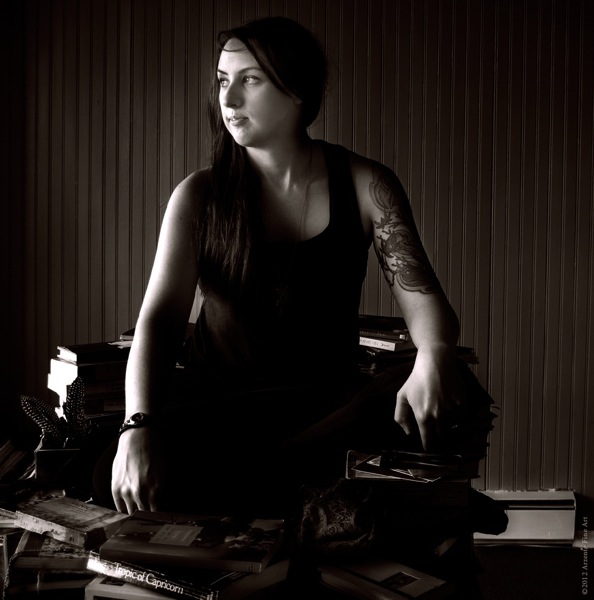
Photo by James Arzente


““You don’t really want to be a poet.  First of all, if you’re a woman, you have to be three times as good as any of the men.  Secondly, you have to fuck everyone.  And thirdly, you have to be dead.” – a male poet, in conversation (Jong, 43)”

I recommend the poem that follows in Erica Jong’s book of poems, Fruits and Vegetables, first published in 1968.

The other day a photographer, James Arzente, came to my apartment to photograph me for a book he’s doing on artists and writers.  After a long email dialogue, we came up with a concept, and piled all of the physical remains of what it took to write my memoir (piles of notepads filled with chicken scratch, journals, photographs, music, books, costumes, pens, mementos, and postcards) onto the kitchen table.  The photographer wanted to get at what’s inside my head, and I pulled out as much physical evidence as I could possibly find, but it wasn’t even the half of it.

He pried further and further to figure out what makes me tick.  On one hand, it made me understand the intensity of what it must feel like to be a celebrity.  On the other, I was exhausted by it, and exhausted of being the sole focus.  I grew sick of myself, ill with the knowledge of my current unsatisfactory state.

“You will never really be understood,” he said, “And you have to be okay with that.”

We talked about what it means to be a woman and a writer.  I want to celebrate my womanhood, but being female has always felt like a strike against me.  I’m working through it, towards a love and acceptance of my own gender.  It’s difficult when I’ve been attacked for being a woman, not only by strangers, but also by friends and lovers.  My healing comes from strong female role models, who repair me through their wisdom and our shared stories.

“Who do you feel you are on the inside?” James asked me.

“I feel like an outlaw.  I feel like I’m fighting against the roles prescribed for me by others.  I feel invisible.  I’m in a chrysalis phase, and working non-stop to create my body of work.  It’s killing me that my book isn’t out there yet, when I have so much more to give.  I’m waiting for recognition, when in my mind, I am already known for what I do.  In reality, I’m a drifter that no one really knows all that well.”

The truth is, I feel more like a Hunter S. Thompson, a Henry Miller, a Charles Bukowski, a Norman Mailer than a woman.  None of my heroes understood women at all, and didn’t care to understand.  But women inspired their stories.  They almost had an unhealthy worship of the women that castrated them in a sense.  Scared to death of the great goddess that might reach up and snuff them out.

Right now, at the Seattle Art Museum, the Elles exhibit of twentieth century women artists, is here from the Pompidou in Paris.  Everyone seems to have a strong opinion about the show.  Some are angry over the feeling that women’s art is segregated.  Some felt it was too political.  Some were disturbed by the empty pockets of history, where women really weren’t allowed to fully partake, as in the Bauhaus movement.

For me, I found the exhibit to be enormously invigorating, and at times disturbing.  Throughout history, women have been told that their life should be a sacrifice for the family.  In much of the art, I found that same sense of sacrifice, but it was an angry outcry against prescribed roles.  A gigantic woven bee hive/cocoon – enormous and frightening, like death hanging from a hook in the ceiling.  A film of a naked carefree woman on the beach, hula hooping with barbed wire, each turn ripping her abdomen to shreds.  Marina Abramavic’s performance piece, “I must be beautiful, I must be beautiful, art must be beautiful,” as she rips at her scalp with a brush.

Grouping all of this art together is enormously satisfying and powerful.  It tells a narrative, fighting to redefine what it means to be a woman, determined to have equality and a voice.

“To create is an act of liberation and every day this need for liberation comes back to me.” – Louise Bourgeois

I think as well, it would be impossible for the art to not be political.  In an article by Robin Held in City Arts Magazine she states, “Only 5 percent of the art on display in U.S. museums is made by women, although 51 percent of U.S. visual artists today are women.”  And this is the current state of the art world.  Just today I walked through the art section at a bookstore, and the only female artist I saw on the shelves, was Georgia O’Keefe.  I never even noticed the disparity before.

All this week, I have been enmeshed in talks with women artists on how they feel about the exhibit, and how they feel about their role in art today.  The women of the sixties and seventies had a lot of wisdom and history to offer.  One woman spoke of how she couldn’t sign her real name to a piece, because if they knew she was a woman, she wouldn’t get a show.  She used her initials instead.  To be a success, she had to deny the feminine.  But now, because of political battles that have been won, she is free to sign her real name, and wears her womanhood like a badge of honor.

Strikingly, the women of my generation said that they don’t identify as women.  One felt that anything written before 1980 was a “dinosaur text.”  They were firmly planted in the here and now, living dangerously outside the context of history.  I sensed abhorrence within them of their femaleness.  The same abhorrence that existed in society in the 1950’s, when my mother was raised to think that being a woman made her unclean – doomed to keep cleaning, just to make up for it.  Back then, household appliances were sold as devices to cure psychological ailments.

Young women artists want to shed their femaleness like a dead skin.  And then they are shocked when those issues subconsciously come out in their art.  One was disturbed when people found the feminine in her art.  It made her angry. She might clothe herself with male-dominated activities to feel stronger, but she is still facing the unavoidable fact of her existence as a woman.

This same aversion to the female, I believe, has created a large disconnect among young women.  I know I am at a difficult stage of life for female friendships – babies, work, lack of money, flakiness, geographical distance.  But even so, all of the women I know look at each other with a deep sense of mistrust until proven otherwise.  I am just as guilty as everyone else, and I’ve practically given up.  Yet when I do find that closeness with other women, I find my confidence blossoms.

Women seem to feel sick of the issue of equality, and what that means.  The issue has always been there, and it’s not going away anytime soon.  It’s a constant struggle.  And if we let go of it, there are plenty of men waiting in the wings to take back their control over our bodies.  If your own body makes you ill, and you want to avoid it, then why not hand over the control?

In the young women, I saw myself, and I didn’t like what I saw.  This week has changed me.  I want to embrace who I am within this body within this world.  But I also demand that society embrace my mind even more than the visual elements that I might express.  Yes, I am a woman, but first and foremost, I am a human being.